Knee replacement and hip replacement are operations in which badly damaged joint surfaces, most often worn by osteoarthritis, are removed and replaced with artificial components made of metal, ceramic and a specialised medical plastic (polyethylene). The aim is to relieve pain, make movement easier and allow you to manage daily life independently again. Joint replacement is usually considered when pain continues to limit walking, sleep and everyday activities despite non-surgical measures such as pain relief, exercise, weight management and physiotherapy.
This page covers first-time (primary) hip and knee replacement: who it is for, the types of implant, preparing for surgery, the day of the operation, rehabilitation, living with a joint replacement and the possible risks. The stages and non-surgical management of hip osteoarthritis, and the replacement of an existing implant (revision surgery), are covered on separate pages.
What is a hip or knee replacement?
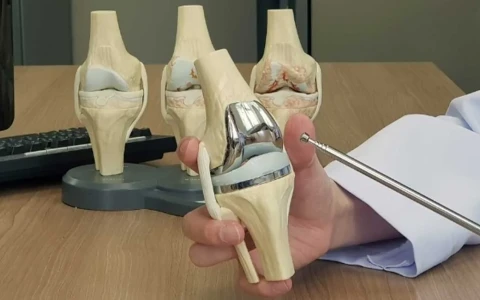
In a knee replacement, the lower end of the thigh bone (femur) and the upper surface of the shin bone (tibia) are reshaped by removing a thin layer of bone and are then capped with metal components. A polyethylene insert is placed between them to provide a smooth gliding surface, and the back of the kneecap may also be resurfaced. A knee replacement is therefore really a resurfacing operation: the whole knee is not removed, and many of the ligaments are preserved.
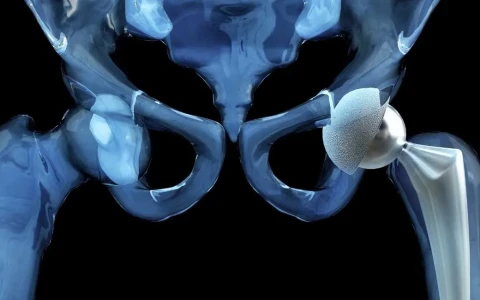
In a hip replacement, a cup and liner are fitted into the socket of the pelvis (the acetabulum), and a stem is inserted into the canal of the thigh bone. A ball made of metal or ceramic is attached to the top of the stem, and this ball moves within the liner to form the new hip joint.
Who is a joint replacement suitable for?
The decision combines what the X-rays show with how the condition affects your life. Arthritis on an X-ray is not, on its own, a reason to operate; people with marked changes but few symptoms can often be managed without surgery. Joint replacement is most often considered for:
- Advanced osteoarthritis
- Inflammatory arthritis, such as rheumatoid arthritis
- Avascular necrosis of the hip, where part of the femoral head loses its blood supply
- Post-traumatic arthritis following an old fracture
- Hip damage arising from developmental dysplasia of the hip
- Certain hip fractures in older people
Important signs include pain that keeps you awake at night, stops you walking after short distances or makes stairs, putting on socks or getting in and out of a car difficult, and pain that has not improved after several months of appropriate non-surgical treatment. Age alone does not decide the matter; your general health, bone quality and expectations are taken into account as well. Our article on who should have knee replacement surgery discusses the criteria for the knee in more detail, and the stages and non-surgical options for the hip are covered on our hip osteoarthritis page.
Alternatives to replacement and special situations
Joint replacement is an effective treatment once joint damage is advanced, but it is not the first answer to every painful joint. Losing weight, regular strengthening exercise, physiotherapy, using a walking stick and, where appropriate, joint injections ease symptoms for many people and may delay the need for surgery.
In a younger, active person whose arthritis is confined to one compartment of the knee, especially when there is bow-legged or knock-kneed alignment, an osteotomy that realigns the leg and shifts load onto the healthier side may postpone a replacement for some time. This is described on our page on adult leg deformity correction.
Marked bone deformity, leg shortening, a hip that sits high because of childhood dysplasia, previous operations or old fractures that have healed around the joint all make joint replacement technically more demanding. These "complex primary" cases, along with revision surgery, are discussed separately on our page on complex and revision joint replacement.
Assessment and preparation before surgery
A good joint replacement begins with careful planning. Assessment includes:
- Clinical examination: range of movement, ligament stability, leg alignment, leg lengths and walking pattern. The spine is examined too, so that pain from the lower back is not mistaken for hip pain.
- Weight-bearing X-rays: standing views of the knee and, where needed, a full-length leg X-ray, or a pelvic X-ray for the hip. The size and position of the components are planned on these images.
- CT scanning: may be requested where there is marked deformity, bone loss, or when a robotic system is used for planning.
- General health assessment: blood tests, an anaesthetic review and, if necessary, a cardiology opinion, with the aim of having blood sugar, blood pressure and any anaemia well controlled.
- Checking for sources of infection: dental, urinary and skin infections are treated before surgery.
Stopping smoking, improving blood sugar control, moving towards a healthy weight and starting strengthening exercises before the operation all support recovery and reduce some complication risks. Your doctor will advise how any regular medicines, particularly blood thinners, should be managed around surgery; do not stop them on your own. Small changes at home, such as removing loose rugs, fitting a grab rail in the bathroom and using a raised toilet seat, also make the first few weeks easier.
What types of joint replacement are there?
Types of knee replacement
- Total knee replacement: resurfaces all three compartments of the knee (inner, outer and behind the kneecap) and is the most commonly performed type.
- Partial (unicompartmental) knee replacement: may be suitable when arthritis is limited to one compartment, the ACL is intact and the deformity is not marked. It is a smaller operation and recovery is usually quicker, but careful patient selection is essential.
- Patellofemoral replacement: used in selected patients when only the joint between the kneecap and the thigh bone is affected.
Total knee replacements come in different designs, such as those that retain the posterior cruciate ligament and those that take over its function; the choice depends on the ligaments and the degree of deformity. Knee components are most often fixed with bone cement.
Types of hip replacement
- Total hip replacement: the standard operation, in which both the socket and the head of the thigh bone are replaced. Components may be uncemented (press-fitted so that bone grows onto them over time), cemented, or a combination of the two (hybrid); the choice depends on bone quality and age.
- Hemiarthroplasty (partial hip replacement): only the head of the thigh bone is replaced, mainly for certain hip fractures in older people.
- Hip resurfacing: now used only to a limited extent, in carefully selected younger patients.
The moving surfaces of a hip replacement are usually a ceramic or metal head against a highly cross-linked polyethylene liner, or a ceramic head against a ceramic liner. In patients at higher risk of dislocation, a dual mobility cup may be preferred.
Robotic and navigation-assisted surgery
Robotic systems and computer navigation are tools that help position the components at the planned angle and location. They can improve the precision of component placement, but research into their effect on long-term outcomes is ongoing and they are not necessary for every patient. Sound planning and careful surgical technique remain the deciding factors.
| Feature | Total knee replacement | Partial knee replacement | Total hip replacement |
|---|---|---|---|
| What is replaced | All the joint surfaces of the knee | Only the damaged compartment | The hip socket and the head of the thigh bone |
| Who may be suitable | Widespread arthritis, deformity or ligament problems | Arthritis limited to one compartment, healthy ligaments | Advanced hip arthritis, avascular necrosis, damage from dysplasia |
| Hospital stay (typical) | 1–4 days | 1–2 days | 1–4 days |
| Feeling the benefit in daily life | Several months; full recovery may take 6–12 months | Usually quicker | Usually between a few weeks and 3 months |
The day of surgery and your hospital stay
Most operations are carried out under a spinal anaesthetic, which numbs the body from the waist down, combined with light sedation; a general anaesthetic is used in some cases. Nerve blocks and local anaesthetic injected around the joint may be used for pain relief. The procedure itself usually takes one to two hours.
For a hip replacement, the joint can be approached from the back, the side or the front. Each approach has its own advantages and risks, and the choice depends on your anatomy and the surgeon's experience. Differences between approaches relate mainly to the speed of recovery in the first few weeks; in the long run, what matters most is that the components are positioned accurately.
Under modern "enhanced recovery" programmes, most patients are helped out of bed by a physiotherapist on the day of surgery or the following day and start walking with a frame. Blood clots are prevented with medication, leg exercises and, where needed, compression stockings. The length of stay depends on your general health but is usually a few days.
Rehabilitation, recovery and life with a new joint
Rehabilitation matters as much as the operation itself. Recovery usually progresses through the following stages:
- The first two weeks: walking with a frame or two crutches, home exercises for movement and strength, and wound care.
- Weeks 2–6: moving to one crutch or a stick, managing stairs and doing most daily tasks independently. Most people return to desk work and driving towards the end of this period or shortly afterwards, once their doctor agrees.
- Weeks 6–12: walking without aids and returning to most everyday activities.
- Months 3–12: continued gains in strength and stamina; swelling and warmth around a knee replacement settle over several months.
After a knee replacement, regular exercise is essential to regain full straightening and enough bend, and recovery generally takes longer than after a hip replacement. After a hip replacement, depending on the surgical approach, you may be asked to avoid certain positions for the first few weeks, such as bending the hip deeply while turning it inwards. You can read more in our articles on physiotherapy after knee replacement and returning to daily life after hip replacement.
Living with a joint replacement and how long it lasts
Low-impact activities such as walking, swimming, cycling, golf and dancing are generally encouraged. Running, jumping and contact sports are usually discouraged because they may increase wear, although this should be discussed individually. Data from national joint registries show that the great majority of modern implants continue to function for many years; even so, how long a joint replacement lasts varies with age, activity level, body weight, bone quality and the position of the components. If wear, loosening or infection develops over time, revision surgery may be needed. Even without symptoms, it is important to attend regular check-ups and to have any bacterial infection elsewhere in the body treated promptly.
Possible risks and complications
Hip and knee replacements are planned and widely performed operations, but they are still major surgery. The possible risks include:
- Infection: uncommon but serious, and may require further operations and long courses of antibiotics. Diabetes, smoking, obesity and treatments that suppress the immune system increase the risk.
- Blood clots (deep vein thrombosis) and pulmonary embolism: preventive treatment reduces but does not eliminate this risk.
- Hip dislocation: most likely in the first few months.
- Leg length difference: a slight difference may be noticed, particularly after hip replacement.
- Knee stiffness and persistent pain: in a small but important group of people, knee pain does not settle completely or movement remains limited.
- Fracture around the implant, loosening or wear: these may develop over the years.
- Nerve or blood vessel injury: rare.
- General medical risks: heart, chest and urinary problems and risks related to the anaesthetic, particularly in people with other health conditions.
These risks should be discussed in detail before surgery in the light of your own health. After the operation, seek medical advice promptly if you notice discharge from the wound, increasing redness, a fever, swelling and pain in the calf, or sudden breathlessness.
When should you seek an orthopaedic assessment?
The following suggest that the joint should be assessed in detail:
- Hip, groin or knee pain lasting weeks or months, especially pain that wakes you at night
- A walking distance that keeps getting shorter, a limp, or a new need for a walking stick
- Marked difficulty putting on socks, tying shoelaces or climbing stairs
- A knee that is gradually becoming bowed or knock-kneed, or that will not straighten fully
- Daily life that remains restricted despite non-surgical treatment
- New pain, swelling, warmth or discharge around an existing joint replacement
Prof. Dr. Halil İbrahim Balcı's approach
Prof. Dr. Halil İbrahim Balcı is a faculty member in the Department of Orthopaedics and Traumatology at Istanbul University's Istanbul Faculty of Medicine and holds the European Board of Orthopaedics and Traumatology (EBOT) qualification. In keeping with his academic work in deformity surgery and limb reconstruction, planning for joint replacement includes a detailed assessment of leg alignment, leg lengths and differences in bone shape. The decision to operate is made only after symptoms, examination and imaging findings and the non-surgical options have been discussed with the patient. Consultations are available in Turkish, English and French, and you can request one through the appointment page.
Key points
- Hip and knee replacements resurface badly damaged joints with artificial components to relieve pain and improve movement.
- The decision is based not on X-rays alone but on the severity of symptoms, the response to non-surgical treatment and your general health.
- Total, partial and hemiarthroplasty options exist; the choice depends on the state of the joint and the quality of the bone.
- Rehabilitation is as important as the operation, and recovery usually takes longer after a knee replacement.
- Risks such as infection, blood clots, dislocation and persistent pain should be discussed openly before surgery.