Ilizarov surgery is a limb reconstruction technique in which a circular external fixator, a frame of rings attached to the bone with thin tensioned wires and pins, is used to lengthen a bone gradually, correct a deformity, heal a fracture that has failed to unite, or fill a gap in the bone with new bone. It relies on the body's ability to grow new bone and soft tissue in response to slow, controlled stretching. For that reason it is less a single operation than a treatment journey lasting several months, in which patients and their families play an active part.
The Ilizarov method is considered for problems that are difficult to solve with conventional plates or nails: leg length differences, complex deformities, non-unions, bone loss after injury or infection, and congenital limb differences. It can be used in children and adults alike. Whether it is the right choice for a particular person can only be decided after examination and imaging, taking into account their goals and day-to-day circumstances.
What is the Ilizarov method and how does it work?
The method was developed in the 1950s by the Soviet orthopaedic surgeon Gavriil Ilizarov in Kurgan, Siberia, and spread to Europe and the rest of the world from the 1980s onwards. Ilizarov's key observation is known as the "tension-stress principle": when a bone is cut in a controlled way and the two ends are drawn apart slowly and steadily, the body forms new bone in the gap. This process is called distraction osteogenesis. Muscles, nerves, blood vessels and skin adapt and lengthen at the same time.
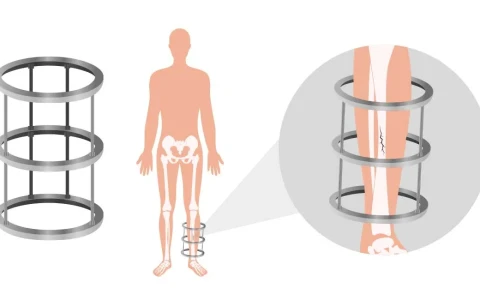
A classic Ilizarov frame has three main components:
- Rings: metal or carbon-fibre rings that encircle the arm or leg.
- Wires and pins: thin wires (usually 1.5–1.8 mm) passed through the bone and tensioned onto the rings, together with thicker half-pins screwed into the bone from one side.
- Connecting parts: threaded rods and hinges linking the rings; adjusting them lengthens, compresses, angulates or rotates the bone.
Alongside the classic frame, surgeons now also use hexapod frames: computer-assisted circular fixators with six adjustable struts. The surgeon enters the measurements of the deformity into planning software, which generates a personalised schedule showing how far each strut should be turned every day. This allows complex deformities with angular, rotational and length components to be corrected simultaneously and gradually.
When is Ilizarov surgery used?
The great strength of a circular frame is that it controls the bone in every direction and can be adjusted while treatment is under way. The main indications are:
- Bone and limb lengthening: leg length discrepancy, short stature caused by skeletal dysplasia and, in selected cases, cosmetic lengthening. Our limb lengthening surgery page compares the available lengthening methods.
- Bone deformities: bow legs and knock knees, rotational problems and complex deformities in more than one plane. The principles of measurement and planning are explained on our deformity surgery page.
- Non-unions: compressing the bone ends or performing bone transport, particularly in non-unions that have already been operated on, are infected or involve bone loss. This difficult group is covered on our page on complex and infected non-unions.
- Bone infections: regenerating bone to fill the defect left once infected bone has been removed (see bone and soft tissue infections).
- Congenital limb differences: conditions such as fibular hemimelia, congenital femoral deficiency and congenital pseudarthrosis of the tibia, as well as some foot deformities.
- Fractures with severe soft tissue damage and joint contractures: open fractures in which a plate or nail would be risky, and stiff joints that need to be opened up gradually.
For more on the role of the technique in bone deformities, see our article on which deformities can be corrected with the Ilizarov technique.
Bone transport: how is a bone defect filled with new bone?
Bone transport is one of the most distinctive applications of the Ilizarov method. When a gap of several centimetres remains in a bone after injury, infection or tumour surgery, a section of healthy bone is cut in a controlled way and this "transport segment" is moved across the gap by the frame at roughly 1 mm a day. New bone forms behind the moving segment, just as it does in lengthening. When the segment reaches the other end, the two ends meet and unite. This area is called the docking site, and a small additional procedure is sometimes needed to help it heal. Bone transport makes it possible to rebuild the limb with the patient's own living bone, without large bone grafts, but it is a long process that calls for patience.
Circular frames compared with other methods
No single method suits every patient in limb reconstruction. A circular frame is the natural choice in some situations, whereas a monolateral fixator or an internal lengthening nail may be more appropriate in others. The table below is intended only as a general guide; the choice is always made individually.
| Method | Strengths | Limitations |
|---|---|---|
| Circular frame (Ilizarov, hexapod) | Gradual correction of large and multiplanar deformities; usable in infection and bone loss; can be adjusted during treatment; usually allows early weight-bearing | Bulky external frame; pin-site care; affects daily life and sleep; long treatment time |
| Monolateral external fixator | Less bulky; relatively simple to apply; more comfortable on the thigh | Less control over complex multiplanar corrections; pin-site care is still needed |
| Internal (intramedullary) lengthening nail | No external frame; no pin-site infections; a more comfortable process | Needs a bone canal of suitable size; limited for large, gradual angular corrections; weight-bearing may be restricted during lengthening; generally avoided when infection is present |
| One-stage correction with a plate or nail | Shorter treatment; no external frame | Cannot provide major lengthening or gradual correction; risky with poor soft tissues or infection |
In some patients these methods are combined. Lengthening may be carried out with an external fixator, for example, after which a nail or plate is inserted so that the frame can come off earlier. This can shorten the time spent in the frame.
Assessment and planning before surgery
Much of the success of Ilizarov surgery is decided before the operation, at the planning stage. Assessment usually includes:
- A thorough examination: limb lengths, joint range of motion, gait, and the condition of the skin, nerves and circulation.
- Standing long-leg X-rays: radiographs showing the whole leg from hip to ankle, on which the mechanical axis, joint angles and any length difference are measured.
- CT or MRI where needed: to measure bone rotation, look closely at a non-union or define the extent of an infection.
- Blood tests: markers of infection, vitamin D levels and general health.
- Personal preparation: stopping smoking (which markedly slows bone healing), attention to nutrition, planning for home and work, school arrangements for children and, where helpful, psychological support.
During planning the surgeon decides how many rings the frame will have, the safe corridors for wires and pins, where the bone will be cut and how fast the correction should proceed. In some centres the frame is pre-assembled to the patient's measurements before surgery. Technical details are discussed further in our article the Ilizarov method: technical details and application criteria.
How is Ilizarov surgery performed? The treatment step by step
- Surgery: under general or regional (spinal) anaesthesia, wires and pins are inserted into the bone under X-ray guidance and the rings are assembled. If lengthening or gradual correction is planned, the bone is cut through a small incision in a way that preserves the periosteum (the membrane covering the bone) and its blood supply as far as possible. This is called a corticotomy or osteotomy.
- Hospital stay: usually a few days, during which pain is brought under control, pin-site care is taught and physiotherapy begins.
- Latency period: after the bone cut there is usually a wait of 5–7 days to allow new bone formation to start; this may be shorter in children.
- Lengthening or correction phase: the frame is adjusted in several small steps spread through the day, typically adding up to about 1 mm a day for lengthening. The adjustments are often made at home by the patient or family, following the schedule provided. Check-ups with X-rays take place every one to two weeks, and the rate may be changed according to how the new bone and soft tissues are responding.
- Consolidation phase: once the target is reached, the frame is left in place without further adjustment while the new bone matures. This phase is usually longer than the lengthening phase; as a rough guide it may last about twice as long.
- Frame removal: when X-rays show that the new bone is mature enough, the frame is removed, usually under a short anaesthetic. A cast, splint or protective internal fixation may be used for a while afterwards.
The overall treatment time ranges from a few months to more than a year, depending on the amount of correction or lengthening, the patient's age, bone quality and general health. Any estimate of duration is therefore a range rather than a fixed figure.
Living with a frame and rehabilitation
While the frame is on: pin-site care, mobility and sleep
Living with a frame is the most demanding part of treatment, but it is manageable, and most people settle into a routine after the first few weeks. The main points to bear in mind are:
- Pin-site care: the places where wires and pins leave the skin are cleaned and checked regularly according to the protocol you are given. Redness, discharge or increasing pain can usually be controlled with simple measures if noticed early.
- Weight-bearing and walking: circular frames usually allow early weight-bearing with crutches or a walking frame. Putting weight through the leg supports bone formation, but how much weight you may bear is decided by your surgeon.
- Physiotherapy and exercise: muscles are stretched during lengthening and correction, so daily exercises and stretches are an essential part of treatment to prevent stiffness in neighbouring joints such as the knee and ankle.
- Showering and hygiene: rules about showering and getting the pin sites wet vary between centres and stages of treatment, so follow the instructions you are given.
- Clothing and sleep: loose trousers or trousers with side zips, and fabric covers for the frame, make daily life easier. Supporting the leg on pillows helps at night.
- School, work and emotional support: depending on the individual, many people return to desk-based work or school while treatment is still under way. Because the process can be tiring, support from family and, if needed, psychological support are important.
Practical advice on getting back to everyday activities is given in our article on returning to daily life after lengthening with the Ilizarov technique.
After the frame comes off
Removing the frame is not the end of treatment but the start of its final stage. The new bone continues to mature for some time, so weight-bearing is usually increased gradually. Physiotherapy to regain muscle strength, joint movement and a normal walking pattern may continue for several more months. Small round scars remain at the pin sites and tend to fade with time. A return to running and contact sports is planned only once X-rays show the bone is fully mature and your surgeon agrees. Follow-up continues at intervals until the bone has finished remodelling.
Possible risks and complications
The Ilizarov method is a powerful reconstructive tool, but like any surgery it carries risks, and because treatment is long, minor problems along the way are common. Many of them can be treated if they are recognised early:
- Pin-site infection: the most frequent problem. It is usually superficial and settles with more frequent care or oral treatment; deep infection is less common.
- Joint stiffness and muscle tightness: particularly during lengthening, the knee or ankle may lose movement or the foot may drop into a pointed position (equinus). Physiotherapy and, if needed, splints are used to prevent this.
- Nerve and blood vessel problems: stretching too quickly can affect nerves; if numbness or weakness appears, the rate is slowed or lengthening is paused.
- Problems with the new bone: premature consolidation, slow maturation, bending, or fracture after the frame is removed.
- Broken wires, pain and disturbed sleep, and other mechanical or comfort-related issues.
- Blood clots (deep vein thrombosis) and the need for further surgery.
The likelihood of these problems varies from person to person with age, the type of problem, the amount of lengthening or correction and general health. The risks that apply to your own situation should be discussed in detail before surgery.
When should you seek an assessment?
It is worth seeing an orthopaedic and trauma surgeon to find out whether Ilizarov treatment or another reconstructive method might help if you have:
- a noticeable difference in leg length or a limp
- a bone deformity that is getting worse or causing knee or ankle pain
- a fracture that has not healed after several months, or a broken implant
- recurrent discharge or infection in a bone that has been operated on before
- a child born with a difference in an arm or leg
If you are already being treated in a frame, contact your treatment team without delay if you develop a fever, increasing redness or discharge at the pin sites, loose or broken wires, new numbness, weakness or a change of colour in the foot, or swelling and pain in the calf.
Prof. Dr. Halil İbrahim Balcı's approach
Prof. Dr. Halil İbrahim Balcı is a faculty member in the Department of Orthopaedics and Traumatology at Istanbul University's Istanbul Faculty of Medicine. He studied deformity surgery and Ilizarov techniques at the Paley Institute in West Palm Beach, USA, as a research fellow in 2014 and as an observer in 2019, and co-edited the Springer book "Basic Techniques for Extremity Reconstruction: External Fixator Applications According to Ilizarov Principles" (2018). Since 2015 he has served on the board of Turkish ASAMI, the national association for the study and application of the Ilizarov method. For each patient the method is chosen on the basis of the examination and imaging findings, with the pros and cons of a circular frame and its alternatives discussed openly. You can request a consultation through the appointment page.
Key points
- Ilizarov surgery uses a circular external frame to lengthen, correct or heal bone gradually, or to fill a bone defect with new bone.
- It is used for leg length differences, complex deformities, difficult non-unions, bone infections and congenital limb differences.
- Treatment moves through surgery, a latency period, lengthening or correction, consolidation and frame removal, and takes months.
- Pin-site care, regular check-ups and physiotherapy are essential; most complications can be managed if recognised early.
- The right method is chosen individually after examination and imaging.