
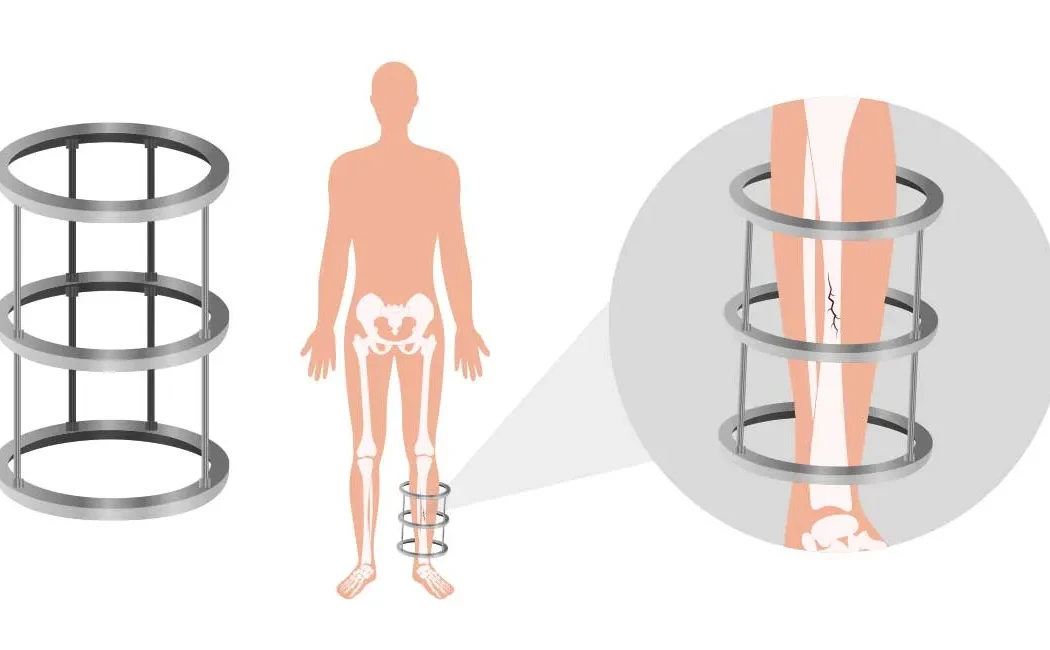
The Ilizarov technique, developed by Russian orthopedic surgeon Gavriil Ilizarov, is a specialized surgical method utilized for correcting extremity deformities. Its fundamental principle involves the controlled and gradual stretching of bone tissue to reshape and lengthen it. This method not only addresses problematic areas within the bone structure but also facilitates the adaptation of soft tissues, providing significant treatment advantages.
The applications of the Ilizarov technique are broad. It is most commonly used for correcting long bone deformities such as varus (inward angulation), valgus (outward angulation), limb length discrepancies, nonunion fractures, bone infections resulting in damage, bone loss cases, and congenital or acquired differences in limb length.
Limb Lengthening and Cosmetic Lengthening Surgery
The Ilizarov method is frequently preferred for lengthening bones in the lower extremities, particularly the tibia and femur. Through a controlled distraction process, new bone tissue forms as the distance between bone segments increases. This makes it possible to correct congenital or acquired limb length discrepancies. The technique also shows effective results in cosmetic limb lengthening surgeries.
Deformity Surgery
Bone curvatures, especially developmental disorders seen in children and adolescents, are corrected using the Ilizarov frame. Varus (inward bending), valgus (outward bending), and flexion (bending) deformities can be treated with this method. In particular, the Ilizarov technique allows for three-dimensional alignment of bone segments in complex multiplanar deformities.
Nonunion and Bone Loss
The Ilizarov system provides a treatment opportunity by isolating the bone in open fractures, infections, or cases of previously nonunion fractures. The principle of distraction osteogenesis stimulates new bone formation, accelerating fracture healing.
Bone and Soft Tissue Infections
In the treatment of infections such as chronic osteomyelitis, the Ilizarov method reconstructs the bone following surgical debridement. It allows soft tissues to adapt without excessive strain. This method is advantageous in correcting deformities caused by infection.
Pediatric Orthopedic Applications
Deformities resulting from growth abnormalities in children can be treated safely with the Ilizarov technique without damaging growth plates. The controlled distraction method adapts well to the flexible bone structure of children, supporting growth development.
Advantages of the Ilizarov Technique
The most significant advantages of this method include its minimally invasive nature, capability to correct deformities in multiple planes, active patient participation in the treatment process, and minimal soft tissue damage. Moreover, it shows clinical success in challenging cases involving infection and nonunion.
Treatment Process and Rehabilitation
After Ilizarov application, patients typically undergo a treatment period ranging from 6 to 12 months. During this time, the rate and amount of distraction are regularly monitored and bone formation is assessed. Physical therapy helps maintain joint mobility and facilitates soft tissue adaptation. Long-term patient compliance and care are critical for a successful outcome.
Scientific Foundations and Current Research
Numerous studies on the Ilizarov technique demonstrate that the bone regeneration achieved is biologically supported. The principle of distraction osteogenesis induces new blood vessel formation in the bone, shortening the healing process. Additionally, its multiplanar deformity correction ability offers advantages over other surgical techniques.
The Ilizarov method is considered an indispensable approach in modern orthopedic practice, particularly in joint-preserving and lengthening surgeries. Proper patient selection, surgical expertise, and a multidisciplinary approach enhance treatment success.