
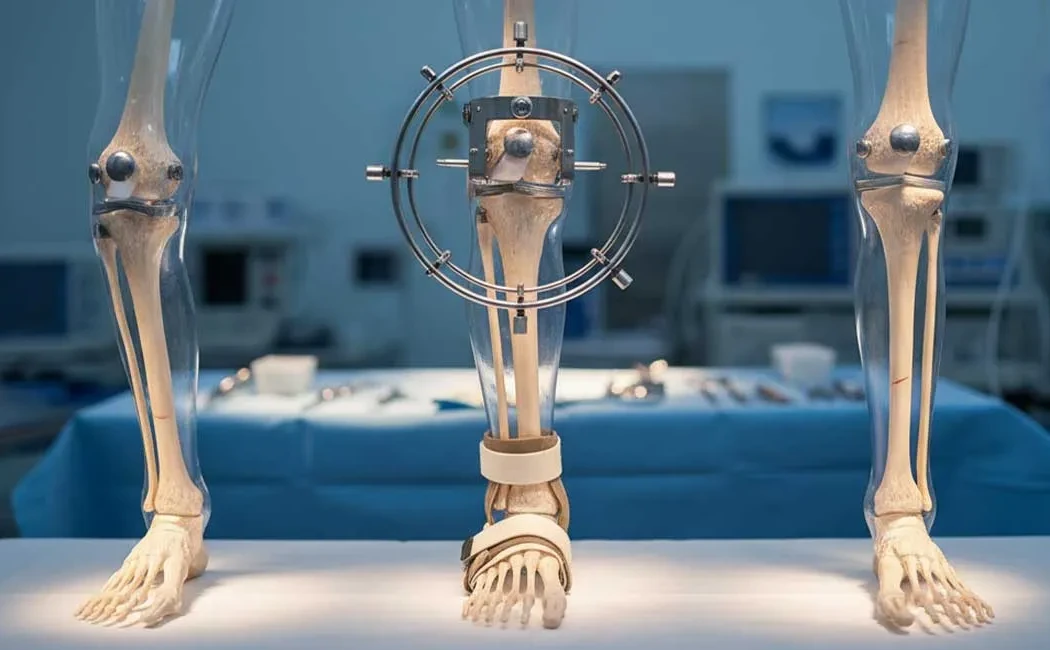
Deformity surgery is a comprehensive orthopedic field focused on correcting shape abnormalities, curvatures, and length discrepancies in the musculoskeletal system. Deformities affecting load-bearing joints such as the leg, knee, and ankle may lead to both aesthetic concerns and significant functional limitations. These surgical procedures aim to restore the patient’s anatomy to normal biomechanical parameters, preserving joint health and improving quality of life.
Lower limb deformities can be congenital or develop secondary to trauma, infection, or malunited fractures. The treatment approach is tailored based on the deformity’s severity, the patient’s age, and bone quality. Advanced surgical techniques developed by leading centers such as the Paley Institute enable precise planning and successful outcomes even in complex cases.
Introduction to Deformity Surgery
Deformity surgery involves much more than a simple bone correction; it entails realigning the bone in three-dimensional space, adjusting joint angles, and restoring soft tissue balance. This subspecialty relies on principles of limb reconstruction and often requires detailed engineering-like calculations. The goal is to correct the mechanical axis and optimize load distribution across joints.
Pre- and post-surgical comparisons of angular deformities provide clearer insights into the corrections achieved.
Untreated deformities may gradually cause joint degeneration (osteoarthritis), pain, and difficulty walking. Hence, early diagnosis and timely surgical intervention are critical for preserving long-term joint function. Modern surgical methods emphasize minimally invasive techniques and biological healing support to accelerate patients’ return to daily activities.
What Are Lower Extremity Deformities?
Lower extremity deformities refer to deviations from the normal anatomical alignment of bones from the hip to the ankle. These deviations may occur in the frontal (coronal), sagittal (side), or axial (rotational) planes. The most common deformities include Genu Varum (bow legs) and Genu Valgum (knock knees).
Accurate classification of these deformities forms the foundation of an effective treatment plan. Deformities are not limited to angular deviations; rotational abnormalities and limb length discrepancies are frequently observed alongside. For instance, rotational deformities of the femur or tibia can lead to in-toeing or out-toeing gait patterns. According to WHO (World Health Organization) standards, such structural issues are classified as functional impairments requiring surgical correction.
Applications of Deformity Surgery
Deformity surgery addresses a broad spectrum of clinical conditions, ranging from congenital anomalies to sequelae of trauma. Developmental disorders detected in childhood but left untreated may necessitate more complex surgical interventions in adulthood.
Key application areas include:
- Congenital Bone Disorders: Conditions such as fibular or tibial hemimelia involving limb deficiencies.
- Post-Traumatic Deformities: Curvatures resulting from improperly healed fractures (malunions).
- Infection Sequelae: Bone loss and deformity following osteomyelitis (bone infection).
- Metabolic Bone Diseases: Deformities caused by conditions like rickets that soften bones.
- Leg Length Discrepancy Surgery: Procedures aimed at equalizing limb lengths through lengthening surgeries.
Surgical Planning and Diagnostic Techniques
The key to successful deformity surgery lies in meticulous preoperative planning. This begins with a thorough physical examination and advanced radiological imaging. Full-length orthoroentgenograms capturing the hip to ankle are essential for determining the mechanical axis and the deformity’s center of rotation and angulation (CORA).
Deformity analysis and precise measurement techniques enable the surgeon to calculate correction angles accurately.
The patient journey from diagnosis to full recovery involves multiple stages summarized in the following flowchart:
During planning, guidelines from the AAOS (American Academy of Orthopaedic Surgeons) and current literature are referenced. Computed tomography (CT) based 3D modeling is used to assess rotational deformities. These data inform decisions on osteotomy location and fixation methods.
The Paley Institute Approach and Surgical Principles
The Paley Institute is globally recognized for its pioneering principles in limb reconstruction and lengthening. Prof. Dr. Halil İbrahim Balcı has been trained and gained experience within this school of thought, which emphasizes mathematical deformity analysis and biological preservation.
Paley’s method focuses not only on bone correction but also on protecting soft tissues (muscles, nerves, vessels) to enhance functional recovery. The table below outlines the core surgical principles and techniques employed by the Paley Institute.
A distinctive feature of this approach is “reverse planning.” The surgeon determines the desired final position of the limb after surgery and works backward to plan the procedure. This reduces intraoperative surprises and ensures high accuracy in achieving correction goals.
Surgical Techniques and Correction Methods
Techniques in deformity surgery vary depending on the deformity type and patient needs. Two principal methods are acute correction and gradual correction. Acute correction involves immediate realignment during surgery with fixation by plates, screws, or nails. Gradual correction uses external fixators to adjust deformities progressively over time.
For detailed information on frequently used methods in our clinic, please visit our lower extremity deformity surgery page.
Implant technology plays a significant role in treatment success.
In some cases, deformity correction is combined with limb lengthening. These combined surgeries utilize magnetic nails or computer-assisted external fixators (Ilizarov, Taylor Spatial Frame). More details are available in our bone lengthening surgery article. Scientific literature, including studies indexed on PubMed, supports the efficacy of combined techniques in appropriately selected patients.
Postoperative Care and Rehabilitation
Surgery is only part of treatment; postoperative care and rehabilitation are equally crucial for optimal outcomes. Recovery protocols differ based on the technique used. Patients treated with plate and screw fixation are generally non-weight-bearing initially, whereas those with nails or external fixators may begin partial weight-bearing earlier.
Rehabilitation focuses on physiotherapy to maintain joint range of motion and strengthen muscles. Particularly in lengthening procedures, extensive stretching exercises are necessary to prevent muscle tightness. Our comprehensive guide on post-limb lengthening surgery care provides detailed recommendations.
Complications and Risk Management
As with all surgeries, deformity correction carries potential risks. These include infection, nerve damage, vascular injury, or anesthesia-related complications. The most specific risks relate to bone healing, such as delayed healing (nonunion) or incorrect healing (malunion), which may require additional treatment.
Comprehensive information on nonunion and its treatment is available on our nonunion surgery page. Similarly, revision surgery for malunions is a complex area requiring specialized expertise, as detailed on our malunion surgery resource. Articles from respected journals like the Journal of Bone and Joint Surgery (JBJS) emphasize how surgical experience and patient compliance significantly influence risk management.
Deformity Surgery in Children
Pediatric patients occupy a special place in deformity surgery. Since children’s bones are still growing, interventions must avoid damaging growth plates. In some cases, guided growth techniques such as hemiepiphysiodesis use growth plates to correct deformities gradually (“guided growth”).
Pediatric lower limb deformities require different treatment algorithms than adults. Management of congenital deformities is complex and should be performed by experienced pediatric orthopedic teams. Early and appropriate interventions can ensure a healthy skeletal structure throughout life. For more, see our childhood lower extremity deformities and congenital deformity surgery in children pages.
Technological Advances: Robotics and New Approaches
Integration of technology into medicine has brought revolutionary advances in deformity surgery. Computer-assisted navigation, patient-specific 3D-printed cutting guides, and robotic surgical systems enhance precision. These technologies allow surgeons to execute planned corrections with millimeter accuracy.
Especially in complex cases, robotic technologies in deformity surgery reduce radiation exposure and shorten operation time. Future integration of AI-supported planning algorithms is expected to further improve treatment outcomes.
The information provided is for general informational purposes only and does not constitute medical advice. It is not a substitute for professional diagnosis, treatment, or consultation. Diagnosis and treatment decisions should only be made following a personal examination by a qualified healthcare professional. Since each patient's clinical condition varies, surgical and non-surgical treatments may differ accordingly. The content is based on current scientific knowledge and up-to-date medical practices. Do not delay seeking professional care or ignore medical advice based on the information provided here.