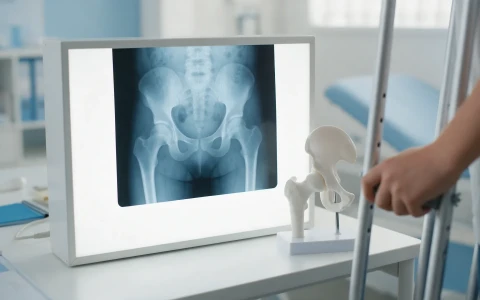
Perthes disease is a childhood hip condition caused by a temporary loss of blood supply to the femoral head. We explain the symptoms, stages, diagnosis and treatment options for parents.
On this page 8 sections
- What is Perthes disease and what causes it?
- What are the symptoms of Perthes disease?
- Stages of the disease: how does the femoral head heal?
- How is Perthes disease diagnosed, and what can it be confused with?
- Treatment of Perthes disease
- Daily life, school and sport
- When should you see a doctor?
- Key points
Perthes disease (Legg-Calvé-Perthes disease) is a childhood hip condition in which the blood supply to the ball of the hip joint, the femoral head, is temporarily interrupted. It most often affects children aged 4 to 8, and the first sign is usually an intermittent limp with pain in the groin, thigh or knee. Over time the bone regains its blood supply and heals; the aim of treatment is to keep the femoral head as round as possible and preserve hip movement throughout this long process.
This article explains what Perthes disease is, how it shows itself, how it is diagnosed and what treatment involves, written with parents in mind. Every child is different, and the treatment plan is based on examination and imaging findings.
What is Perthes disease and what causes it?
During childhood, the femoral head receives its blood through a limited number of small vessels. In Perthes disease this blood flow stops for a period for reasons that are not yet understood, and part of the bone in the femoral head dies (avascular necrosis). The body then restores the blood supply, gradually clears away the dead bone and lays down new bone. The process takes years, and while the bone is soft it can flatten and change shape under load.
Some key facts about Perthes disease:
- It is around four to five times more common in boys than in girls.
- It usually affects one hip; in a small number of children both hips are involved, generally at different times.
- The exact cause is unknown. Links with delayed bone age, low birth weight and exposure to tobacco smoke at home are being studied.
- It is not caused by an injury, and it is not the result of anything parents did.
What are the symptoms of Perthes disease?
Symptoms usually come on gradually and become clearer over weeks or even months. Parents often notice the limp first:
- a limp that comes and goes, often worse after play or running;
- pain in the groin, front of the thigh or knee, which may be mild or absent;
- reduced hip movement, especially when moving the leg out to the side or turning it inwards;
- thinning of the thigh muscles and, later, a slight difference in leg length.
Knee pain is an important trap: pain from the hip can be referred along the nerves to the knee. Any child who limps and complains of knee pain should therefore have their hip examined as well.
Stages of the disease: how does the femoral head heal?
Perthes disease passes through a series of stages, which together usually take two to four years and sometimes longer:
- Initial stage: blood flow is lost and the femoral head looks denser and slightly smaller on X-ray. Early X-rays can look normal.
- Fragmentation stage: as the body clears the dead bone, the femoral head looks fragmented. This is when the bone is softest and most likely to change shape.
- Re-ossification stage: new bone forms and the femoral head becomes stronger again.
- Healed (residual) stage: bone healing is complete; the femoral head has either kept its round shape or healed flatter and wider.
Long-term hip health depends mainly on how round the femoral head is at the end of healing and how well it fits the socket.
How is Perthes disease diagnosed, and what can it be confused with?
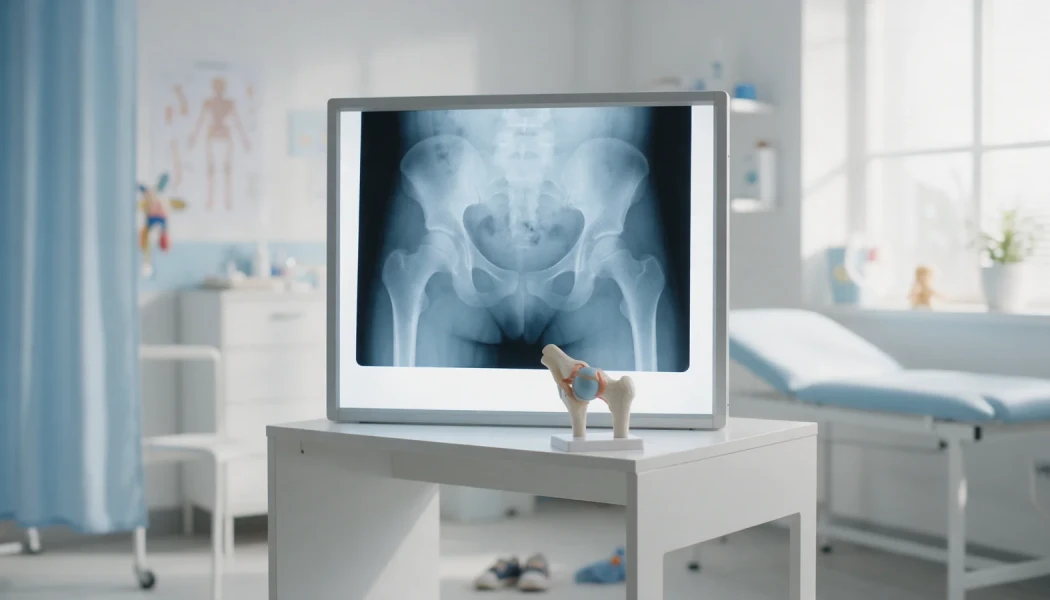
The diagnosis is made by clinical examination and X-rays of the hip taken in two views. MRI can help in the early stages, before changes appear on X-ray. When both hips are affected symmetrically, skeletal dysplasias and certain blood disorders that can look similar are also considered.
Hip pain and limping in children have other causes too. The table compares three conditions that are often confused:
| Feature | Transient synovitis | Septic arthritis (joint infection) | Perthes disease |
|---|---|---|---|
| Onset | Sudden, often after a cold | Sudden and rapidly worsening | Gradual, over weeks |
| Fever | None or mild | Usually high | None |
| Weight-bearing | Walks with a limp | Often refuses to stand | Walks with a limp |
| Blood tests | Usually normal | Raised inflammatory markers | Normal |
| Course | Settles within days to two weeks | Needs emergency treatment | Heals over several years |
For another important hip condition of infancy and childhood, developmental dysplasia of the hip, see our article on hip dislocation in children.
Treatment of Perthes disease
The main goals of treatment are to keep the femoral head seated within the socket (the acetabulum) while it heals and to preserve hip movement. A softened femoral head that stays inside the socket tends to mould to its shape and heal rounder, a principle known as "containment". Treatment choices depend largely on:
- the child's age at onset (the femoral head generally has more capacity to remodel when the disease starts at a younger age);
- how much of the femoral head is involved and how well its outer column of bone is preserved;
- how stiff the hip is and whether the femoral head tends to slip out of the socket.
Non-surgical treatment
Regular monitoring and physiotherapy are the mainstay, particularly in younger children and when less of the femoral head is affected. Exercises to maintain hip movement, short periods of rest or crutches during painful spells, and limiting high-impact activities may be recommended. In some children with marked stiffness, casts that hold the hips spread apart may be applied for a short period under anaesthetic.
Physiotherapy usually includes stretches that maintain the hip's ability to move outwards and rotate inwards, strengthening of the muscles around the hip, and exercises in water. Doing the exercises regularly at home helps to prevent loss of movement between appointments. Check-ups with X-rays every few months track the stage of the disease, and the treatment plan may be adjusted according to what they show.
Surgical treatment
In suitable children whose disease started at an older age and involves more of the femoral head, operations to improve the fit of the head in the socket may be considered, either by realigning the top of the thigh bone (femoral osteotomy) or the pelvis (pelvic osteotomy). After healing, children left with deformity and stiffness may benefit from other joint-preserving procedures and, in selected cases, from techniques that temporarily offload the hip with an external fixator. The right approach depends on age, stage and imaging, and is decided individually.
Daily life, school and sport
Because Perthes disease is a long journey, it matters that a child's daily life stays as normal as possible. General advice includes:
- swimming and, where appropriate, cycling are often recommended, as they keep the hip moving with little load on the joint;
- during the active stages, high-impact activities such as running, jumping and contact sports may need to be limited;
- sharing information with teachers allows PE lessons to be adapted where needed;
- long periods of restriction can affect a child emotionally, so talking about feelings and offering suitable activities helps.
Follow-up continues until the end of adolescence, even after the disease has healed. Depending on the shape of the femoral head, a difference in leg length can develop; our article on leg length discrepancy in children explains the options.
When should you see a doctor?
Ask for your child to be assessed by an orthopaedic specialist if you notice:
- a limp that lasts more than a few days or keeps coming back;
- unexplained pain in the groin, thigh or knee;
- difficulty moving the leg out to the side, turning it in or putting on shoes;
- thinning of the thigh muscles or a difference in leg length.
Hip pain with a fever, or a child who will not put any weight on the leg or move it, needs urgent assessment to rule out a joint infection. Perthes disease is followed and treated within paediatric orthopaedics and the care of childhood lower limb deformities. Prof. Dr. Halil İbrahim Balcı worked as a research fellow in deformity surgery and paediatric orthopaedics at the Paley Institute in the United States.
Key points
- Perthes disease is a hip condition caused by a temporary loss of blood supply to the femoral head, most often in children aged 4 to 8.
- A limp and pain in the groin, thigh or knee are the usual symptoms; knee pain may come from the hip.
- The disease heals in stages over two to four years, and the aim is to keep the femoral head round.
- Depending on age, extent and hip movement, treatment involves monitoring, physiotherapy or surgery.
- Hip pain with fever or refusal to bear weight needs urgent assessment.
Frequently Asked Questions
In Perthes disease the bone regains its blood supply and heals, usually over two to four years. What matters most is how round the femoral head is once healing is complete. When the disease starts at a younger age and involves less of the femoral head, the hip generally has a better chance of remodelling well. Children left with some deformity may develop hip problems later in life, so follow-up continues until the end of adolescence.
Yes, although the type of sport depends on the stage of the disease. Swimming and, where appropriate, cycling are usually encouraged because they keep the hip moving with little load on the joint. During the active stages, high-impact activities such as football, basketball, jumping and running may need to be limited. As the femoral head becomes stronger, activities are increased gradually. Which sports are suitable, and when, is decided by the orthopaedic specialist based on check-ups and X-rays.
Perthes disease is not generally considered an inherited condition, and the chance of a brother or sister being affected is low. However, when both hips are affected at the same time and in a symmetrical way, or when other family members have similar hip problems, inherited skeletal dysplasias that can mimic Perthes disease are considered. The doctor will therefore take a detailed family history and may request further tests.
The decision is never based on a single factor. The child's age at onset, how much of the femoral head is involved, how stiff the hip is and whether the head tends to slip out of the socket are all considered together. When the disease starts later in childhood and affects a large part of the femoral head, surgery to improve how the head sits in the socket may be discussed. In most younger children, monitoring and physiotherapy are the main approach.
Transient synovitis is an inflammation of the hip joint that often follows a cold and settles by itself within a few days to two weeks. In Perthes disease, the limp and pain last for weeks, come and go, and changes in the femoral head appear on X-ray. If a child diagnosed with transient synovitis does not improve within the expected time, or the symptoms keep coming back, the hip should be reassessed with X-rays.
This article is for general information only and does not replace a medical examination, diagnosis or treatment. Treatment options and outcomes vary from person to person.
Related treatment area Childhood Lower Limb Deformities: Bow Legs, Knock Knees and In-Toeing