
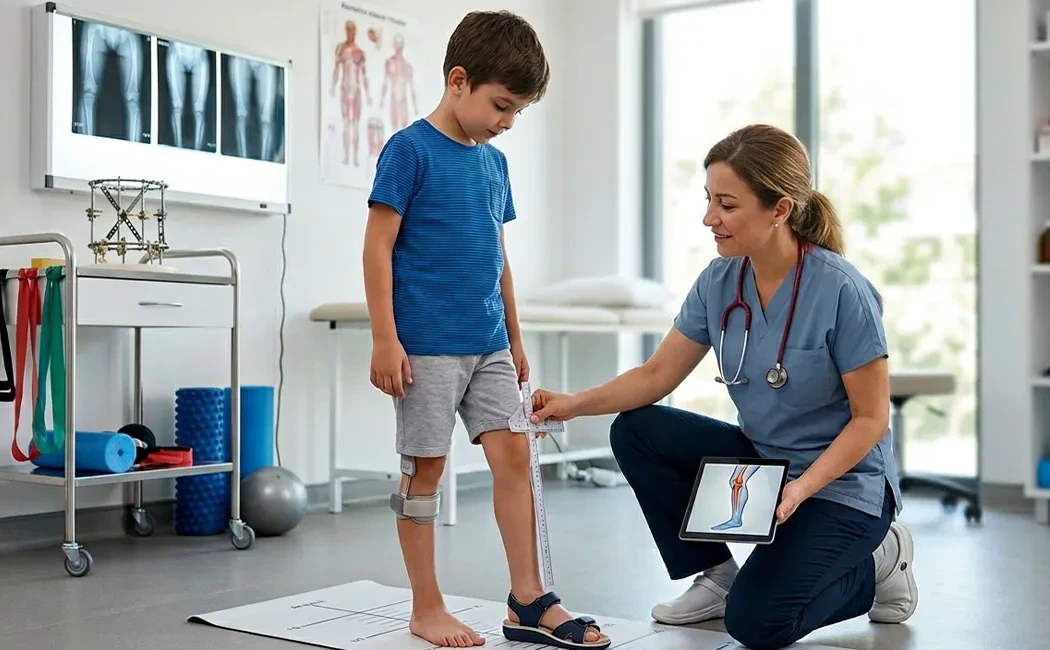
Leg length discrepancy in children refers to a measurable difference in the length between the two legs. This orthopedic condition can affect a child's gait mechanics, spinal health, and overall quality of life. Parents often notice this condition by observing limping or uneven shoulder levels in their child. Accurate early diagnosis and planning are essential to prevent potential permanent skeletal complications later on. Treatment approaches range from simple shoe lifts to complex surgical reconstructions.
What Is Leg Length Discrepancy?
Leg length discrepancy (anisomelia) is defined as a difference in the length of the lower limbs. This difference may originate from the femur (thigh bone), the tibia (shin bone), or both. The discrepancy is primarily categorized into structural (anatomical) and functional types. Structural shortness refers to an actual physical shortening of the bone itself, whereas functional shortness occurs when bone lengths are equal but perceived leg length difference results from hip or spinal issues.
Understanding the distinction between structural and functional types is important.
Causes of Leg Length Discrepancy in Children
Leg length differences in children can arise from numerous factors. Correct identification of these causes is the first step in developing an effective treatment plan.
Congenital Causes
Some children are born with structural abnormalities affecting bone development. Conditions requiring congenital deformity diagnosis and surgical interventions include fibular hemimelia (partial or complete absence of the fibula), proximal femoral focal deficiency (underdevelopment of the upper femur), and hemihypertrophy (one side of the body growing more than the other). Various syndromes causing asymmetric limb growth are also described under pediatric lower extremity deformities.
Developmental and Acquired Causes
Conditions that develop after birth during growth are also common. Infections like osteomyelitis, trauma affecting the growth plate (physis), or fractures may slow or halt bone growth. Malunions (improper fracture healing) and their management can also result in angulation or shortening, contributing to leg length discrepancy. Additionally, disorders such as neurofibromatosis or Ollier disease may influence bone growth rates and lead to asymmetry.
Symptoms and When to See a Doctor
Leg length discrepancy may be asymptomatic if the difference is less than 2 cm and often well tolerated by children. However, as difference increases, symptoms become noticeable. Common signs include limping, dropping one shoulder while walking, walking with a bent knee on the longer leg side, or tiptoeing on the shorter leg side. Untreated discrepancies can lead to spinal curvatures (scoliosis) and back pain.
Parents should seek medical advice if asymmetry in gait or shoulder height is observed, or if they have concerns related to common pediatric orthopedic deformities. Conditions like hip dysplasia, when diagnosed late, may present with leg length difference and require differential diagnosis through thorough examination.
How Is Leg Length Discrepancy Diagnosed?
A precise diagnosis underpins effective treatment. The specialist begins by evaluating the child’s medical history and growth potential.
Physical Examination and Clinical Findings
During clinical assessment, the doctor observes the child walking and standing. Pelvic balance is checked, and leg lengths are measured using a tape measure. The "block test" involves placing blocks of varying heights under the shorter leg until the pelvis levels out, helping differentiate between functional and structural shortness.
Imaging Techniques and Measurements
Radiological imaging is essential for definitive diagnosis and millimeter-level accuracy. Orthoroentgenogram (long-leg standing X-ray) captures bone lengths from hip to ankle. These measurements form the basis for surgical planning.
Treatment Options
Treatment depends on the severity of discrepancy, the child’s age, and remaining growth potential. The goal is to achieve equal leg lengths by skeletal maturity.
Epiphysiodesis
Epiphysiodesis involves temporarily or permanently halting growth at the growth plate (physis) of the longer leg. This procedure is done while the child still has growth potential. By slowing the longer leg’s growth, the shorter leg can catch up naturally. It is less invasive with typically shorter hospital stays. However, timing is critical: too early intervention may result in over-shortening, whereas late treatment may not fully correct the discrepancy.
Leg Lengthening Surgeries
When the discrepancy is significant (usually 4-5 cm or more) or growth potential is depleted, bone lengthening surgery is considered. This procedure entails surgically cutting the bone (osteotomy) and gradually lengthening it using an external fixator or internal (intramedullary) nail, typically at about 1 mm per day.
During this process, principles of lower extremity deformity surgery are applied to correct any bone angulation. Risks such as delayed or non-union of the bone may necessitate non-union surgery techniques to promote healing.
Non-Surgical Approaches
Mild discrepancies (usually under 2 cm) may not require surgery. Shoe lifts or insoles can balance the pelvis and compensate for gait irregularities or back pain. Although these do not correct bone length, regular monitoring ensures that the difference does not worsen.
Decision-Making Process: When Is Each Treatment Recommended?
The key factor guiding treatment choice is the child’s bone age and projected leg length difference at maturity. Physicians use "growth prediction charts" to estimate expected discrepancies in adulthood. Discrepancies estimated between 2-5 cm may be managed with epiphysiodesis, while those exceeding 5 cm generally warrant lengthening surgery.
Preoperative and Postoperative Care
Successful treatment extends beyond surgery, requiring thorough preparation and rehabilitation.
Psychological and Physical Preparation
Especially for prolonged lengthening procedures, the child and family’s psychological readiness is vital. Psychological preparation before lengthening surgery supports adaptation to external devices and helps maintain motivation. Physical prehabilitation, including exercises to maintain joint mobility, is recommended.
Postoperative Rehabilitation and Follow-Up
Post-surgery, intensive physical therapy facilitates bone healing and joint function. Post-lengthening surgery care includes family education to reduce infection risk and ensure correct device management. Regular X-rays monitor bone regeneration (regenerate), and guided weight-bearing progression is planned.
Conclusion and Information Notice
Leg length discrepancy in children can be effectively managed with timely and appropriate interventions. Treatment plans must be individualized based on anatomical structure, growth potential, and lifestyle. Continuous communication between parents and healthcare providers plays a crucial role in the success of the treatment.
The information provided is for general informational purposes only and does not constitute medical advice. It is not intended to replace individual diagnosis, treatment, or professional guidance. Diagnosis and treatment should always be planned following an in-person consultation with a qualified healthcare provider. Since each patient’s clinical condition is unique, surgical or non-surgical treatments may vary accordingly. The content is based on current scientific knowledge and up-to-date medical practices.