
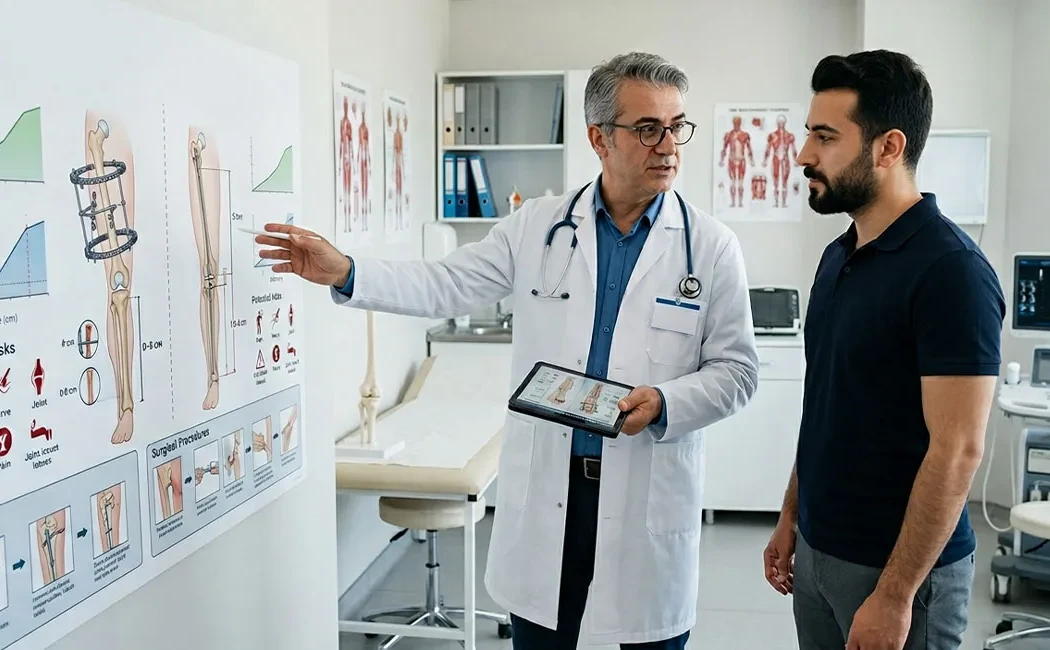
Short stature can arise from genetic factors, hormonal imbalances, or congenital anomalies, affecting individuals' quality of life both physically and psychologically. Advances in limb reconstruction technology now allow orthopedic surgeons to address functional impairments as well as meet aesthetic expectations through various surgical methods. Both cosmetic and medical heightening techniques are based on the biological principle of "distraction osteogenesis," where the bone is surgically cut and gradually lengthened under controlled conditions.
These surgical interventions are applied not only for medical indications such as limb length discrepancy and dwarfism (achondroplasia) but also for cosmetic purposes in individuals with constitutional short stature. However, cosmetic and medical heightening procedures are complex orthopedic treatments requiring meticulous planning, expertise, and a prolonged rehabilitation period. Selecting the appropriate method depends on evaluating the patient's anatomical profile, goals, and socioeconomic factors.
Overview of Heightening Surgery
Heightening surgery has its roots in the mid-20th century and continues to evolve. The core principle is creating a controlled bone fracture (osteotomy) and slowly separating the bone segments by about 1 mm per day, allowing new bone tissue to form in the gap. This process requires not only bone growth but also gradual stretching of the surrounding muscles, nerves, blood vessels, and skin.
Modern techniques aim to maximize patient comfort and minimize complications. Orthopedic authorities such as the Turkish Orthopedics and Traumatology Association (TOTBID) and the American Academy of Orthopedic Surgeons (AAOS) emphasize that such procedures should be performed in specialized centers with a multidisciplinary team. The treatment duration spans from detailed preoperative analysis through the lengthening phase and bone consolidation.
What are Cosmetic and Medical Heightening Methods?
These methods are classified primarily by the fixation device’s location—internal or external. Medical heightening is often used to correct unilateral shortening, post-traumatic deformities, or congenital anomalies, while cosmetic heightening typically involves symmetrical lengthening of both legs (femur or tibia).
The underlying principle of bone lengthening surgery combines the biological bone regeneration capacity with mechanical stability. Differences between methods emerge in factors such as return to daily activities, infection risk, scarring, and cost. The two most common contemporary techniques are fully internal magnetic nails (Precice) and circular external fixators (Ilizarov).
Precice (Magnetic Nail) Method
The Precice method involves an intramedullary telescopic nail inserted entirely inside the bone canal, with no visible external components. Lengthening is achieved via an External Remote Controller (ERC) that generates a magnetic field to gradually extend the nail.
This method offers major advantages in patient comfort. The absence of external rods reduces the risk of pin tract infections significantly and enhances mobility. It is preferred by patients with high aesthetic concerns and in delicate treatments such as upper limb lengthening.
Ilizarov (External Fixator) Method
The Ilizarov method is a cornerstone of bone lengthening and deformity correction. It uses a circular frame composed of rings and wires fixed externally around the limb. Lengthening is manually controlled by the patient or caregiver adjusting nuts on the device periodically.
Biologically, the Ilizarov technique is highly reliable and effective for complex deformities or cases with infection risks. It is frequently employed in congenital deformity correction and pediatric patients due to its versatility. However, the burden of carrying an external apparatus and the risk of pin site infections are notable drawbacks.
Comparison of Precice and Ilizarov Methods
The most critical decision for patients is choosing the method best suited to their needs. Factors such as cost, comfort, treatment duration, and scar visibility are considered. Comparisons between Precice and Ilizarov reveal that the magnetic nail excels in comfort and hygiene, whereas the Ilizarov method stands out for cost-effectiveness and multi-plane deformity correction capability.
Safe Limits in Heightening Surgery
In heightening surgery, "more length" does not always mean "better outcome." Exceeding physiological limits can lead to complications such as muscle contractures, nerve injuries, and joint stiffness. Based on scientific literature and clinical experience, the safe lengthening limit per single bone segment (either femur or tibia) is generally between 5 and 8 cm.
Determining these limits depends on the patient’s soft tissue flexibility and bone healing capacity. In accordance with lower extremity deformity surgery principles, complication risks increase exponentially with greater lengthening. Length exceeding 8–10 cm often requires combined strategies or staged procedures involving both femur and tibia.
Postoperative Recovery and Rehabilitation
Surgery is only the beginning of the treatment journey. A disciplined rehabilitation program during the postoperative period is essential for a successful outcome. Throughout the lengthening phase, patients must engage in regular physical therapy to maintain joint range of motion and muscle strength. Patient adherence to post-lengthening care recommendations is crucial to ultimate success.
The recovery timeline includes hospitalization, home-based lengthening, and final device removal or full bone load-bearing. Regular X-ray monitoring tracks bone regeneration (the regenerate).
Potential Risks and Complications
Like all surgeries, heightening procedures carry risks. Common issues involve pin site infections (in fixator methods), joint stiffness, and transient pain. More severe complications include deep vein thrombosis (DVT), nerve damage, and delayed or nonunion of bone healing.
In cases of poor bone healing, additional surgeries involving plates and screws for nonunion may be necessary. Minimizing risk requires smoking cessation, balanced nutrition, and strict compliance with medical follow-ups.
Emerging Technologies and Advances
Technological advancements in orthopedics make heightening procedures safer and more predictable. Computer-assisted planning, 3D modeling, and robotic surgical assistants enable millimeter-precise deformity correction. Improvements in lengthening nails increase their load-bearing capacity and reduce mechanical failure risks.
New devices and technologies aim to shorten patients’ return to normal life. Weight-bearing magnetic nails like Precice Stryde (subject to market availability) and smart fixation systems are setting future standards.
All information provided is for general informational purposes only and does not constitute medical advice. The content is not a substitute for professional diagnosis, treatment, or guidance. Diagnosis and treatment should be planned only after an in-person consultation with a qualified healthcare provider. Since each patient's clinical condition is unique, surgical or non-surgical treatments may vary accordingly. The information is based on current scientific knowledge and up-to-date medical practices. Do not delay seeking professional care based on the information provided.