Slipped capital femoral epiphysis affects the hip growth plate in teenagers and sometimes shows up only as knee pain. Symptoms, diagnosis, treatment and follow-up explained.
On this page 8 sections
- What is slipped capital femoral epiphysis and why does it happen?
- Symptoms of slipped capital femoral epiphysis: why it may start as knee pain
- How is it diagnosed?
- Treatment of slipped capital femoral epiphysis
- Possible problems and long-term follow-up
- Weight, activity and everyday life
- When should you see a doctor?
- Key points
Slipped capital femoral epiphysis (SCFE) is a hip condition of adolescence in which the ball at the top of the thighbone (the femoral head) slips backwards and downwards relative to the femoral neck at the level of the growth plate. It is most common between the ages of 10 and 16, during the growth spurt, and may cause pain in the hip, groin or thigh, or only in the knee, together with a limp. Because the pain can be felt in the knee, the condition is easily missed; in any teenager with hip or knee pain and a limp, the hip should be examined and, if needed, an X-ray of both hips taken.
SCFE needs prompt assessment, but when it is recognised early it can be managed with well-planned treatment. This article explains the symptoms, how the diagnosis is made, the treatment options and long-term follow-up in plain language for families.
What is slipped capital femoral epiphysis and why does it happen?
Children's bones have growth plates near their ends: layers of cartilage that allow the bone to lengthen. During the rapid growth of puberty these plates are wider and mechanically weaker. When the load on the hip growth plate exceeds what it can withstand, the femoral head stays in the socket while the neck of the thighbone shifts forwards and upwards. It is often compared to a scoop of ice cream slipping off its cone.
The exact cause is not always known, but certain factors increase the risk:
- Being overweight, the most common associated factor, as it increases the load on the hip
- The pubertal growth spurt
- Hormonal and metabolic conditions such as an underactive thyroid, growth hormone treatment or kidney disease
- Previous radiotherapy to the hip region
SCFE is somewhat more common in boys. If it occurs outside the typical age range, for example in a child younger than ten, an underlying hormonal cause may be looked for. Perthes disease, which causes hip pain and a limp in younger children, usually between 4 and 8, is a different condition.
Symptoms of slipped capital femoral epiphysis: why it may start as knee pain
Some of the nerves that supply the hip joint also carry sensation from the front of the thigh and the inner side of the knee. A hip problem can therefore be felt only as knee pain. That is why, when a teenager with knee pain has a normal knee examination and X-ray, the hip should be checked.
Common symptoms include:
- Pain in the groin, hip, thigh or knee, often increasing gradually over weeks
- A limp and tiring on longer walks
- The foot on the affected side turning outwards when walking
- Reduced ability to turn the hip inwards
- The leg rolling outwards when the hip is bent
- The leg appearing slightly shorter than the other
Doctors divide slips into two groups according to whether the child can bear weight. This distinction helps determine how urgent treatment is and what the risks are.
| Feature | Stable slip | Unstable slip |
|---|---|---|
| Walking | Can walk, with or without crutches | Cannot bear weight, even with crutches |
| Onset | Usually pain developing gradually over weeks | Often sudden, severe pain, sometimes after a minor fall |
| Frequency | More common | Less common |
| Blood supply to the femoral head | Lower risk of disruption | Higher risk of disruption |
How is it diagnosed?
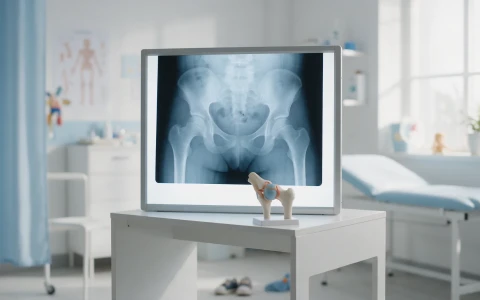
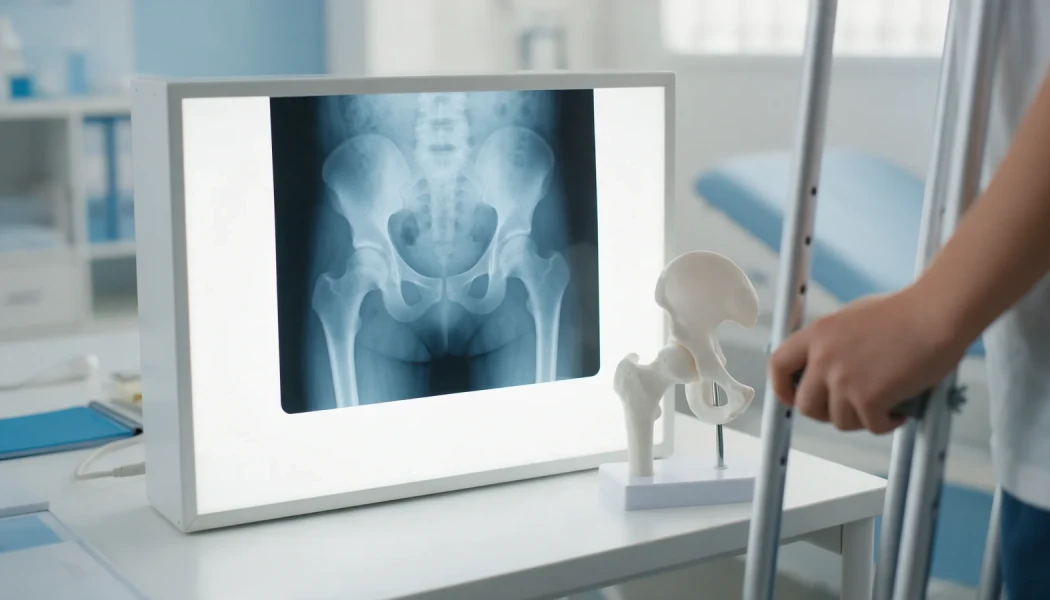
The diagnosis is made by examination and X-ray. The doctor assesses walking, hip movement and leg lengths. X-rays of both hips are taken from the front and the side, because an early slip may not be obvious on the front view alone and the condition of the other hip also needs to be known. On the front view, checking whether a line drawn along the upper edge of the femoral neck (Klein's line) passes through the femoral head is one simple way of spotting a mild slip. If suspicion is high but the X-ray findings are borderline, an MRI can help show early changes.
The slip is graded as mild, moderate or severe according to angles measured on the X-ray. In children outside the usual age range, or with other symptoms, blood tests to check hormone levels may be requested.
Treatment of slipped capital femoral epiphysis
Once the diagnosis is made, the first step is to stop weight-bearing on the affected leg to prevent the slip from progressing. The child moves around on crutches or in a wheelchair, and treatment is usually arranged within a short time. The aims are to stop the slip progressing, protect the blood supply to the femoral head and allow the growth plate to close safely.
- Fixation in situ with a screw: the method commonly used for stable slips. Through a small incision and under X-ray guidance, usually a single screw is passed across the growth plate. The slip is not forced back; it is fixed where it lies.
- Options for unstable and severe slips: the surgeon may fix the hip while taking measures to protect the blood supply to the femoral head. For some severe slips, more extensive open surgery to realign the femoral head may be considered in experienced centres.
- Protecting the other hip: in a proportion of children the other hip also slips over time. For children who are younger, have a hormonal condition or would find regular follow-up difficult, a preventive screw in the unaffected hip may be discussed.
Screw fixation is performed under general anaesthetic and usually needs only a short hospital stay. Because the incision is small, pain after surgery usually eases considerably within a few days, and pain relief is planned by the team. It helps families to discuss the process, the use of crutches and the return to school with the team before the operation.
After surgery the child walks with crutches for a period, and weight-bearing is increased gradually as advised by the surgeon. Return to running, jumping and contact sports is planned once the growth plate has been assessed at follow-up. The most suitable method depends on the type and severity of the slip and the child's age, and is decided individually.
Possible problems and long-term follow-up
Follow-up does not end with surgery. At review appointments the doctor looks out for the following:
- Loss of blood supply to the femoral head (avascular necrosis): the risk is higher after unstable slips; it may cause hip pain and stiffness.
- Cartilage damage (chondrolysis): thinning of the joint cartilage, causing stiffness and pain.
- Hip impingement: the shape left by a healed slip can cause pinching during hip movement and contribute to cartilage damage. You can read more in our article on hip impingement syndrome.
- Osteoarthritis later in life: depending on the remaining deformity, hip osteoarthritis may develop at a younger age. For the early warning signs, see our article on early signs of hip osteoarthritis.
Follow-up with regular X-rays continues until the growth plates have closed. For young people with a marked remaining deformity and ongoing symptoms, further surgery to reshape the hip may be considered later on.
Weight, activity and everyday life
Because excess weight is an important risk factor, weight management is part of treatment and of protecting the other hip. It should be discussed without blaming the child, together with the family and, where helpful, with support from paediatric, nutrition and endocrinology specialists. Once the surgeon allows it, low-impact activities such as swimming and cycling are usually a good place to start. The weeks on crutches can affect school life, so talking to teachers and, if needed, psychological support may also be part of the process.
When should you see a doctor?
Seek assessment without delay in the following situations:
- Sudden, severe hip or groin pain and inability to put weight on the leg: go to an emergency department without trying to make your child walk.
- Hip, groin, thigh or knee pain lasting more than a week or two in a child aged 10 to 16
- An unexplained limp, or the foot turning outwards when walking
- Knee pain that persists despite a normal knee examination and X-ray
- New pain in the other hip in a child who has previously been treated for SCFE
SCFE falls within paediatric orthopaedics, one of Prof. Dr. Halil İbrahim Balcı's clinical interests. The treatment plan is drawn up after the examination and imaging findings have been reviewed with the family.
Key points
- Slipped capital femoral epiphysis is a slip of the femoral head at the hip growth plate, most common between 10 and 16 years of age.
- It may start with hip, groin, thigh or only knee pain and a limp, so the hip should be examined in teenagers with knee pain.
- Diagnosis is by examination and X-rays of both hips; once diagnosed, weight-bearing is stopped.
- Treatment is usually fixation of the femoral head in place with a screw; severe and unstable slips need an individual plan.
- Regular follow-up of both hips until growth is complete is important.
Frequently Asked Questions
The usual approach today is to fix the femoral head surgically to stop the slip from progressing. Rest or casting does not reliably prevent progression, so these methods are generally not used. In most cases the operation is screw fixation through a small incision. The appropriate method is chosen after examination and imaging, according to the type and severity of the slip.
Yes. In some children the condition affects both hips at diagnosis, or the other hip slips later. This risk continues as long as the growth plates remain open, so both hips are monitored regularly until growth is complete. In some children a preventive screw in the unaffected hip may be agreed with the family after considering age and risk factors.
The timing depends on the type of slip, the surgery performed and how healing looks on follow-up X-rays, so it varies from child to child. Usually crutches and gradual weight-bearing come first, followed by low-impact activities such as swimming and cycling. Return to running, jumping and contact sports waits until the surgeon has assessed the growth plate at follow-up.
In many children the screw causes no problems and can be left in place. Removal may be discussed in some situations, for example if the screw causes symptoms or further hip surgery is planned in the future. Because removing a screw is also an operation, the decision is made individually after growth has finished, weighing the potential benefits and risks.
Some of the nerves that carry sensation from the hip joint also supply the front of the thigh and the inner side of the knee. The brain may therefore feel pain coming from the hip as if it were in the knee; this is called referred pain. If a teenager has knee pain and a limp without clear findings in the knee, the hip should be examined and, if necessary, X-rayed.
This article is for general information only and does not replace a medical examination, diagnosis or treatment. Treatment options and outcomes vary from person to person.
Related treatment area Paediatric Orthopaedics: Common Bone and Joint Problems in Children