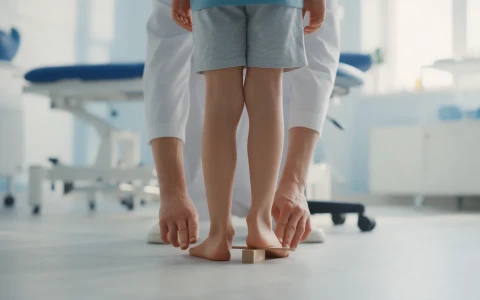
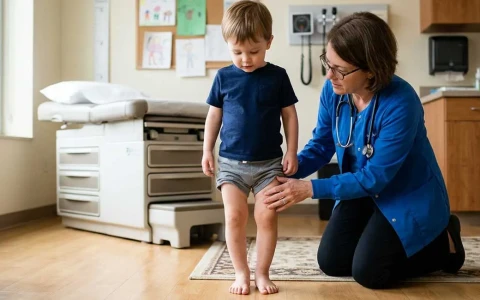
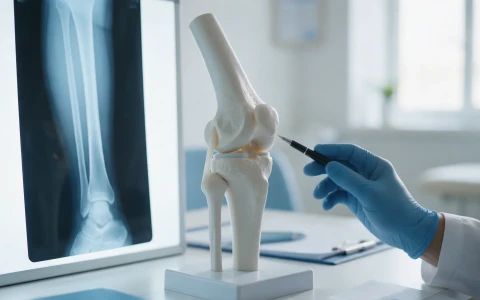
Guided growth temporarily slows one side of a growth plate to correct knock knees or bow legs in children without cutting the bone. We explain who it suits, how it works and the risks.
On this page 8 sections
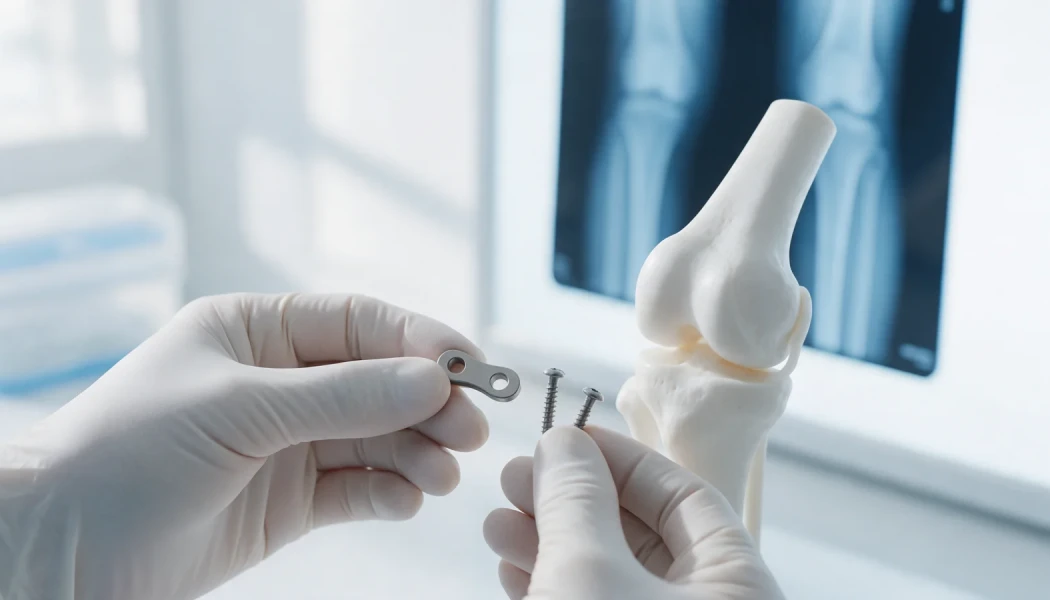
Guided growth surgery is a minor operation used in growing children to correct angular deformities such as bow legs or knock knees without cutting the bone, by temporarily slowing growth on one side of a growth plate. The device most often used is a small plate fixed across one side of the growth plate with two screws, widely known as an 8-plate because of its shape. As the other side keeps growing normally, the leg gradually straightens, and the plate is removed once alignment has been restored.
The technique only works while the growth plates are still open, and it is not needed for physiological bowing that is expected to correct itself with age. This article explains which children it suits, how it is done, how progress is monitored and what the risks are.
What is guided growth and how does it work?
Near the ends of the long bones lies the growth plate (physis), a layer of cartilage that makes the bone longer. Most leg deformities in children are linked to the two sides of the growth plates around the knee, at the lower end of the thigh bone and the upper end of the shin bone, growing at different rates.
In guided growth, the plate is placed on the convex (outer curve) side of the deformity: on the inner side of the knee for knock knees and on the outer side for bow legs. One screw anchors into the bone above the growth plate and the other into the bone below it. Acting like a hinge, the plate slows growth on that side; as the opposite side keeps growing, the screws gradually splay into a V shape and the alignment slowly corrects. In medical literature this is also called temporary hemiepiphysiodesis. Staples were used for the same purpose in the past; today these small tension-band plates are widely preferred.
Which children might benefit from guided growth?
The first step is to decide whether the bowing is simply part of normal development. Bow legs in infancy and knock knees around the age of three to four are common, and the legs usually approach adult alignment by about seven or eight. We describe these stages in detail in our guide to leg bowing in children. Guided growth is mainly considered for:
- Bow legs or knock knees that are more marked than expected for age, do not correct on their own or are getting worse
- Deformities caused by skeletal dysplasias such as achondroplasia
- Bowing from rickets that persists despite metabolic treatment
- Early-stage Blount disease in carefully selected children
- Conditions that disturb growth, such as multiple hereditary exostoses and Ollier disease
- Other angular problems, such as an outward tilt of the ankle or a knee that cannot fully straighten (flexion contracture)
For the technique to work, the growth plates must be open and enough growth must remain for the correction to happen. If a bony bridge has formed across part of the growth plate, guided growth alone may not be enough. In Blount disease, particularly in advanced and late-onset forms, the response is less predictable, so other options are also weighed up; we discuss this in our article on Blount disease.
Assessment before a decision is made
- Examination: the gap between the knees or ankles, walking pattern, joint laxity and any twisting (rotation) of the leg are assessed.
- Full-length standing leg X-ray: taken from hip to ankle, it shows the weight-bearing axis of the leg and the joint angles, and identifies whether the deformity comes from the thigh bone, the shin bone or both.
- Estimating remaining growth: the child's age, bone age where needed and signs of puberty are considered together.
- Blood tests: carried out if a metabolic cause such as rickets is suspected.
An important point: an 8-plate corrects angular deformity but does not correct twisting (rotational deformity) of the bone. Rotational problems that cause in-toeing or out-toeing are assessed and managed differently.
How is guided growth surgery performed?
- The operation is done under general anaesthetic using a live X-ray imaging device (fluoroscopy).
- The plate is placed level with the growth plate, usually through an incision of a few centimetres, and fixed with two screws.
- If needed, plates can be inserted in both legs, or in both the thigh bone and the shin bone, in the same session.
- Children usually go home the same day or after one night in hospital. A cast is not normally needed, and most children start putting weight on the leg within a few days as comfort allows.
- A return to school is usually possible within a short time; running and sport resume once the wound has healed, on your surgeon's advice.
How long does correction take and how is it monitored?
The speed of correction depends on the child's age, the bone treated and the size of the deformity. It tends to be quicker in younger children who are growing fast and slower in those nearing the end of puberty. In general the process takes months, and in some children it can take one to two years.
During this period, children are typically reviewed every three to six months, with X-rays as needed. Once alignment has been restored, the plate and screws are removed in a short procedure. Keeping follow-up appointments really matters: if the plate stays in longer than needed, the deformity can overcorrect, so that knock knees, for example, turn into mild bow legs.
In children treated at a young age with many years of growth ahead, some of the deformity may return after the plate is removed (rebound). For this reason, the correction is sometimes taken slightly further, or only one screw is removed so that the plate can be reactivated if needed. Follow-up continues at intervals until growth is complete.
Guided growth or osteotomy?
If the growth plates have closed, or too little growth remains for correction, the deformity is corrected with an osteotomy, in which the bone is cut in a controlled way and fixed in the right alignment. The main differences are summarised below:
| Feature | Guided growth (8-plate) | Corrective osteotomy |
|---|---|---|
| Suitable for | Children with open growth plates and enough growth remaining | Teenagers and adults who have stopped growing, or severe deformities |
| Is the bone cut? | No | Yes |
| Correction | Gradual over months, driven by growth | At once during surgery, or gradually with a frame |
| Incision and recovery | Small incision, usually a quick return | Larger procedure, longer for the bone to heal |
| Corrects rotation? | No | Can be done in the same operation |
| Second procedure | Plate removal needed | Implant removal sometimes needed |
You can read about correction methods for people who have finished growing on our adult leg deformity correction page, and an overview of lower limb deformities in children on our childhood lower limb deformities page. Prof. Dr. Halil İbrahim Balcı developed his experience in paediatric deformity surgery and Ilizarov techniques as a research fellow and observer at the Paley Institute in the USA.
Possible risks and things to be aware of
Although guided growth is a minor procedure, like any operation it carries some risks:
- Overcorrection into the opposite deformity if follow-up is missed
- Partial return of the deformity after the plate is removed
- The plate being felt under the skin or irritating the surrounding tissue
- Screw loosening or breakage, particularly in heavier children and in Blount disease
- Occasionally a wound infection or temporary knee stiffness
- Rarely, a lasting effect on the growth plate
- Incomplete correction and the need for an osteotomy later
Many of these risks can be reduced by careful patient selection and regular follow-up. Results vary from child to child.
When should you see a doctor?
It is sensible to have your child assessed by an orthopaedic surgeon if you notice:
- Bow legs that become more noticeable or worsen after the age of two to three
- Marked knock knees that persist beyond the age of seven to eight
- Bowing on one side only, or a clear difference between the two legs
- Knee or ankle pain, frequent falls or a change in walking pattern
- Noticeably short stature compared with peers, or a family history of rickets or skeletal dysplasia
- A missed review date, or a sense that the leg is curving the other way, in a child who already has a guided growth plate
Key points
- Guided growth aims to correct leg bowing without cutting the bone by temporarily slowing one side of a growth plate.
- It is only suitable for children with open growth plates and enough growth remaining, and is not needed for physiological bowing.
- Correction happens gradually over months; regular reviews and timely plate removal are essential parts of the process.
- Once growth has finished, or when there is also rotational deformity, other methods such as osteotomy are needed.
- The right approach is decided individually after examination and a full-length standing leg X-ray.
Frequently Asked Questions
Because guided growth is done through small incisions and the bone is not cut, most children start putting weight on the leg and walking within a few days, as comfort allows. Crutches may be useful for a short time at first, and a cast is not usually needed. Running, jumping and sport are resumed once the wound has healed, according to the child's progress and the surgeon's advice.
The plate keeps slowing growth on one side, so if it stays in after alignment has been corrected, the leg can start to curve the other way: knock knees, for example, may gradually turn into bow legs. That is why regular reviews and removing the plate at the right time are an integral part of treatment. If you have missed a review, contact your surgeon promptly rather than waiting for the next routine appointment.
In guided growth only one side of the growth plate is temporarily slowed while the other side continues to grow, so a noticeable effect on overall leg length is not usually expected. When both legs are treated symmetrically, a length difference between them is not expected either. If only one leg is treated, or if there is already a length difference, leg lengths are measured separately during follow-up.
There is no strict age limit; the key requirements are open growth plates and enough growth left for correction. When the procedure is done at a very young age, the chance of some deformity returning after plate removal is higher. In children close to the end of puberty, there may not be enough time left for correction. Timing is decided by looking at age, bone age, signs of puberty and the size of the deformity together.
With rickets, the first step is to treat the underlying metabolic problem together with paediatric endocrinology or nephrology. In nutritional rickets, some of the bowing can improve considerably with this treatment alone. If the deformity persists once the metabolic condition is under control, or remains marked, as often happens in inherited forms, guided growth may be considered as one of the options in suitable children.
This article is for general information only and does not replace a medical examination, diagnosis or treatment. Treatment options and outcomes vary from person to person.
Related treatment area Childhood Lower Limb Deformities: Bow Legs, Knock Knees and In-Toeing