An open fracture is an emergency in which the broken bone is exposed through a wound. First aid steps, the Gustilo classification, infection risk and how surgical treatment is carried out.
On this page 8 sections
- What is an open fracture, and how does it differ from a closed fracture?
- First aid for an open fracture: what to do and what not to do
- What happens in the first hours in hospital?
- How are open fractures classified? The Gustilo-Anderson system
- Surgical treatment of open fractures
- Possible complications and recovery
- When should you see a doctor?
- Key points
An open fracture is a broken bone in which the skin and soft tissues over the break are torn, so that the fracture is exposed to the outside environment. The bone end may be sticking out of the wound, or there may be nothing more than a small puncture wound near the fracture; either way, germs can reach the broken bone. An open fracture is therefore a medical emergency: call an ambulance, cover the wound with a clean dressing, and in hospital antibiotics should be started as soon as possible and surgical cleaning planned.
Open fractures usually follow high-energy injuries such as road traffic accidents, falls from height, accidents at work and some sports injuries. The bone most often affected is the shin bone (tibia), because its front surface lies just beneath the skin with only a thin layer of soft tissue covering it. This article covers first aid for an open fracture, what happens in the first hours in hospital, the stages of surgical treatment and what to watch for during recovery.
What is an open fracture, and how does it differ from a closed fracture?
In a closed fracture the bone is broken but the skin over it is intact. In an open fracture the skin and the tissues beneath it are breached down to the fracture. This can happen when a sharp bone end pierces the skin from the inside, or when an external force such as a crush or impact tears the tissues from the outside. Any wound close to a fracture is treated as an open fracture until proven otherwise.
There are three main reasons why an open fracture is serious:
- Risk of infection: soil, fragments of clothing and bacteria from the skin can reach the fracture, which can lead to deep infection and bone infection (osteomyelitis).
- Soft tissue damage: injury to the muscle, bone lining and blood vessels that nourish the bone can slow healing.
- Associated injuries: high-energy accidents may also damage blood vessels and nerves, or cause injuries elsewhere in the body.
First aid for an open fracture: what to do and what not to do
What to do
- Call an ambulance, making sure first that the scene is safe.
- Control bleeding by placing a clean cloth or gauze over the wound and pressing. If bone is protruding, press around it rather than directly on it.
- Cover the wound with a clean, ideally sterile, dressing.
- Keep the arm or leg still in the position you found it, using soft supports such as a folded towel or pillow if needed.
- Remove rings, bracelets or watches before swelling starts.
- Keep the injured person warm and calm, and watch for signs of shock such as pale skin, cold sweat, a rapid pulse or confusion.
What not to do
- Do not try to push a protruding bone back in.
- Do not try to straighten or pull the injured limb.
- Do not try to clean inside the wound, and do not apply creams, powders, cologne or home remedies.
- Do not give the person anything to eat or drink, as they may need an operation.
What happens in the first hours in hospital?
In the emergency department, the team first checks breathing, circulation and any injuries elsewhere in the body. Standard steps for an open fracture then follow:
- Antibiotics: intravenous antibiotics are started as soon as possible, ideally within the first hour after the injury.
- Tetanus protection: vaccination history is checked, and a tetanus booster and/or immunoglobulin are given if needed.
- Wound care: the wound is photographed, obvious debris is removed and it is covered with a sterile dressing moistened with saline. The photograph means the dressing does not have to be lifted repeatedly.
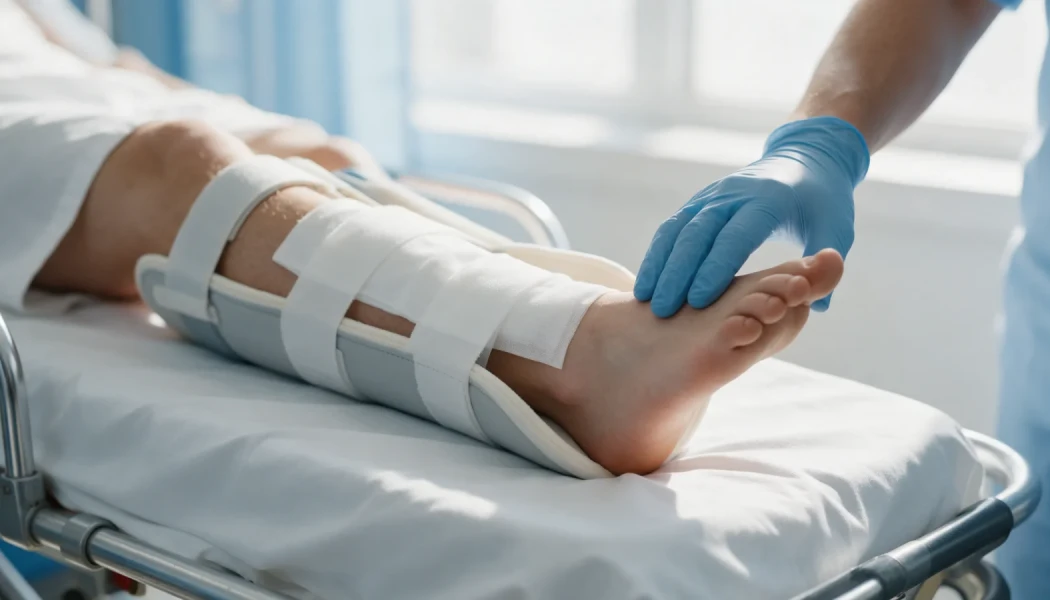
- Splinting and circulation checks: the limb is brought into as straight a line as possible and splinted, and pulses, sensation and movement are checked.
- Imaging: X-rays are taken, sometimes with a CT scan, and blood vessel imaging is requested if vascular injury is suspected.
- Close monitoring: pain and sensation are monitored for compartment syndrome, a dangerous rise in pressure within the muscle compartments.
How are open fractures classified? The Gustilo-Anderson system
Open fractures are usually graded with the Gustilo-Anderson classification to help plan treatment. The final grade is often decided during surgical cleaning, once the tissues can be seen directly.
| Type | Wound | Soft tissue |
|---|---|---|
| Type I | Under 1 cm, clean | Minimal damage, usually a simple fracture |
| Type II | 1–10 cm | Moderate soft tissue damage |
| Type IIIA | Usually over 10 cm, or a high-energy injury | Extensive damage, but the bone can be covered with local tissue |
| Type IIIB | Extensive | Bone is left exposed and needs a tissue transfer (flap) to cover it |
| Type IIIC | Variable | Associated with an arterial injury that needs repair |
Moving from type I to type III, the likelihood of infection and healing problems rises, and treatment becomes more complex.
Surgical treatment of open fractures
Surgical cleaning (debridement)
The cornerstone of treatment is the careful removal of dead and contaminated tissue in the operating theatre, followed by thorough washing of the wound with saline. Timing depends on the severity of the injury: immediately for heavily contaminated wounds or when a blood vessel is injured, usually within 12 hours for other high-energy injuries and generally within 24 hours for simpler open fractures. Some patients need a repeat debridement a few days later, depending on the state of the tissues.
Stabilising the fracture
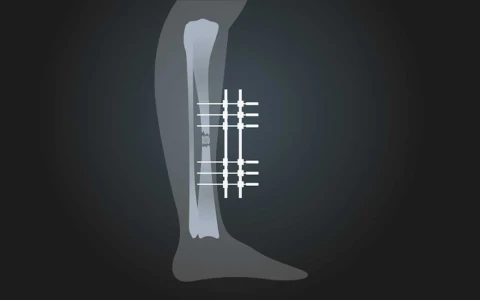
If the wound and the patient's condition allow, the fracture can be fixed definitively at the same operation with an intramedullary nail or a plate. When the soft tissues are badly damaged, or the patient's general condition does not allow a long operation, a temporary external fixator is applied first and definitive fixation is carried out later. Circular (Ilizarov-type) frames can also be used in complex fractures; their role in bone healing is explained in more detail in our article on external fixators in nonunion.
Soft tissue cover
Covering bone and implants with healthy tissue is crucial in preventing infection. If the wound cannot be closed directly, the plastic surgery team uses muscle or skin flaps, ideally within the first few days and preferably within 72 hours. Negative pressure (vacuum) dressings may be used in the meantime. This combined approach, in which orthopaedic and plastic surgeons work side by side, is known as "orthoplastic" care.
When bone has been lost
If bone has been lost in the injury or removed during debridement, the gap may first be filled with antibiotic-loaded bone cement. Once infection is under control, the bone is rebuilt using techniques such as bone grafting, the two-stage induced membrane technique or bone transport with the Ilizarov method.
Possible complications and recovery
Even with early, appropriate treatment, some problems can develop after an open fracture. Knowing about them helps you spot warning signs early:
- Infection: this ranges from a superficial wound infection to deep infection reaching the bone. The diagnosis and treatment of bone infection are described on our bone and soft tissue infections page.
- Delayed union and nonunion: open fractures generally take longer to heal than closed ones. If healing stalls, the options are assessed under nonunion surgery.
- Compartment syndrome: a rise in pressure within the muscle compartments that needs emergency surgery.
- Joint stiffness, malunion and muscle weakness: physiotherapy and regular follow-up aim to minimise these.
Recovery time depends on the fracture site, the soft tissue damage and the treatment, and open shin bone fractures often take many months to heal. Stopping smoking, keeping blood sugar under control, eating well and attending follow-up appointments all help. If infection develops, our article on surgery for bone and soft tissue infections explains when an operation may be needed.
When should you see a doctor?
After treatment for an open fracture, contact your doctor without delay if you notice:
- fever, shivering or feeling generally unwell
- increasing pain, redness, warmth or swelling
- discharge or an unpleasant smell from the wound, or the wound opening up
- redness, discharge or pain around the pin sites if you have an external fixator
- numbness, a change in colour or coldness of the fingers or toes, or severe pain not relieved by painkillers
- pain and swelling in the calf, shortness of breath or chest pain
- new movement, clicking or a change in shape at the fracture site later on
Key points
- In an open fracture the broken bone is exposed to the outside through a wound in the skin, and urgent treatment is needed.
- First aid means calling an ambulance, controlling bleeding, covering the wound and keeping the limb still; never push the bone back in.
- Early antibiotics, tetanus protection, surgical debridement and stabilisation of the fracture are the foundations of hospital treatment.
- In severe injuries, orthopaedic and plastic surgeons work together on soft tissue cover and rebuilding any lost bone.
- Regular follow-up for infection and healing problems is important, and recovery varies from person to person.
Frequently Asked Questions
Most open fractures need the wound to be cleaned in the operating theatre, because removing dead and contaminated tissue is the main way of preventing infection. How the fracture is then stabilised depends on the severity of the injury, which bone is involved and the patient's general condition. In some very small wounds with simple fractures, the approach may differ; this decision is made after examination, imaging and assessment of the wound.
Open fractures generally take longer to heal than closed fractures, because of soft tissue damage and disruption to the bone's blood supply. The time depends on the fracture site, the Gustilo grade, whether any bone has been lost and whether infection develops. Open fractures of the shin bone, for example, often take many months to unite. Physiotherapy and a full return to everyday life may continue for some time after the bone has healed.
Bacteria that enter an open fracture wound can multiply quickly at the fracture site. Starting antibiotics as early as possible after the injury, ideally within the first hour, helps to stop them from becoming established and causing deep infection. Antibiotics are not enough on their own; they are combined with surgical debridement and covering the wound with healthy tissue. The choice of antibiotic and how long it is given for are decided by the doctor.
If infection is suspected, blood tests, imaging and, where needed, tissue samples are used to identify the cause. Treatment usually involves further surgical cleaning of the infected tissue and a prolonged course of antibiotics guided by culture results. Whether the implant is left in place or exchanged depends on when the infection appeared and whether the fracture has healed. If bone is lost, reconstruction techniques may be considered at a later stage.
No. Do not try to wash or clean inside the wound at the scene, as this can push dirt deeper, increase bleeding and damage the tissues. It is enough to cover the wound with a clean, ideally sterile, dressing, control bleeding with gentle pressure and keep the limb still. Cleaning of the wound is carried out in hospital under appropriate conditions, usually in the operating theatre.
This article is for general information only and does not replace a medical examination, diagnosis or treatment. Treatment options and outcomes vary from person to person.
Related treatment area Bone Infection Treatment: Osteomyelitis and Soft Tissue Infections