Osteomyelitis is an infection of bone, usually caused by bacteria. Its acute and chronic forms, symptoms in children and adults, diagnostic tests and the antibiotic and surgical treatment options.
On this page 8 sections
- What is osteomyelitis and how does it develop?
- Acute and chronic osteomyelitis: what is the difference?
- What are the symptoms of osteomyelitis?
- How is osteomyelitis diagnosed?
- Osteomyelitis treatment: antibiotics and surgery
- Follow-up after treatment and the risk of recurrence
- When should you see a doctor?
- Key points
Osteomyelitis is an infection of bone, usually caused by bacteria. In children it most often arrives through the bloodstream and appears suddenly (acute osteomyelitis), with fever, a limp and reluctance to use an arm or leg. In adults it is more often a complication of an open fracture, surgery, an implant such as a plate or nail, or a diabetic foot ulcer. Osteomyelitis treatment depends on the type and stage of the infection: antibiotics started early are often effective, whereas long-standing (chronic) infection usually needs surgery to remove dead bone and, where necessary, to rebuild the bone.
This article explains how osteomyelitis develops, the differences between acute and chronic forms, the tests used to diagnose it and the treatment options. Symptoms and treatment vary from person to person, depending on how the infection started, how long it has been present, the organism involved and the person's general health.
What is osteomyelitis and how does it develop?
Healthy bone is quite resistant to infection. For bacteria to settle in bone there is usually a route of entry, or a condition that lowers the bone's defences. The main routes are:
- Through the bloodstream (haematogenous spread): bacteria from elsewhere in the body travel in the blood and lodge in bone. This is the most common route in children, and the infection usually starts near the growth plates at the ends of the long bones. In adults this route more often affects the spine.
- Direct contamination: bacteria can reach bone directly after an open fracture, surgery or the insertion of an implant. A large share of osteomyelitis in adults falls into this group.
- Spread from nearby tissue and poor circulation: diabetic foot ulcers or non-healing wounds caused by vascular disease can gradually spread into the underlying bone.
The most common cause is a bacterium called Staphylococcus aureus; other bacteria can be involved in young children, and occasionally tuberculosis or fungi infect bone. In chronic and implant-related infections, bacteria build a protective, sticky layer called a biofilm on dead bone or metal surfaces. Antibiotics struggle to reach bacteria inside a biofilm, which is why medication alone is often not enough in these situations.
Acute and chronic osteomyelitis: what is the difference?
| Feature | Acute osteomyelitis | Chronic osteomyelitis |
|---|---|---|
| Duration | Days to a few weeks | Weeks, months or years; may flare up from time to time |
| Typically affects | Children (spread through the blood) | Adults (after a fracture, surgery, an implant or diabetes) |
| Typical symptoms | Fever, severe pain, swelling, redness, not using the limb | Persistent or recurring pain, a discharging opening in the skin (sinus); often no fever |
| What happens in the bone | Inflammation of living bone, sometimes an abscess | Fragments of dead bone (sequestrum), biofilm, thickened bone |
| Main treatment | Antibiotics, with drainage of any abscess | Surgical debridement, targeted antibiotics and reconstruction when needed |
What are the symptoms of osteomyelitis?
In children
- fever, tiredness and irritability
- a limp, refusing to walk or not using an arm
- tenderness, swelling and warmth over one spot on a bone
- in babies, vague signs such as poor feeding or crying when the nappy is changed or a limb is moved
In children, bone infection can be accompanied by infection of the neighbouring joint (septic arthritis). A child with a fever who will not let a joint be moved needs urgent assessment.
In adults
- pain at a fracture or surgical site that does not settle, or returns after a period of improvement
- redness, swelling and warmth, with discharge from the wound or a wound that will not heal
- a discharging opening at the site of an old fracture or operation that opens and closes from time to time
- increasing pain around an implant, or loosening of the implant
- a foot ulcer reaching down to the bone in people with diabetes
- in spinal infection, back pain that persists at night, sometimes with fever
How is osteomyelitis diagnosed?
The diagnosis is made by combining examination findings with laboratory tests and imaging:
- Blood tests: white cell count, CRP and ESR support the diagnosis and are used to monitor the response to treatment, although normal results do not rule out infection, particularly chronic infection.
- Blood cultures: help to identify the bacterium in patients with a fever, especially children.
- X-rays: may look normal at first; bone changes usually become visible after 10 to 14 days. In chronic infection, dead bone fragments and thickened bone may be seen.
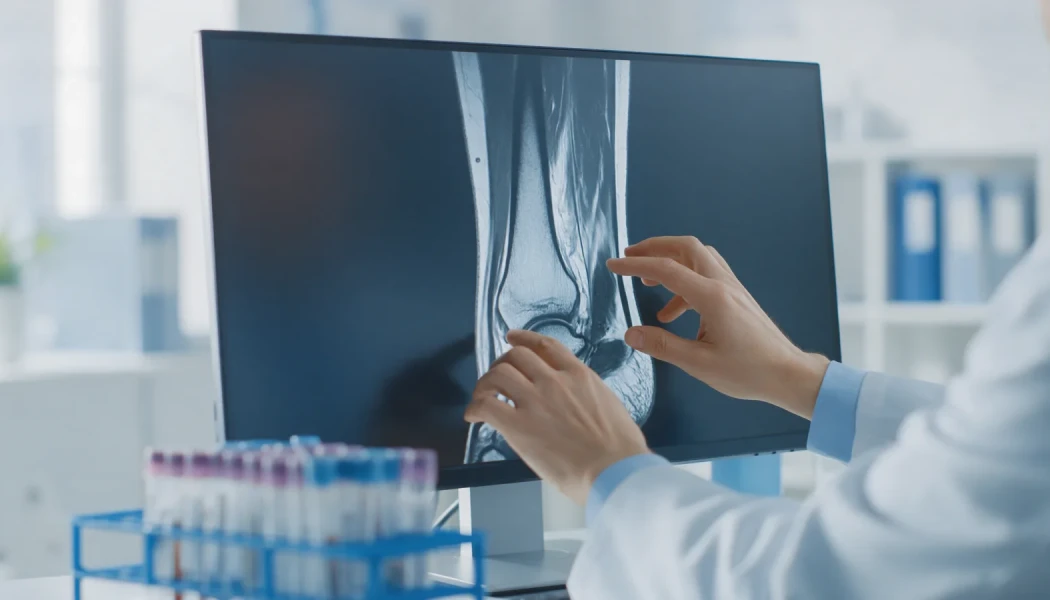
- MRI: shows early changes in the bone marrow and any abscess, and is very valuable for early diagnosis and for mapping the extent of infection.
- CT scan: shows dead bone fragments and bone structure in detail and helps with surgical planning.
- Ultrasound and nuclear medicine scans: used in selected cases, for example to detect an abscess under the bone lining in children or to assess areas around implants.
- Bone biopsy and culture: the key step for confirming the diagnosis and choosing the right antibiotic. A biopsy also distinguishes infection from certain bone tumours that can look similar.
Where the patient's condition allows, samples are taken before antibiotics are started, so that the organism can be identified accurately.
Osteomyelitis treatment: antibiotics and surgery
Antibiotic treatment
Antibiotics are usually given into a vein at first and then, in suitable patients, by mouth. Treatment typically lasts for weeks, and the choice of antibiotic is guided by culture results, often together with an infectious diseases specialist. In many children with acute osteomyelitis, antibiotics started early are sufficient, although an abscess may need draining. It is important not to stop the medicines before the recommended time, even if symptoms improve.
Surgical treatment
Surgery is considered when there is an abscess or dead bone, when the infection has become chronic, when an implant is infected or when the response to antibiotics is inadequate. Whether surgery is needed for a bone infection is decided on an individual basis. Surgical treatment usually involves the following steps:
- Debridement: careful removal of infected and dead bone and soft tissue. This is the cornerstone of treatment.
- Dead space management: antibiotic-loaded bone cement or absorbable carriers are placed in the cleaned area to deliver high local antibiotic levels.
- Stabilisation: if the bone is unstable, an external or circular frame may be used, and an infected implant may be removed or exchanged.
- Soft tissue cover: where needed, plastic surgeons use muscle or skin flaps to cover the bone with healthy tissue.
- Reconstruction of bone loss: gaps left after debridement can be rebuilt with bone grafts, bone transport or two-stage techniques.
Treatment planning looks not only at the bone but at the person as a whole. Stopping smoking, controlling blood sugar and improving nutrition all make an important contribution to bringing infection under control. Situations in which infection and nonunion occur together are covered on our complex and infected nonunion page, and for a broader overview you may find our article on orthopaedic approaches to bone infection helpful.
Follow-up after treatment and the risk of recurrence
With early diagnosis and appropriate treatment, acute osteomyelitis usually settles well. Because the growth plate is occasionally affected, which can cause a leg length difference or angular deformity, children are often followed up for a while as they grow. In chronic osteomyelitis the infection can be brought under control, but in some patients it can flare up again, even years later. Regular check-ups, blood tests and imaging where needed are therefore part of aftercare. Physiotherapy and psychological support are also important during a long course of treatment.
When should you see a doctor?
See a doctor promptly, the same day if necessary, if you notice:
- bone pain together with a fever
- a limp, refusal to walk or not using an arm in a child with a fever
- redness, discharge or opening of a wound after a fracture or operation, or pain that returns
- a discharging opening at the site of an old fracture or operation
- a non-healing foot ulcer, or swelling and redness of the foot, in someone with diabetes
- steadily increasing pain in an area containing an implant
Treating bone infection requires orthopaedic surgeons, infectious diseases specialists, plastic surgeons and radiologists to work together, and our bone and soft tissue infections page summarises the approaches used. Prof. Dr. Halil İbrahim Balcı is a co-editor of a Springer book on external fixator applications according to Ilizarov principles; these methods are among the reconstruction options for bone loss after infection in suitable patients.
Key points
- Osteomyelitis is a bone infection, usually bacterial, that spreads through the blood in children and often follows a fracture, surgery or diabetes in adults.
- Acute osteomyelitis typically causes fever and severe pain, while chronic osteomyelitis causes recurring pain and a discharging sinus.
- Diagnosis combines blood tests, imaging such as MRI and CT, and bone biopsy with culture.
- Antibiotics are often enough for acute infection, but chronic infection usually requires surgical debridement and reconstruction.
- Treatment and follow-up are planned individually, and bone pain with fever should be assessed without delay.
Frequently Asked Questions
Acute osteomyelitis in children usually resolves when it is diagnosed early and treated with appropriate antibiotics. In chronic osteomyelitis, the infection can be brought under control by removing dead bone, giving targeted antibiotics and reconstructing the bone where needed, but in some patients it may flare up again, even years later. Regular check-ups after treatment are therefore important. The outlook depends on the type of infection and the person's general health.
Antibiotic treatment usually lasts for weeks, with the duration depending on whether the infection is acute or chronic, the bacterium involved, whether surgical debridement has been carried out and whether an implant is present. In complex cases where lost bone has to be rebuilt, the whole treatment process can extend over many months. The exact plan is set by the treatment team according to examination findings, blood tests and imaging results.
Osteomyelitis is not passed from person to person through everyday contact. The infection sits inside the bone, so it poses no risk to family members, classmates or colleagues through normal contact. If there is a discharging wound, careful hand hygiene during dressing changes and proper disposal of used dressings are recommended. For certain resistant bacteria, additional precautions may be taken in hospital.
Not always. The decision depends on when the infection started, whether the fracture has healed, whether the implant is still secure and which bacterium is involved. In some infections that appear shortly after surgery, the implant can be left in place and treated with debridement and antibiotics. In chronic infection, however, biofilm on the metal often means the implant needs to be removed or exchanged. The right approach is decided individually after examination and imaging.
Yes. In some cases osteomyelitis and certain bone tumours can look similar on X-ray and MRI, and both can cause pain, swelling and changes in blood tests. When the diagnosis is uncertain, a bone biopsy is therefore performed, and the sample is examined both for infection and under the microscope for tumour cells. Reaching the correct diagnosis is the essential first step in choosing the right treatment.
This article is for general information only and does not replace a medical examination, diagnosis or treatment. Treatment options and outcomes vary from person to person.
Related treatment area Revision Surgery for Complex and Infected Nonunion