Madelung deformity is a curving of the wrist caused by abnormal growth of the radius, and it is usually noticed in adolescence. Its causes, symptoms, assessment and treatment options.
On this page 8 sections
Madelung deformity is a curving of the radius, the forearm bone on the thumb side, and a change in the shape of the wrist joint, caused by part of the radius growth plate near the wrist not growing properly. It is usually noticed between the ages of 8 and 14, during the growth spurt of puberty; it is more common in girls and often affects both wrists. The main symptoms are a bony bump that becomes prominent on the back of the wrist, pain that increases with activity, and reduced ability to rotate the forearm. Mild cases can be observed, while surgical correction is considered for people with pain, loss of function or progression.
Madelung deformity is rare and is sometimes part of a genetic condition that also causes short stature. This article explains its causes, symptoms, how it is assessed and how treatment varies according to the stage of growth.
What is Madelung deformity?
The forearm has two bones: the radius on the thumb side and the ulna on the little-finger side. Most of the wrist joint is formed between the lower end of the radius and the small wrist (carpal) bones. In Madelung deformity, the part of the growth plate at the lower end of the radius that faces the palm and the little-finger side grows slowly or closes early. Because the rest of the growth plate keeps growing, the radius bends and the joint surface tilts towards the palm and the little-finger side.
As a result, the carpal bones slip into the gap between the radius and the ulna and take on a "V"-shaped arrangement. The head of the ulna, which is now relatively long compared with the radius, forms a prominent bump on the back of the wrist. The forearm often looks slightly shorter than in other children of the same age.
What causes Madelung deformity?
Madelung deformity can occur on its own or together with certain genetic conditions:
- Leri-Weill dyschondrosteosis: an inherited skeletal dysplasia caused by changes in the SHOX gene, which plays a role in bone growth; it causes shortening of the middle segments of the forearms and legs. It is the most widely recognised condition associated with Madelung deformity.
- Turner syndrome and other SHOX-related conditions: wrist changes may be seen together with short stature.
- Idiopathic Madelung deformity: cases in which no underlying genetic change is found.
Many patients have an abnormally thick, short ligament running from the inner part of the lower end of the radius to one of the carpal bones (the lunate). This structure, called the Vickers ligament, is thought to tether that part of the growth plate and restrict its growth, and it plays an important role in surgical planning.
Some conditions can produce an appearance similar to Madelung deformity, including fractures that damage the growth plate, bone infections and inherited conditions with multiple bony outgrowths. In these cases treatment is planned according to the underlying cause. For other rare conditions seen in childhood, see our article on rare childhood deformities.
Symptoms: a wrist bump, pain and stiffness
The symptoms of Madelung deformity range from mild to marked. Some young people notice only a difference in appearance, while others have symptoms that affect daily activities:
- A prominent bony bump on the back of the wrist, on the little-finger side
- A wrist that looks stepped or bayonet-shaped when viewed from the side
- Wrist pain that increases with sport, carrying loads or writing for long periods
- Reduced ability to turn the palm upwards and to bend the wrist backwards
- Reduced grip strength
- A forearm that looks relatively short
Pain often appears during the teenage years and, in some people, eases once growth is complete. Rarely, tendons passing over the prominent head of the ulna can become irritated.
Assessment: X-rays, MRI and genetic evaluation
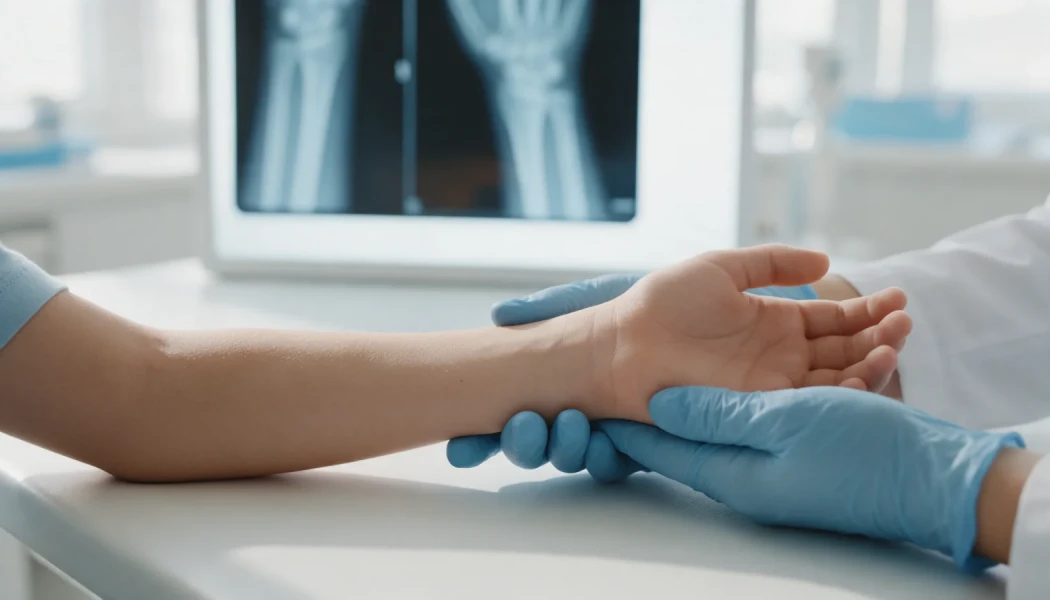
Assessment begins with an examination of both wrists and forearms. The doctor assesses range of movement, where the pain is, grip strength and nerve function. Height, the proportions of the arms and legs and whether anyone in the family has similar wrists are also considered.
The main investigations are:
- X-rays: front and side views of both wrists and forearms show the tilt of the radius, the arrangement of the carpal bones and the position of the ulna. The severity of the deformity is judged by measuring how far the radius joint surface tilts towards the little-finger side, how far the lunate has sunk between the radius and ulna, and how far the carpal bones have shifted towards the palm.
- MRI: useful for showing the Vickers ligament, the state of the growth plate and the cartilage, particularly when planning surgery.
- CT scan: may be used for three-dimensional planning of complex deformities.
- Genetic and endocrine assessment: for children with short stature or a family history of similar wrists, tests for SHOX gene changes and an opinion from a paediatric endocrinologist may be recommended.
Non-surgical treatment and observation
Mild Madelung deformity that is not painful and does not significantly affect function often does not need surgery. In this case the approach includes:
- Regular examination and, where needed, X-rays until growth is complete
- Adjusting or pausing activities that strain the wrist during painful periods
- Short-term use of a wrist splint
- Physiotherapy to maintain range of movement and muscle strength
- Pain relief if needed, as advised by your doctor
Non-surgical measures do not change the shape of the bone, but they can help keep symptoms under control. Whether the deformity progresses, and how symptoms change during follow-up, guide any decision about surgery.
Surgical options for Madelung deformity
Surgical options are considered when there is persistent pain, marked loss of movement, progression of the deformity or a difference in appearance that is a significant concern for the young person. The single most important factor in choosing the method is whether the growth plate is still open:
| Stage of growth | Aim | Main options |
|---|---|---|
| Children who are still growing | To limit progression of the deformity | Release of the Vickers ligament and removal of the abnormal part of the growth plate; if needed, stopping growth of the ulna |
| Adolescents near or at the end of growth, and adults | To correct the shape of the radius and the tilt of the joint surface | Radius osteotomy (often combined with Vickers ligament release), with shortening of the ulna if needed |
| Marked shortening and severe deformity | To gain length as well as correction | Gradual correction and lengthening with an external fixator |
Procedures on the growth plate are only worthwhile in children who still have enough growth ahead of them. Remaining growth is therefore estimated by considering bone age, assessed on an X-ray of the hand and wrist, together with the stage of puberty, and the method is chosen accordingly.
A radius osteotomy involves cutting the bone in a controlled way, realigning it and holding it with a plate and screws. For the planning principles used to correct bone deformities, see our article on the CORA principle in deformity surgery. In severe deformities with shortening, the radius can be corrected and lengthened gradually over days to weeks with an external fixator. The general principles of these methods are described on our page on upper limb lengthening and deformity correction.
After surgery a splint or cast is usually worn for a few weeks, followed by physiotherapy to work on movement and strength. The aims of surgery are to reduce pain and improve function and appearance; the gain in range of movement and the time needed to recover vary from person to person.
When should you see a doctor?
An assessment by an orthopaedic specialist is advisable if you notice:
- A bony bump on the back of the wrist that is becoming more prominent
- Wrist pain that started in the teenage years and increases with activity
- Difficulty turning the palm upwards or bending the wrist
- A change in the shape of one or both wrists
- Short stature, shortening of the forearms and legs, or a family history of similar wrists
- Numbness or weakness in the fingers, or new difficulty opening and closing the hand
Prof. Dr. Halil İbrahim Balcı's clinical and academic interests include upper limb lengthening and deformity correction surgery. In Madelung deformity, the treatment plan is drawn up by considering the examination and imaging findings, the stage of growth and the person's own expectations together.
Key points
- Madelung deformity is a curving of the wrist caused by part of the growth plate at the lower end of the radius not growing properly.
- It is usually noticed in adolescence, more often in girls, and frequently affects both wrists; it may be associated with SHOX-related conditions.
- The main symptoms are a bump on the back of the wrist, pain with activity and reduced forearm rotation.
- Assessment uses X-rays of both wrists and, where needed, MRI and genetic evaluation.
- Mild cases are observed; for pain, loss of function or progression, surgery chosen according to the stage of growth may be considered.
Frequently Asked Questions
In some people Madelung deformity is part of an inherited condition. In particular, Leri-Weill dyschondrosteosis, caused by changes in the SHOX gene, can be passed from parent to child, and short stature may accompany the wrist changes. However, Madelung deformity also occurs without any underlying genetic cause. If there is a family history of similar wrists or short stature, genetic assessment may be recommended.
Because the deformity results from uneven growth at the radius growth plate, it progresses mainly during growth. Once the growth plates have closed, the shape of the bone usually does not change significantly. In some people, however, pain and stiffness may continue in later years because the wrist and forearm joints no longer fit together well, so follow-up after growth is advisable for those with symptoms.
The main aims of surgery are to reduce pain, improve the alignment and appearance of the wrist and support function. Some patients gain more forearm rotation and wrist bending, but the improvement varies from person to person and completely normal movement cannot always be expected. It is important to discuss realistic goals with your surgeon before the operation.
Many children with mild deformity and no pain can continue to play sport. Activities that put heavy load through the wrist, such as gymnastics, weightlifting or sports involving handstands, may increase pain and might need to be adjusted. During painful periods a short break and a splint may be advised. Which activities are suitable is decided on the basis of the examination findings.
Madelung deformity can occur together with short stature, particularly in SHOX-related Leri-Weill dyschondrosteosis and Turner syndrome. In these conditions the middle segments of the forearms and legs are shorter. For children who are also short, a paediatric endocrinology and genetics assessment may be recommended alongside the orthopaedic evaluation. When Madelung deformity occurs on its own, height is usually not affected.
This article is for general information only and does not replace a medical examination, diagnosis or treatment. Treatment options and outcomes vary from person to person.
Related treatment area Rare Childhood Limb Deformities: Fibular Hemimelia, Femoral Deficiency