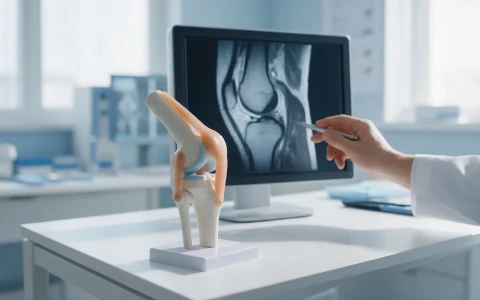
A stress fracture is a crack that develops gradually from repeated loading. We explain the symptoms, who is at risk, why X-rays can miss it, how long healing takes and how to return to sport safely.

On this page 8 sections
A stress fracture is a crack in a bone that develops gradually from repeated loading rather than from a single injury. The typical symptom is pain that builds with exercise, eases with rest and can be pinpointed to one spot on the bone. Most stress fractures heal without surgery once the load is reduced and the return to sport is carefully graded, but some sites, such as the hip and the top of the foot, need closer monitoring and occasionally an operation.
Because running, hiking and sport all pick up in the summer months, stress fractures become more common at this time of year. This article explains how a stress fracture develops, who is at risk, the warning signs, and how diagnosis and healing work.
What is a stress fracture and who gets one?
Bone is living tissue that constantly renews itself in response to load. When the load outpaces the bone's ability to repair, microscopic damage and swelling build up inside the bone; this is called a "stress reaction". If loading continues, the damage can coalesce into a crack visible on imaging, a stress fracture. Stress reactions and stress fractures are therefore seen as stages of the same process, often grouped together as bone stress injuries.
There are two main types: a fatigue fracture, when healthy bone is subjected to excessive, repetitive load, and an insufficiency fracture, when bone weakened by conditions such as osteoporosis cracks under everyday loads.
Risk factors
- Training errors: increasing distance, duration or intensity too quickly, too little recovery, or a change of surface or footwear.
- Sport and occupation: long-distance runners, military recruits, dancers, and sports with jumping and sudden changes of direction such as basketball and football.
- Low energy availability: not eating enough for the training load, known as relative energy deficiency in sport (REDs), harms bone health. In female athletes, irregular or absent periods are an important warning sign.
- Bone health: low vitamin D or calcium, low bone density and a previous stress fracture.
- Biomechanics: high-arched or flat feet, a difference in leg length or leg alignment problems.
- Other factors: smoking, low body weight and some chronic illnesses.
Where do stress fractures usually occur?
Stress fractures mostly affect the weight-bearing bones of the leg and foot. The location is the single most important factor in planning treatment. At "high-risk" sites the blood supply is poorer or the fracture lies on the tension side of the bone, so healing may be slow or the crack may progress to a complete fracture.
| Site | Commonly seen in | Risk category |
|---|---|---|
| Inner, back surface of the shin bone (tibia) | Runners, military recruits | Low |
| Second and third metatarsals | Long walks, running, dance | Low |
| Fibula (the thin bone beside the shin bone) | Runners | Low |
| Heel bone (calcaneus) | Military recruits, long-distance walkers | Low |
| Femoral neck (hip) | Long-distance runners | High |
| Front of the shin bone | Jumping sports | High |
| Navicular (top of the midfoot) | Running, basketball, athletics | High |
| Base of the fifth metatarsal | Football, basketball | High |
What are the symptoms of a stress fracture?
Stress fracture pain usually creeps up and worsens over a few weeks:
- pain felt at first only at the end of or after exercise, later starting earlier in the session;
- pain that eases with rest but, as things progress, is felt on walking, at rest and at night;
- tenderness over a specific spot on the bone that you can point to with one finger;
- mild swelling, often more obvious on the top of the foot with metatarsal fractures;
- pain when hopping on the affected leg.
"Shin splints" (medial tibial stress syndrome), which cause pain along the inner edge of the shin, can be confused with a stress fracture. Shin splint pain tends to spread over a longer stretch of bone, whereas stress fracture pain is usually concentrated in a small area. In runners, pain in the groin or front of the thigh should always be taken seriously, as it can signal a stress fracture of the femoral neck.
Diagnosis: why the X-ray may look normal
In the early stages of a stress fracture, X-rays often look normal; signs of healing bone may only become visible after a few weeks. A normal X-ray therefore does not rule out a stress fracture.
- MRI: can show bone marrow oedema and a fracture line early on, and helps to grade the injury. It is commonly used when a stress fracture is suspected.
- CT scan: useful for showing the fracture line in detail at sites such as the navicular.
- Blood tests and bone density scan: in recurrent stress fractures or suspected insufficiency fractures, vitamin D, calcium and bone density are assessed.
Your doctor will also ask about your training programme, diet, footwear and, for women, menstrual cycle, because understanding why the fracture happened is key to preventing another.
Stress fracture treatment and healing time
Low-risk stress fractures
The foundation of treatment is giving the bone time to heal. The activity causing pain is stopped or reduced; if everyday walking hurts, crutches, a walking boot or a stiff-soled shoe may be used for a while. Fitness can be maintained with low-impact activities such as swimming, pool running and, where appropriate, cycling. At low-risk sites, healing commonly takes around 6–8 weeks, although this varies with the site, the severity and the individual.
The second part of treatment is correcting whatever caused the fracture. The training programme is reworked, any vitamin D or calcium deficiency is treated under medical supervision and diet is reviewed against training load. Suitable footwear or insoles may help when foot shape contributes to overload, and physiotherapy can address muscle weakness. If these steps are skipped, the fracture may heal but another stress fracture can develop in the same or a different bone.
High-risk stress fractures
At sites such as the femoral neck, navicular and fifth metatarsal, a longer period without weight-bearing, a cast or a boot may be needed. If the fracture line is wide, healing is delayed or there is a risk of complete fracture, surgical fixation with a screw or nail may be considered. A fracture that fails to heal can become a nonunion; our article on nonunion treatment options explains how this is managed.
Returning to sport
Returning to sport begins not when the pain disappears but when the bone has shown it can cope with load. A general roadmap looks like this:
- everyday walking is pain-free and there is no tenderness over the bone on examination;
- simple tests such as single-leg hopping are pain-free when checked by a doctor or physiotherapist;
- running restarts with short run segments alternating with walking, on alternate days;
- duration is increased first, then speed and gradient, step by step;
- if pain returns, drop back to the previous stage and let your doctor know.
How can stress fractures be prevented?
Summer brings its own risks: long holiday walks you are not used to, running on sand or hard tarmac, new and intensive training plans, and thin-soled summer footwear can all put unexpected load on bone. The following steps help to reduce the risk:
- Increase weekly distance and intensity gradually rather than all at once, and avoid jumping straight into hard training at the start of summer.
- Plan at least one or two rest days a week and prioritise sleep.
- Eat enough energy and protein for your training, include calcium-rich foods and ask your doctor about checking your vitamin D level.
- Replace worn-out shoes and vary your running surfaces where possible.
- Add strength work for the hips, calves and feet; our article on exercises that support joint health is a good starting point.
- Female athletes whose periods become irregular, and anyone with repeated stress fractures, should be assessed for underlying causes.
When should you see a doctor?
It is advisable to see an orthopaedic specialist if you have:
- bone pain that does not settle after a few days' rest, or that keeps getting worse;
- pinpoint tenderness or swelling over a bone;
- pain when walking, at rest or at night;
- groin or front-of-thigh pain after running (stop loading the leg and get it assessed promptly);
- pain and swelling on the top of the foot, especially if you do jumping sports;
- a previous stress fracture or irregular periods.
Bone and joint injuries in active people are assessed as part of sports surgery. The right treatment is planned once the site and severity of the fracture have been established through examination and imaging.
Key points
- A stress fracture is a crack that develops gradually from repeated loading, most often in the bones of the leg and foot.
- Pain that builds with exercise, eases with rest and is focused on one spot is the classic symptom.
- X-rays may be normal early on; MRI is commonly used to confirm the diagnosis.
- Most stress fractures heal with load reduction and a graded return to sport; high-risk sites may need surgery.
- Building training load gradually, eating enough and resting well are the foundations of prevention.
Frequently Asked Questions
It depends on where the fracture is and whether walking hurts. For a low-risk stress fracture where everyday walking is pain-free, short distances are often allowed. If walking is painful, crutches or a walking boot help the bone to heal. At high-risk sites such as the femoral neck or navicular, you may need to avoid putting weight on the leg altogether. The exact site should be confirmed with imaging before this decision is made.
Stress fractures at low-risk sites commonly heal in around 6–8 weeks, although a full return to sport can take a little longer. At high-risk sites, with larger fractures or when load reduction was delayed, recovery may take several months. Diet, vitamin D status, smoking and returning to training too early are among the main factors that affect healing. The expected timeline is assessed individually, based on examination and imaging.
Shin splints cause pain along the inner edge of the shin over several centimetres and often ease once you have warmed up. With a stress fracture, the pain is usually concentrated in one spot, gets worse as exercise continues and later may be felt on walking or at night. Sharp pain when pressing on one particular point of the bone suggests a stress fracture. An MRI scan is often needed to tell the two apart with confidence.
You can usually keep fit with activities that do not load the injured bone. Swimming, pool running and upper-body training are generally suitable, while cycling depends on where the fracture is. Running, jumping and sports with sudden changes of direction should wait until your doctor agrees. If an alternative activity causes pain at the fracture site, stop it. Planning the programme with your orthopaedic specialist and physiotherapist is the sensible approach.
Yes. Having had one stress fracture increases the risk of another. The way to reduce that risk is to identify what caused the first one: a sudden rise in training, under-eating, low vitamin D, low bone density, footwear or biomechanical issues. In female athletes, irregular periods should always be looked into. With repeated fractures, further tests such as blood tests and a bone density scan may be recommended.
This article is for general information only and does not replace a medical examination, diagnosis or treatment. Treatment options and outcomes vary from person to person.
Related treatment area Sports Surgery: Treating Knee, Shoulder and Ankle Injuries