In achondroplasia, short arms can make self-care and reaching harder. We explain who might consider humeral lengthening, how the process works, how it differs from leg lengthening and the risks.
On this page 8 sections
- Why are the arms short in achondroplasia, and how does it affect daily life?
- Who might consider humeral lengthening?
- How is humeral lengthening done?
- How does arm lengthening differ from leg lengthening?
- Daily life and physiotherapy during lengthening
- What are the possible risks of humeral lengthening?
- When should you seek an assessment?
- Key points
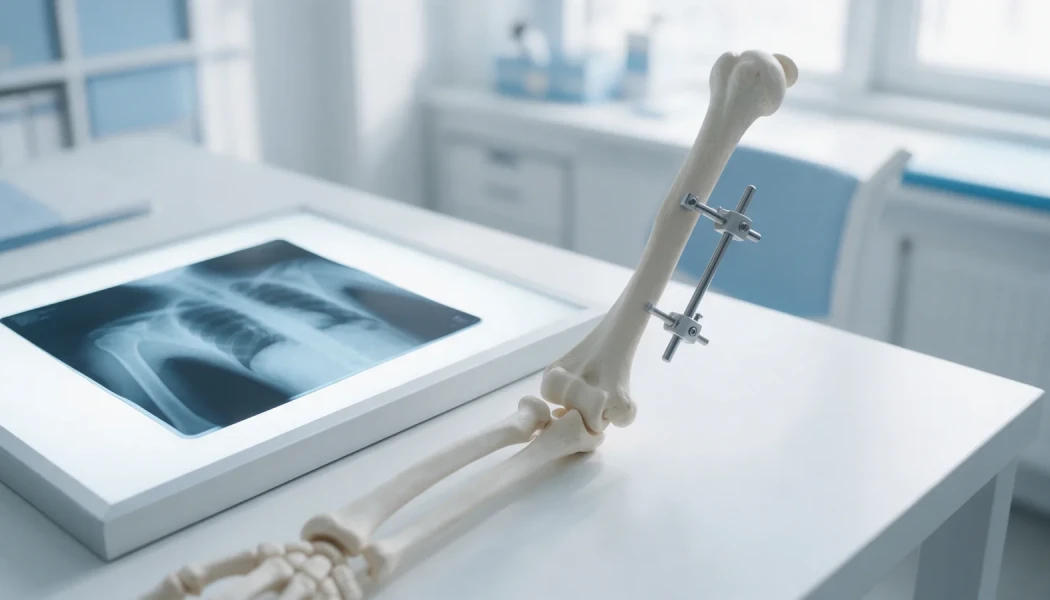
Humeral lengthening is an operation in which the upper arm bone is cut in a controlled way and then gradually lengthened by fractions of a millimetre each day with a fixator, while the body fills the gap with new bone. In achondroplasia, short arms can make everyday tasks such as personal hygiene after using the toilet, dressing and reaching more difficult, so bilateral humeral lengthening may be considered in suitable patients as a way of increasing independence. The aim is function rather than appearance, and the decision is made after examination and imaging, taking into account the goals of the family and, wherever possible, the child.
This article explains how short arms affect daily life in achondroplasia, who might consider arm lengthening, how the process works, how it differs from leg lengthening and what the risks are.
Why are the arms short in achondroplasia, and how does it affect daily life?
In achondroplasia, shortening is most marked in the segments closest to the trunk: the upper arm (humerus) and the thigh. As a result, when the arms hang by the side, the fingertips often reach only to about hip level. Many people also cannot straighten their elbows fully, which shortens their reach further.
The main everyday difficulties that short arms can cause include:
- managing personal hygiene independently after using the toilet;
- pulling trousers up and down, tying shoelaces and brushing hair;
- reaching high shelves, switches, door handles and lift buttons;
- picking things up from the floor without bending, and using some sports equipment or musical instruments.
These difficulties vary from person to person. Many people manage these tasks independently with occupational therapy, long-handled aids, bidets or washlet-style toilets. Arm lengthening is an option to consider after these alternatives have been explored.
Who might consider humeral lengthening?
The decision is never based on a single factor. The assessment usually covers:
- Functional difficulty: how much short arms affect self-care and daily life.
- Age and participation: whether the child is old enough to take part in the process, do the exercises and express their own view.
- Bones and joints: the shape of the humerus, shoulder and elbow movement, and whether there is elbow stiffness or dislocation of the head of the radius (a forearm bone).
- General health: the status of spinal, breathing and other health issues that can accompany achondroplasia.
- Expectations and support: the goals of the family and child, the support available at home during treatment and access to physiotherapy.
Arm lengthening may be part of a staged programme planned alongside leg lengthening, or it may be done on its own. Many people with achondroplasia choose not to have lengthening surgery; that is a personal decision that deserves respect.
Before deciding, the length of the process, what daily life with a frame involves and the difficulties that may arise should be discussed openly with both family and child. Giving the child space to voice worries, answering their questions in an age-appropriate way and offering psychological support when needed all help them cope with treatment.
How is humeral lengthening done?
Lengthening relies on the ability of bone to form new bone when it is gently and steadily pulled apart. The process usually has the following stages:
- Planning: examination and X-rays assess the length and alignment of the bone and the range of joint movement; the amount of lengthening is tailored to the bone, the soft tissues and the functional goals.
- Surgery: through a small incision the humerus is cut in a controlled way (osteotomy) and a monolateral rail fixator or a circular frame is applied. In some adults with suitable bone anatomy, an internal lengthening nail placed inside the bone may be used instead.
- Latency: for about a week after surgery, the bone is given time to start its healing response.
- Distraction: the fixator is lengthened by about 1 mm a day, divided into several small steps. The rate is adjusted at regular reviews according to bone formation, joint movement and nerve function.
- Consolidation: once the target length is reached, the new bone is allowed to harden. This phase usually lasts longer than the lengthening phase.
- Frame removal: when X-rays show enough new bone, the fixator is removed in a short procedure, followed by a period of protection and physiotherapy.
The frame usually stays on for several months in total, depending on how much length is gained and how quickly the individual heals. You can find more on our page about upper limb lengthening and deformity correction.
How does arm lengthening differ from leg lengthening?
Although arm and leg lengthening follow the same biological principle, the experience differs in several ways:
| Feature | Humeral (arm) lengthening | Femoral and tibial (leg) lengthening |
|---|---|---|
| Main aim | Reach and independence in self-care | Height, leg proportions and alignment |
| Weight-bearing | The bone does not carry body weight | Walking and weight-bearing are carefully planned |
| Nerve watched most closely | Radial nerve (lifts the wrist and fingers) | Mainly the peroneal nerve (lifts the foot at the ankle) |
| Joints whose movement must be protected | Shoulder and elbow | Hip, knee and ankle |
| Daily life | If both arms are lengthened together, help with self-care is needed | Walking aids and restricted mobility are the main issues |
For more on leg lengthening and lengthening for medical reasons, see our page on medical limb lengthening.
Daily life and physiotherapy during lengthening
During arm lengthening the hands are usually free, so the child can eat, write and do light tasks. Heavy lifting, games that load the arms and activities with a risk of falling are avoided. When both arms are lengthened together, family help with toileting, washing and dressing is needed, so planning home and school arrangements beforehand is important.
- Physiotherapy: shoulder, elbow, wrist and finger movements are exercised every day. Because the soft tissues are stretched during lengthening, maintaining elbow straightening is particularly important.
- Pin care: pin sites are cleaned according to the team's protocol, and redness, discharge or increasing pain are reported.
- Clothing: sleeveless or wide-sleeved tops, or tops with press studs or Velcro along the sleeve seams, make dressing easier.
- Sleep: lying on the back with the arms supported on pillows can be more comfortable.
- School: informing teachers and agreeing arrangements for breaks, PE and toilet use is helpful.
What are the possible risks of humeral lengthening?
As with any operation, arm lengthening carries risks, which should be discussed in detail beforehand:
- Radial nerve problems: if this nerve, which winds around the humerus, is affected, there may be weakness in lifting the wrist and fingers. It is often temporary but requires close monitoring and adjustment of the lengthening rate.
- Pin-site infection: a common problem with external fixators, usually controlled with simple measures when spotted early.
- Joint stiffness: loss of movement can develop in the shoulder and especially the elbow; regular physiotherapy helps to reduce this risk.
- Problems with bone formation: the new bone may harden too early or too slowly or develop an angle, and a fracture can occur after the frame is removed.
- Pain and disturbed sleep: particularly during the lengthening phase, managed by the team.
Our article on complications in limb lengthening surgery explains these problems and how they are managed.
When should you seek an assessment?
An assessment for arm lengthening may be worth considering for a child or adult with achondroplasia when:
- short arms prevent independence with personal hygiene after using the toilet or with dressing;
- significant difficulties in daily life persist despite aids and occupational therapy;
- elbow stiffness, pain or a bend in the arm is increasing;
- a family planning leg lengthening wants to discuss the timing of arm lengthening as well.
Prof. Dr. Halil İbrahim Balcı's work on bilateral humeral lengthening in achondroplasia received first prize among the external fixation oral presentations at the 24th National Turkish Orthopaedics and Traumatology Congress in 2014, and an abstract award in the upper-extremity category at the ILLRS Congress in Miami in 2015; details are on the awards page. In every case, the appropriate approach is decided individually after examination and imaging.
Key points
- Short arms in achondroplasia can make self-care, dressing and reaching more difficult.
- Humeral lengthening is a functional option for suitable patients aimed at greater independence; aids and occupational therapy are also considered.
- The humerus is cut in a controlled way and lengthened by fractions of a millimetre a day with a fixator, over several months.
- The radial nerve, joint movement and pin sites are closely monitored throughout.
- The decision weighs age, general health, joint condition and the goals of both family and child.
Frequently Asked Questions
There is no fixed age. It is usually planned from school age onwards, when the child can take part in the process, do the physiotherapy exercises and express their own view. Timing takes into account the bone anatomy, joint movement, any planned leg lengthening programme and the family's daily routine. Adults with suitable conditions can also be assessed. The right timing for each person is discussed after examination and imaging.
Both approaches are used. Lengthening both arms together shortens the overall treatment time and makes it easier to keep the two sides equal, but more family help is needed with toileting, washing and dressing during that period. Lengthening one arm at a time allows daily tasks to continue with the other arm, although the process takes longer overall. The choice is made together, based on the child's age, the support available at home and surgical planning.
The fixator usually stays on for several months, depending on how much length is gained and how quickly the new bone hardens. During this time children often continue going to school and doing light daily tasks. After the frame is removed, heavy lifting and sports with a risk of impact are avoided for a while so the new bone can strengthen, and physiotherapy continues. The team decides when full activity can resume, based on follow-up X-rays and examination.
Humeral lengthening aims to increase the length of the upper arm, whereas the inability to straighten the elbow has different structural causes and is not expected to improve with lengthening. In fact, because the soft tissues are stretched during lengthening, particular care is taken to protect elbow movement. Elbow range is therefore measured before surgery and physiotherapy continues throughout. Where there is a significant elbow problem, it is assessed separately and included in the plan.
This article is for general information only and does not replace a medical examination, diagnosis or treatment. Treatment options and outcomes vary from person to person.
Related treatment area Arm Lengthening Surgery and Upper Limb Deformity Correction