
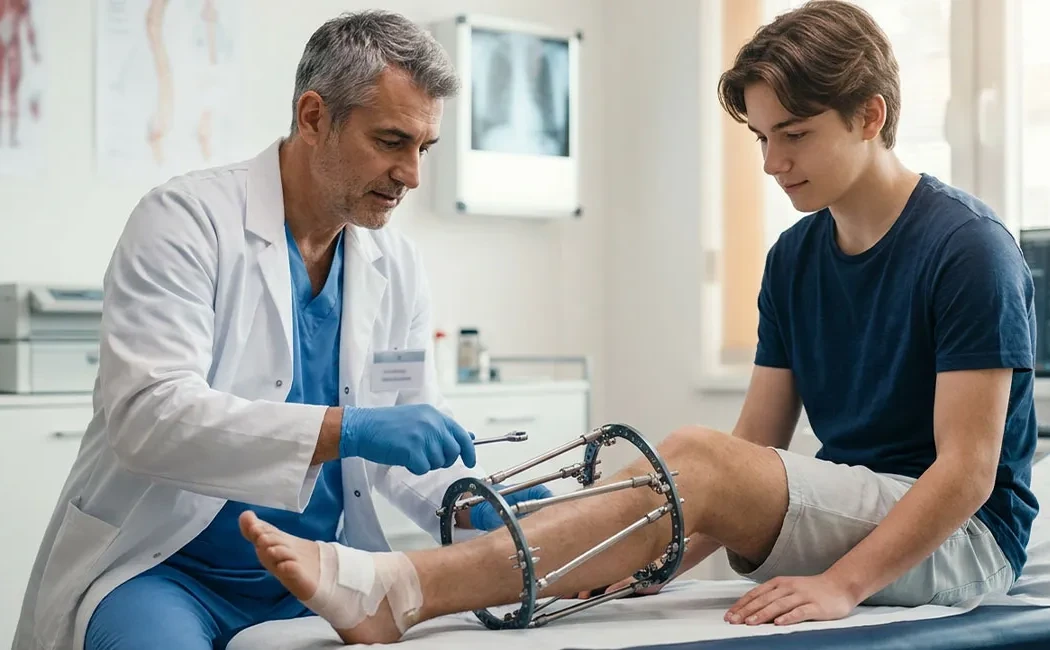
Limb reconstruction and lengthening represent some of the most technical and complex areas within orthopedics and traumatology. This field addresses the restoration of limbs impaired by congenital anomalies, post-traumatic deformities, bone loss, or infections. The primary goal is not only to lengthen or correct the bone but also to maximize the functional capacity of the limb.
The treatment journey starts with a thorough clinical assessment and radiological evaluation. Success in limb reconstruction and lengthening surgery depends on careful patient selection, meticulous surgical planning, and long-term rehabilitation follow-up. Modern approaches in this field aim to improve patients' quality of life and enable them to return safely to daily activities.
When Is It Applied?
Limb reconstruction is a surgical discipline applicable to a broad patient group. These procedures are commonly chosen for treating both congenital and acquired pathologies. In particular, lower limb deformity surgery addresses issues such as leg length discrepancies and angular deformities.
Developmental problems encountered in childhood constitute an important group requiring early intervention. Rare syndromes or congenital bone deficiencies are managed with pediatric deformity surgery. In such cases, protecting growth plates and planning for future growth are critical. Additionally, when lower limb deformities in childhood are detected, minimally invasive correction methods can be applied.
In adults, reconstruction may be necessary following trauma, including cases of malunion, nonunion, or bone infections such as osteomyelitis. Early diagnosis and timely intervention are vital, especially in pediatric orthopedics deformity management.
Surgical Methods and Technologies
The reconstructive surgical techniques employed vary depending on the deformity type and patient expectations. The fundamental principle involves controlled bone cutting (osteotomy) followed by biological healing to facilitate lengthening or correction. Commonly used procedures include bone lengthening surgery and upper limb lengthening and deformity correction surgery.
Ilizarov and Other Lengthening Techniques
The Ilizarov method utilizes circular external fixators and relies on biological tissue regeneration. It is especially effective in complex three-dimensional deformity corrections and treating infected bone. This external system allows bone lengthening at a rate of approximately 1 mm per day.
Next-Generation Devices and Technological Advances
Advancements have brought motorized intramedullary nails (magnetic lengthening nails) which improve patient comfort. These systems avoid the need for external devices and reduce infection risks. Thanks to new technologies in limb lengthening surgery, patients can begin their rehabilitation earlier.
Paley Institute Approach
The Paley Institute is globally recognized in the field of limb reconstruction. Its approach emphasizes maintaining the patient’s functional capacity alongside radiological correction. Treatment planning follows the "Reverse Planning" method, meaning surgical steps are determined starting from the desired final outcome.
This process requires a multidisciplinary team including orthopedists, physiotherapists, and patient cooperation.
Recovery and Rehabilitation
The postoperative period is as important as the surgery. Recovery phases include latent (waiting), distraction (lengthening), and consolidation (bone healing). Intensive physical therapy is necessary to maintain joint mobility and muscle strength. Patients must adhere to daily exercises to prevent contractures (movement restrictions).
Risks and Complications
As with any surgical intervention, limb reconstruction and lengthening carry certain risks. These may include infection, nerve injury, joint stiffness, or delayed bone healing. Cases requiring nonunion surgery arise when biological healing is insufficient.
Moreover, inadequate correction or recurrence of deformity may necessitate malunion surgery. Detailed patient education about common complications in limb reconstruction and management by an expert team are essential for minimizing risks.
When performed in the right hands and indicated properly, limb reconstruction and lengthening can significantly improve patients’ lives. A science-based, ethical, and transparent treatment process requires expert clinical evaluation.
All information provided is for general informational purposes only and does not constitute medical advice. The content is not a substitute for professional diagnosis, treatment, or guidance. Diagnosis and treatment decisions should be made exclusively following an in-person consultation with a qualified healthcare professional. Since each patient's clinical condition is unique, surgical or non-surgical interventions may vary accordingly. The information presented is based on current scientific evidence and up-to-date medical practices. Do not delay seeking professional medical care based on the content provided.