
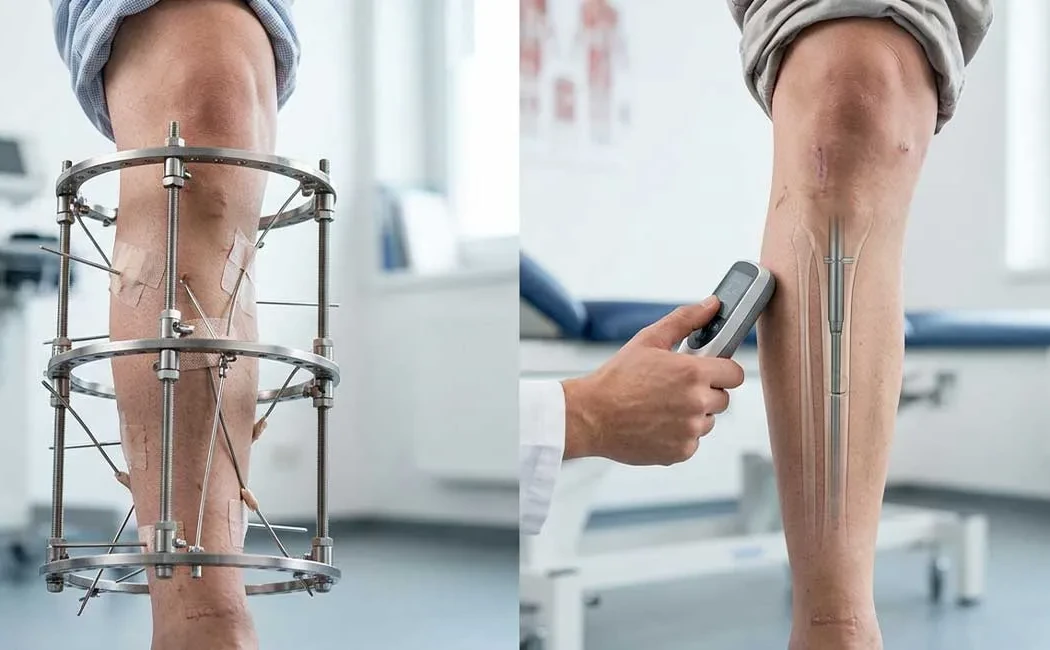
Limb lengthening surgery, applied to correct limb length discrepancies, treat dwarfism, or for cosmetic reasons, has evolved significantly with technological advances. Fundamentally based on "distraction osteogenesis," which involves controlled bone separation allowing new bone tissue formation in the gap, these surgeries use different techniques and devices. The critical step for patients and clinicians is selecting the most suitable lengthening method tailored to the patient's anatomy, expectations, and medical needs.
Currently, the two most commonly compared approaches are the traditional and well-established Ilizarov technique and the more modern Precice system featuring fully implantable devices. This article objectively examines the scientific basis, procedural details, advantages, and disadvantages of both techniques.
Overview of Limb Lengthening Surgery Methods
Limb lengthening surgery involves cutting the bone (osteotomy) surgically and gradually extending it approximately 1 mm per day using specialized devices. The body’s natural healing response activates to form new bone tissue in the created space. Methods are mainly classified based on whether the device is external (outside the body) or internal (implanted).
Technological advancements aim to improve patient comfort and reduce complications. Method choice depends on the amount of lengthening needed, bone deformities present, and the patient’s socioeconomic situation. For more detailed information, readers can visit our detailed guide on bone lengthening surgery.
What is the Ilizarov Method?
Developed by Soviet physician Gavriil Ilizarov, this method revolutionized limb lengthening and deformity correction. The Ilizarov technique uses an external fixation system comprising rings outside the limb connected by wires fixed into the bone. This setup stabilizes bone segments to allow controlled gradual lengthening and correction of angulations if necessary.
Ilizarov is particularly effective for complex bone curvatures, infected nonunions, and multi-planar deformities, demonstrating high success rates. Its biomechanical stability permits patients to bear weight and walk soon after surgery. For a detailed technical explanation, see our article on Ilizarov technique limb lengthening process.
Advantages and Disadvantages
Advantages of the Ilizarov method include its versatility for multi-directional correction and generally lower cost compared to internal methods. Immediate weight-bearing can stimulate bone healing.
However, drawbacks include reduced comfort due to external hardware, which can restrict daily activities. Pin sites where wires penetrate the skin carry a risk of infection. Scar formation after device removal is also possible.
What is the Precice Method?
Precice is a fully internal limb lengthening technique. It involves inserting a telescopic magnetic intramedullary rod inside the bone’s canal. No external hardware or wires are visible. Lengthening is achieved by remotely activating the internal mechanism with a magnetic external remote controller (ERC).
Advantages and Disadvantages
The key advantages of Precice include elimination of pin-site infections, maximized comfort with no external apparatus, minimal scarring, and less restriction on movement compared to external fixators.
Disadvantages involve higher costs and technical limitations. Precice lacks the multi-directional deformity correction capacity of Ilizarov. Patients typically cannot bear full weight on the limb until complete bone healing, necessitating the use of mobility aids such as wheelchairs or crutches during consolidation.
Comparing Ilizarov and Precice Methods
When comparing Ilizarov and Precice, the main differences lie in patient comfort and cost. Ilizarov is biomechanically robust but may impair social functioning, whereas Precice provides greater comfort but may not suit all deformity types or patients.
For instance, when planning upper limb lengthening and deformity correction or lower limb deformity correction and lengthening, the thickness of the medullary canal must be adequate for Precice nails. Narrow canals or active infections may preclude internal methods.
For a more detailed technical and clinical comparison, see our post on Comparing Precice and Ilizarov in limb lengthening surgery.
Additionally, radiological bone formation patterns differ between methods. The image below compares healing stage x-rays for each technique.
Recovery and Rehabilitation
Postoperative rehabilitation is as vital as surgical technique success. Recovery comprises two phases: lengthening and consolidation. Intensive physiotherapy is essential during lengthening to help soft tissues adapt to bone extension.
Maintaining joint range of motion is critical. Adherence to post-limb lengthening surgery exercise and rehabilitation programs prevents permanent disability. Physiotherapy may be challenging with Ilizarov due to external pins, whereas Precice patients usually tolerate exercises better aside from muscle spasms.
Risks and Possible Complications
As with all surgeries, limb lengthening carries risks, potentially varying by method. Ilizarov is commonly associated with pin-site infections, while Precice may rarely experience mechanical failure or rod breakage.
Common risks include:
- Infection: Both superficial (pin site) and deep bone infections (osteomyelitis).
- Nonunion (Pseudoarthrosis): Insufficient bone healing, potentially requiring further surgical intervention. Refer to nonunion surgery and treatment options for more.
- Nerve and Vascular Injury: Stretching nerves during lengthening can cause sensory loss or limited mobility.
- Joint Stiffness: Resulting from inadequate physiotherapy.
Detailed information about complications can be found at complications in limb lengthening surgery. Authorities like the American Academy of Orthopaedic Surgeons (AAOS) and Mayo Clinic recommend these surgeries only be performed at experienced centers.
Conclusion and Information Note
There is no single “best” limb lengthening technique; the choice depends on individual circumstances. Ilizarov remains important for complex and cost-effectiveness considerations, while Precice stands out for comfort and aesthetics. Decision-making must involve a qualified physician considering the patient’s anatomy, history, lifestyle, and expectations.
Remember, these surgeries require long-term commitment and patience. Successful outcomes depend not only on surgical skill but also on adherence to rehabilitation protocols.
The content on this website is provided for general informational purposes regarding limb lengthening surgery methods. It is not intended to replace professional medical advice, diagnosis, or treatment and should not be used as such. Individual anatomical and health conditions vary, and treatment plans must be personalized by an orthopedic and traumatology specialist. For any health-related questions, please consult a qualified healthcare professional and do not delay seeking necessary medical care.