
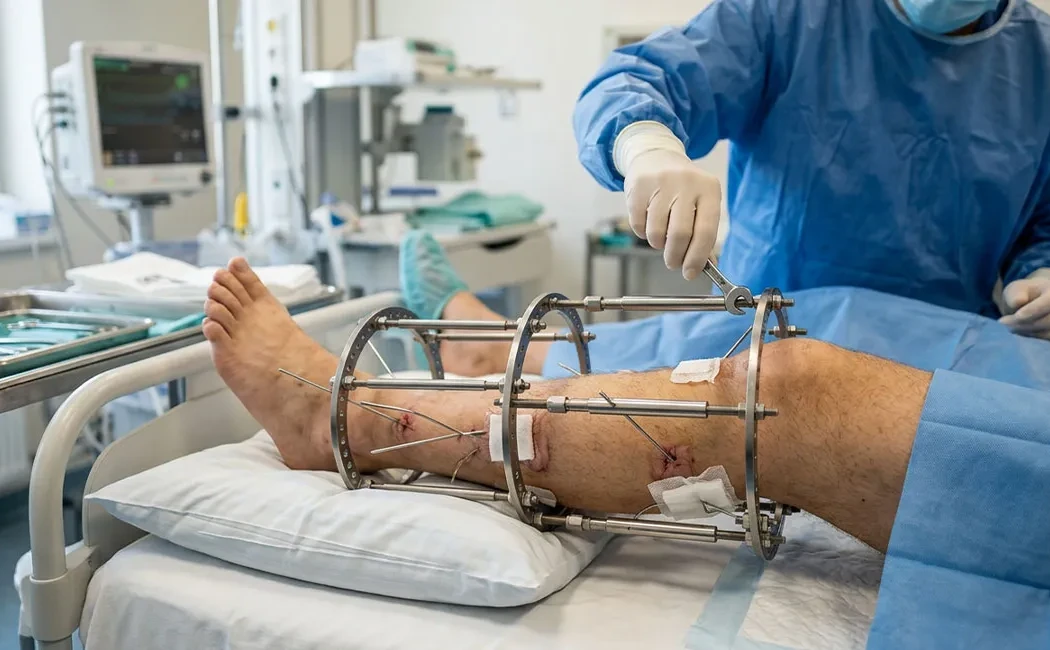
The Ilizarov method is a groundbreaking and complex surgical technique widely recognized in orthopedics and traumatology for bone lengthening, correction of deformities, and repair of bone defects. Developed by Gavriil Abramovich Ilizarov, this method is based on the principle of "distraction osteogenesis." This involves surgically cutting the bone and gradually separating the segments to stimulate new bone formation within the created gap. The Ilizarov method stands out for providing effective solutions in complex cases and when other methods fall short.
Occupying a key place among modern orthopedic limb lengthening techniques, it is applied not only for height increase but also frequently used to manage complications following trauma. The treatment process requires not only surgical precision but also long-term patient compliance and follow-up.
Overview of the Ilizarov Method
Ilizarov surgery leverages the biological capacity of tissues under tension to form new tissue, representing a minimally invasive procedure. This section covers the fundamental definition and operating mechanisms of the method.
What is the Ilizarov Method?
The Ilizarov method is a bone reconstruction treatment performed using circular external fixators. This system consists of rings attached to the bone with wires and pins, connected by telescopic rods. Unlike traditional plate or screw fixation, the Ilizarov system allows three-dimensional correction, enabling simultaneous lengthening, angular, or rotational deformity adjustments. It stimulates the body's own tissue regeneration by utilizing the bone's natural healing potential.
How Does It Work?
The fundamental working principle is based on the "law of tension stress." A low-energy surgical bone cut (corticotomy or osteotomy) is gradually distracted—usually about 1 mm per day—using the external fixator. This mechanical tension enhances blood flow and cell activity at the bone ends, triggering new bone (regenerate) formation. Not only bone but surrounding soft tissues, muscles, nerves, and blood vessels also adapt by lengthening accordingly.
Technical Application Process
The success of the Ilizarov method heavily depends on the accuracy of the surgery and the meticulous management of the treatment process. The technical application encompasses several stages from device mounting to the completion of lengthening.
Structure and Assembly of the Device
The Ilizarov apparatus consists of rings made from stainless steel or titanium, fine wires (K-wires) fixing the rings to the bone, and rods that adjust the space between the rings. Device assembly is tailored to the patient's anatomy and the specific deformity to be corrected.
Osteotomy and Lengthening Phases
The critical surgical step is the controlled bone cut performed without disrupting its blood supply (osteotomy). After surgery, there is a latency period of 5–7 days before lengthening begins. During the distraction phase, the patient or caregiver turns the nuts on the device four times daily to achieve a total of 1 mm bone lengthening per day. More information on the details of Ilizarov limb lengthening technique can be found for step-by-step understanding.
Daily Care and Monitoring
Pin site care to prevent infection is crucial during the treatment period. Patients must perform daily dressings and maintain device hygiene. Additionally, regular checks are needed to ensure that the wires and screws remain secure. The following checklist summarizes daily care steps for patients using the Ilizarov device.
Application Criteria and Indications
The Ilizarov method is not suitable for every patient or condition. Achieving successful outcomes requires appropriate indications and careful patient selection.
When is it Preferred?
This technique is used to treat a wide range of orthopedic conditions, including:
- Congenital or acquired limb length discrepancies (limb lengthening).
- Treatment of bone infections (osteomyelitis).
- Nonunion fractures (pseudoarthrosis). The Ilizarov method for nonunion treatment is a commonly applied solution.
- Correction of angular and complex deformities. The deformities corrected with Ilizarov technique vary in complexity.
- Management of bone defects.
Moreover, the relationship between nonunion surgery and the Ilizarov method plays a critical role in challenging cases. Lower limb deformity surgery using the Ilizarov method is a standard treatment approach for correcting leg bowing.
Patient Selection Criteria
The Ilizarov treatment is a long, demanding process requiring patience. Therefore, patient selection is as important as the surgical technique itself. The ideal candidate is psychologically prepared, a non-smoker (due to the negative effects of smoking on bone healing), capable of adhering to hygiene standards, and able to follow medical instructions precisely. When assessing Ilizarov patient selection criteria, the patient's social support system is also considered.
Risks, Complications, and Safety
As with any surgical intervention, the Ilizarov method carries potential risks. The most common issues include pin site infections, joint stiffness, nerve or vascular injuries, and pain. However, most complications can be managed with early intervention and proper care. Patients should be well informed about Ilizarov method complications beforehand, as this knowledge is essential for safety. Regular medical follow-ups allow early problem identification and prevent permanent damage.
Recovery Process and Rehabilitation
Completion of treatment is not limited to bone lengthening; it also encompasses bone consolidation and restoration of functional ability. After the lengthening phase, the device remains in place until the new bone fully hardens, typically two to three times the duration of the lengthening phase. Physical therapy exercises are crucial during this time to maintain joint mobility and enhance muscle strength.
The post-Ilizarov recovery process influences the patient’s return to daily activities. Furthermore, adherence to rehabilitation programs is essential for long-term results and preservation following Ilizarov limb lengthening.
The information provided herein is for general informational purposes only and does not constitute professional medical advice, diagnosis, or treatment. The Ilizarov method and other surgical procedures are serious medical interventions, and each patient's condition is unique. For any health concerns, diagnosis, or treatment processes, please consult a qualified healthcare professional. The information in this article does not establish a doctor-patient relationship and does not constitute a medical commitment. Treatment outcomes may vary based on individual factors. Do not delay seeking medical care based on the content provided.