
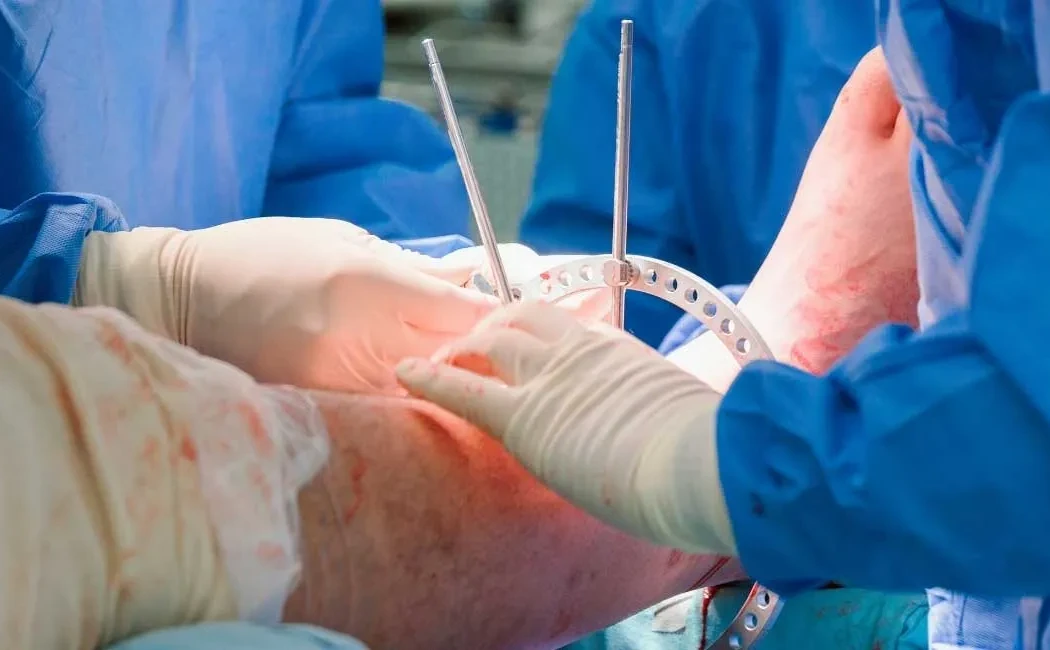
Limb lengthening surgeries have seen increased success in recent years thanks to advancements in orthopedic and traumatology techniques. Initially utilized primarily to address discrepancies in limb length, these methods have since evolved to also meet patients' cosmetic expectations. Today, the main techniques employed for limb lengthening include the Ilizarov method, the Precice system, and various external fixators or intramedullary nail techniques. This article will focus on the surgical principles, advantages, disadvantages, and clinical applications of these methods.
Fundamentals of Limb Lengthening Surgery
The key principle of limb lengthening surgery is to allow new bone tissue to form gradually and in a controlled manner by lengthening the bone. This process starts with an osteotomy, which is the surgical cutting of the bone, followed by the use of lengthening devices to gradually separate the bone ends, creating a gap where new bone tissue can develop. The new bone tissue naturally ossifies and strengthens during the healing process.
Ilizarov Method
Developed by Soviet orthopedic surgeon Gavriil Ilizarov, the Ilizarov method remains a classic external fixator technique employed worldwide. It involves the placement of wires and rings around the bone to stabilize the bone ends and mechanically separate them slowly and controllably. This method is especially preferred for correcting bone deformities, equalizing limb length discrepancies, and treating nonunion cases.
Advantages include the device's adjustability, flexibility for the surrounding soft tissues, and the surgeon's ability to monitor and control the lengthening process instantaneously. However, drawbacks include patient discomfort due to the external device, risk of infection, and the need for extended use.
Precice Magnetic Lengthening System
Precice is a modern and progressive limb lengthening technique. The system uses a surgically implanted magnetic-controlled intramedullary nail for lengthening. Lengthening is achieved comfortably and painlessly via an external magnetic control device. The ability to lengthen from inside the bone and adjust the device externally offers significant benefits to patients.
The Precice method is favored for minimizing infection risk, ease of use, a more aesthetically acceptable appearance, and faster recovery. However, it has limitations including high cost and suitability issues for some patients.
Other Limb Lengthening Techniques
Besides external fixators, other techniques include intramedullary lengthening nails, monolateral fixator systems, and hybrid methods. Monolateral fixators are simpler and easier to apply compared to Ilizarov but have some restrictions. Additionally, combined therapies and multidisciplinary approaches are employed to prevent complications such as nonunion or infection during limb lengthening.
Limb lengthening surgeries can also be combined with bone deformity correction procedures, enabling both length increase and correction of deformities. The surgeon's experience and the patient's overall health are critical factors in choosing the surgical approach.
Risks and Complications in Limb Lengthening Surgery
As with any surgical procedure, limb lengthening carries certain risks. These include infection, nerve or vascular injury, muscle stiffness, uncontrolled bone formation during lengthening, and insufficient lengthening. Patient care and hygiene are especially important with external fixator procedures like the Ilizarov method.
Recently developed magnetic systems have reduced complication rates but still require careful surgical and postoperative monitoring. Detailed patient education, adherence to rehabilitation programs, and regular follow-ups increase the likelihood of a successful outcome.
Who Is a Candidate for Limb Lengthening Surgery?
Limb lengthening surgeries are mainly performed on patients experiencing psychological or functional problems due to short stature. They are also indicated for individuals with limb length discrepancies to improve functional balance. Cosmetic applications are carefully evaluated and decided within ethical guidelines. Suitability in children, adolescents, and adults depends on bone maturity, overall health, and lengthening goals.
Comprehensive assessment, advanced imaging methods, and multidisciplinary teamwork are essential before surgery. Postoperative exercise, physical therapy, and patient monitoring are also critical for successful results.