
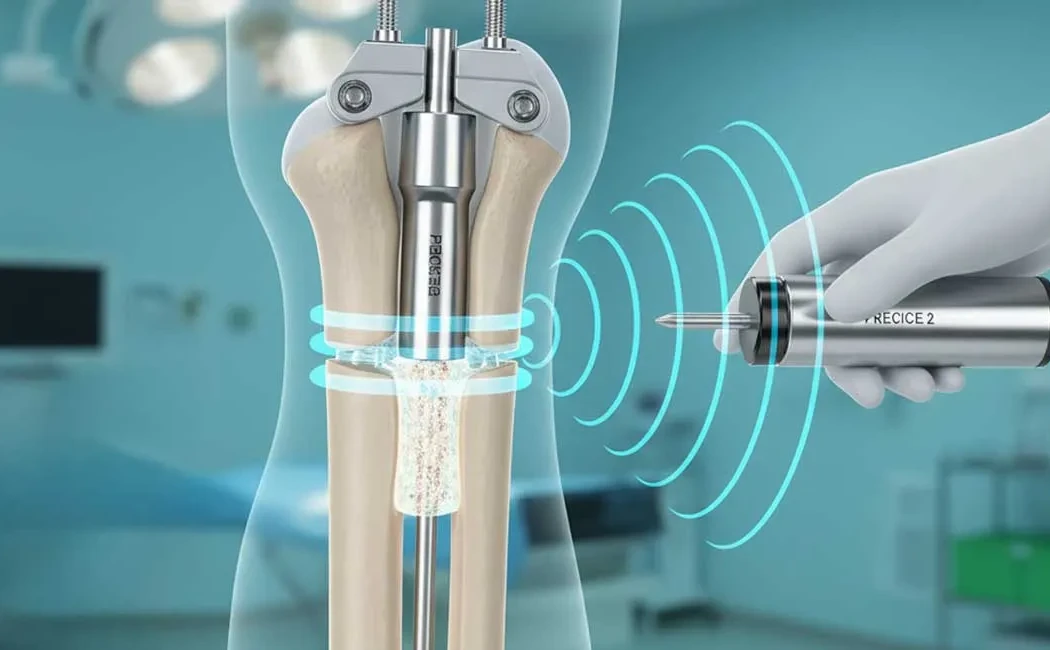
Recent technological advances in limb lengthening surgery have significantly improved patient comfort and treatment success. Among these innovations is the Precice 2 nailing technique, a minimally invasive method that enables lengthening through a magnetic system implanted inside the bone. Unlike traditional methods, it does not require any external hardware attached to the body, offering a modern solution from both aesthetic and functional perspectives.
This technology is particularly preferred in the treatment of limb length discrepancies, short stature, and various bone deformities. Magnetic nail technology reduces the risk of infection after surgery and aims to accelerate patients’ return to daily life. This article will explore the operating principles, advantages, and treatment process of the Precice 2 system in detail.
What is the Precice 2 Nailing Technique?
Precice 2 is a magnetically controlled intramedullary (inside the bone) nail system. Made from a titanium alloy, this device is implanted inside the bone and lengthened millimeter by millimeter via an externally applied magnetic field. This method offers an alternative to external fixators for patients seeking detailed information on bone lengthening surgery.
Magnetic Controlled Lengthening Mechanism
The key feature of the Precice 2 system is its operation via an “External Remote Controller” (ERC). The magnetic motor inside the nail is activated by applying the ERC device over the skin. This magnetic interaction rotates the gear mechanism inside the nail, resulting in telescopic lengthening. Patients can perform the daily lengthening themselves, following the physician’s approved schedule—typically about 1 mm per day. This modern method is among the latest technologies used in limb lengthening surgery.
Technical Specifications of Precice 2
The device is crafted from biocompatible titanium and comes in various sizes to accommodate different bone diameters and lengths. It is suitable for use in both femur (thigh) and tibia (shin) bones. The gear mechanism is designed with a non-backdrivable feature, preventing reversal and maintaining the achieved length while securely bearing mechanical load. Since the nail's load capacity is limited, patients are advised against full weight-bearing until the bone has fully consolidated.
Comparison with Traditional Methods
Bone lengthening techniques have evolved with advances in technology. The Precice 2 method offers significant improvements in patient comfort over older methods. Similar technological comparisons apply in complex procedures such as upper limb lengthening and deformity correction.
Differences from Ilizarov and External Fixator Systems
Ilizarov and other external fixator systems involve metal rings fixed around the limb, attached via wires or pins passing through the skin and bone. This arrangement often leaves permanent skin scars, requires frequent wound care, and has a higher infection risk. In contrast, the Precice 2 system is entirely internal, with no external metal hardware visible. This reduces aesthetic concerns and increases patient mobility. For an in-depth analysis, refer to the Precice versus Ilizarov lengthening comparison.
Patient Comfort and Recovery Process
The magnetic nail does not penetrate soft tissues with wires, avoiding muscle and skin irritation. This results in less pain during lengthening and easier preservation of joint range of motion. Minimizing infection risk—especially deep pin-site infections common with external fixators—helps the healing process proceed more smoothly.
Who is Suitable for the Precice 2 Procedure?
As with all surgeries, Precice 2 is suitable only for selected patient groups after detailed clinical and radiological evaluation.
Medical and Cosmetic Indications
This method is applied for congenital short stature, developmental deformities, or limb length discrepancies due to trauma or bone loss. Reviewing lower limb deformity surgery clarifies its reconstructive role. Additionally, it can be used cosmetically in healthy individuals affected psychosocially by short stature. In adolescents with closed growth plates, as described in pediatric lower limb deformity and surgical approaches, the method is also a viable option.
How is Suitability Assessed?
Critical factors include bone structure, medullary canal diameter sufficient to accommodate the nail, and absence of active infection. Surgical planning involves radiographs and computed tomography imaging.
Surgical Procedure and Lengthening Phases
The treatment process consists of four main stages: preparation, surgery, lengthening, and consolidation (bone healing).
Surgical Stage
Performed under general or spinal anesthesia, small incisions provide access to the bone canal, where a controlled bone cut (osteotomy) is made. The Precice 2 nail is then inserted into the marrow canal and fixed with locking screws. The surgery typically lasts 2-3 hours, with a hospital stay of 2-3 days.
Lengthening Phase
About 5-7 days post-surgery, the latent period ends, and lengthening commences. The patient uses the ERC device at home 3-4 times daily, applying it to the limb to achieve a total daily lengthening of approximately 1 mm.
Healing and Rehabilitation
Once the targeted length is reached, lengthening stops, and bone consolidation begins. Physical therapy is vital during this phase to maintain muscle flexibility and prevent joint stiffness. Refer to post-limb lengthening care and recommendations for guidelines that directly affect rehabilitation outcomes. Pain management following surgery should follow the physician’s advice, as detailed in post-lengthening surgery pain control.
Possible Risks and Complications
While Precice 2 is a safe and modern method, like all surgeries it carries potential risks. Managing these risks requires an experienced surgical team and patient compliance.
Infection, Nerve Injury, and Nonunion
Compared to external fixators, infection rates are considerably lower, though deep infections may rarely occur. Rapid lengthening can cause nerve stretching and temporary sensory impairments. Insufficient bone formation may lead to delayed healing or nonunion. In such cases, nonunion surgery and treatment options may be necessary.
Long-Term Monitoring and Intervention
Axis deviations or joint stiffness must be monitored carefully during the lengthening process. Mechanical failures or nail breakage, though rare, can occur. If bone healing is incomplete or malunion develops, corrective surgery as outlined in malunion surgery and treatment may be warranted.
Medical Disclaimer
The information provided here is for general knowledge and does not substitute personalized medical advice. The suitability and surgical plan for Precice 2 or other methods vary according to each patient’s anatomy and health status. For definitive diagnosis and treatment, consultation with a qualified orthopedic surgeon is essential.
The information provided is for general informational purposes only and does not constitute medical advice. It is not intended to replace professional diagnosis, treatment, or consultation. Diagnosis and treatment should be determined solely through an in-person examination by a qualified healthcare professional. Since each patient's condition is unique, surgical or non-surgical treatments may vary accordingly. The content is prepared based on current scientific evidence and up-to-date medical practices. Do not delay seeking professional medical care based on the information provided.