
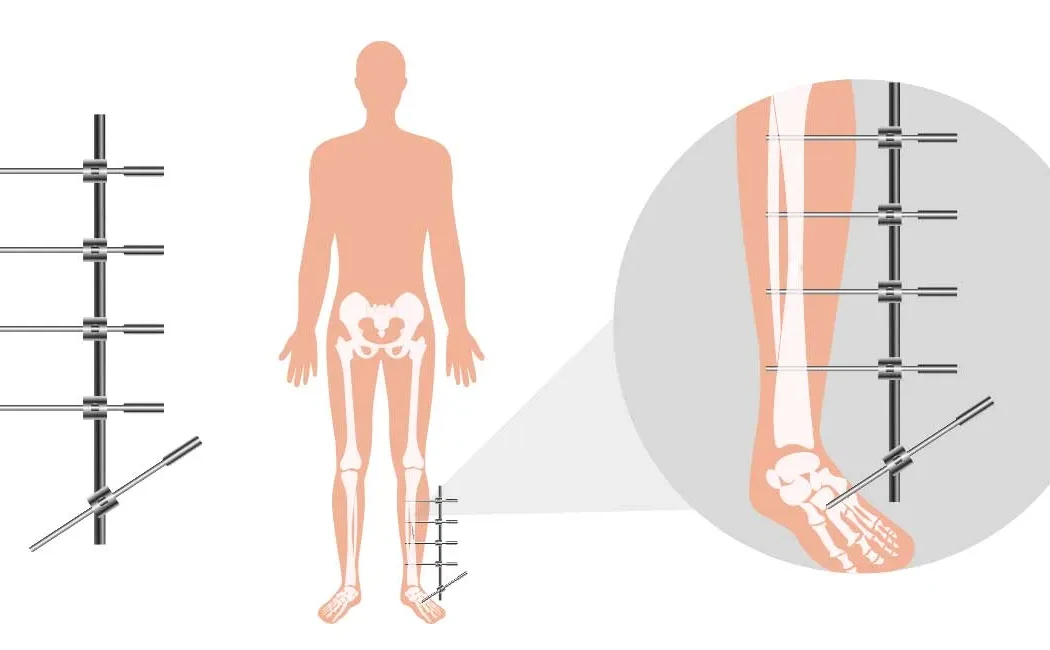
The Ilizarov technique is an advanced orthopedic method particularly used for treating extremity length discrepancies, bone deformities, non-unions, and infected bone problems. Named after Russian surgeon Gavriil Ilizarov, the fundamental principle involves creating a controlled osteotomy (bone cut) followed by slow, controlled mechanical tension on the bone, allowing new bone tissue to form without damaging the surrounding soft tissue. This technique is successfully applied in limb lengthening surgeries, although it requires careful planning and continuous monitoring.
In limb lengthening surgeries, the Ilizarov apparatus comprises rings attached externally around the bone and interconnected by rods forming a frame. After the osteotomy, this framework is used to gradually separate the bone segments in the desired direction, promoting the formation of new bone tissue in the gap. The lengthening is achieved through small daily adjustments.
The limb lengthening process generally consists of four main stages: preoperative evaluation, surgical operation, lengthening phase, and rehabilitation. During the preoperative period, the patient’s overall health status, desired length increase, bone structure, and condition of surrounding tissues are thoroughly assessed. Psychological support may also be necessary because the lengthening process is long and demanding.
During the surgical operation, the orthopedic surgeon performs a controlled osteotomy on the bone and applies the Ilizarov device. This procedure is typically done under local or general anesthesia. After surgery, the patient is educated about the lengthening plan and how to perform daily adjustments. During the lengthening phase, bone segments are gradually distracted at approximately 1 mm per day. New bone tissue, known as the "regenerate," forms in the gap. Both bone and soft tissues adapt to this controlled tension.
The duration of lengthening varies depending on the targeted increase but usually lasts a few months. Regular follow-up radiographs track bone healing. The device remains in place until bone healing and union are complete. Rehabilitation begins once the lengthening is finished, including physical therapy to restore joint mobility, improve muscle strength, and facilitate return to daily activities.
The Ilizarov technique does carry risks such as infection, nerve injury, delayed bone healing, or failure. However, with careful patient selection and meticulous monitoring by experienced orthopedic surgeons, these complications are minimized.
In summary, the Ilizarov technique remains an indispensable method in modern orthopedics for effective limb lengthening surgery. Patients’ understanding of the procedure, compliance throughout the process, and regular check-ups with their physician greatly enhance the success of the operation.