
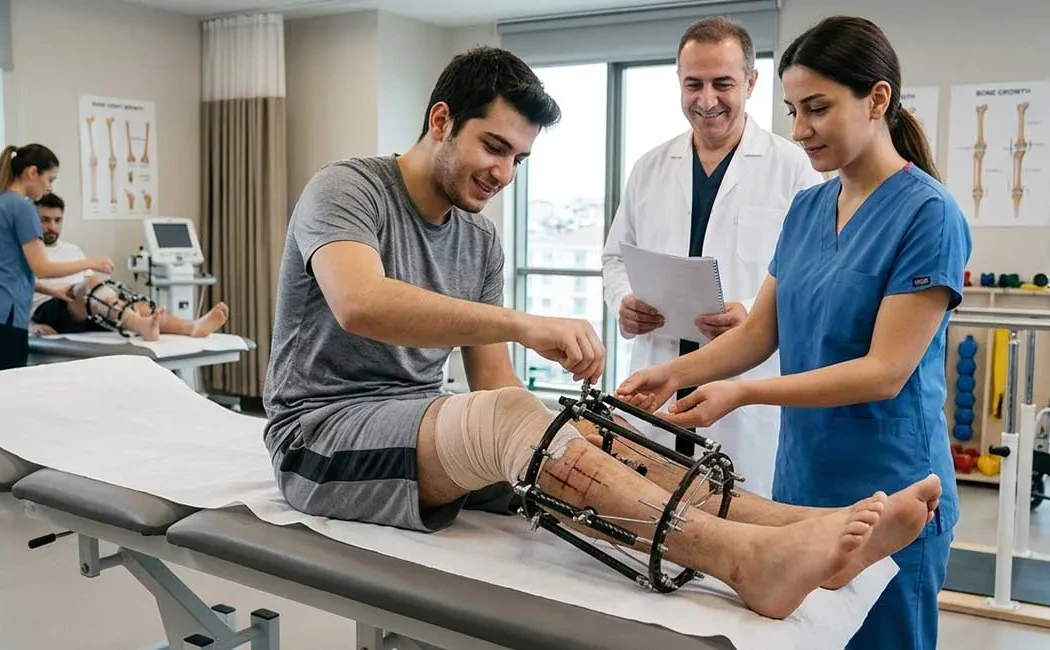
Limb lengthening surgery is a complex procedure within orthopedics and traumatology that serves both reconstructive and aesthetic purposes. It relies heavily on the body’s natural healing mechanisms to extend bone tissue and the surrounding soft tissues (muscles, nerves, blood vessels). This surgical method plays a crucial role especially in treating leg length discrepancies, skeletal dysplasias such as achondroplasia, and bone loss following trauma.
The process is based on a biological principle known as “distraction osteogenesis.” This involves surgically cutting the bone and slowly separating the two bone ends, which stimulates new bone formation in the gap. Limb lengthening surgery is not only about extending the bone but also about a comprehensive treatment that restores the functional capacity of the limb.
What Is Limb Lengthening Surgery?
Limb lengthening surgery involves surgically cutting bone segments and gradually separating them using specialized devices. The body responds by forming new bone tissue called “callus” in the created gap, which eventually hardens into normal bone structure. This method is used to lengthen limbs such as legs, arms, and fingers.
The biological process driving bone growth is complex and depends on the body’s regenerative capacity.
The methods and technologies used in this process vary depending on the patient’s age, bone quality, and the desired lengthening amount. Current medical approaches focus on techniques that maximize patient comfort and minimize the risk of complications.
Who Is a Candidate?
Limb lengthening surgery is typically considered due to medical necessity or significant functional impairment. Indications include congenital bone disorders, growth plate injuries, sequelae of polio, and bone shortening after infection. Traumatic bone losses and malunions are also common candidates for this surgery.
Unilateral limb length discrepancies can negatively affect spine and hip health, leading to gait abnormalities. For more information on treatments for such conditions, you can visit our lower limb deformity surgery and lengthening page. Aesthetic height increase requests are evaluated after thorough psychological and physical assessments and must meet specific criteria.
How Does the Surgical Process Work?
The limb lengthening procedure begins with detailed preoperative analysis and continues until complete bone healing, representing a lengthy journey. Patient compliance and physician follow-up are critical for success. For an overview of the treatment process and financial aspects, you can refer to our article on height increase surgery costs and key factors.
Additionally, understanding detailed information about bone lengthening surgery is important to grasp what the process entails for patients.
Planning and Preparation Stage
Before surgery, a comprehensive radiological and clinical assessment is performed. Orthoradiograms (full-length leg X-rays) measure limb lengths, mechanical axes, and deformity angles with precision. Factors affecting healing potential such as overall health, bone density, and smoking habits are carefully evaluated. Aligning patient expectations with medical realities is essential during this phase.
Surgical Techniques
As technology advances, various techniques are available for lengthening surgery. Options range from traditional Ilizarov external fixators to fully implantable magnetic nails.
1. External Fixators (Ilizarov, Holyfix): Circular or rail-type frames attached externally. The Ilizarov method for leg lengthening is commonly used to correct complex deformities.
2. Combined Method (LON - Lengthening Over Nail): Utilizes both nails and external fixators, allowing early removal of external devices.
3. Motorized Intramedullary Nails (Precice, Stryde): Fully internal nails controlled externally for gradual lengthening.
Similar techniques are applicable for arm and forearm shortening. For further details, please visit our upper limb lengthening and deformity correction page.
Lengthening and Consolidation Phases
Lengthening usually starts 5-7 days after surgery, following the latent period. The bone is typically lengthened at a rate of 1 mm per day (divided into four increments of 0.25 mm). Once the target length is reached, lengthening stops and the consolidation phase begins, where the new bone hardens.
Risks and Complications
Like all surgeries, limb lengthening carries certain risks. Infection—especially at pin sites of external fixators—is common. Muscle tightness leading to joint stiffness and nerve compression may also occur. For more detailed information about potential complications, visit our page on common complications in limb lengthening surgery.
In cases of insufficient bone healing, a “nonunion” can develop. Treatment options for nonunion including surgery can be found at nonunion surgery and treatments.
Rehabilitation and Recovery
Successful surgery is only half the process; effective rehabilitation is equally vital. Physical therapy plays a critical role during lengthening to maintain muscle elasticity and joint mobility. Patients should adhere strictly to daily exercise regimens. For advice on postoperative care, please see our page on post-limb lengthening surgery precautions.
Scientific References and Medical Disclaimer
The information provided is based on current scientific studies from the World Health Organization (WHO), the American Academy of Orthopaedic Surgeons (AAOS), and PubMed. Medical procedures and outcomes may vary between individuals.
This content is intended for general informational purposes only and does not substitute for professional medical advice, diagnosis, or treatment. Always consult your physician or a qualified healthcare provider regarding any health-related questions. Do not delay or discontinue medical treatment based on the information provided here. The outcomes of medical procedures may vary depending on individual circumstances, and no treatment can guarantee definitive success.