
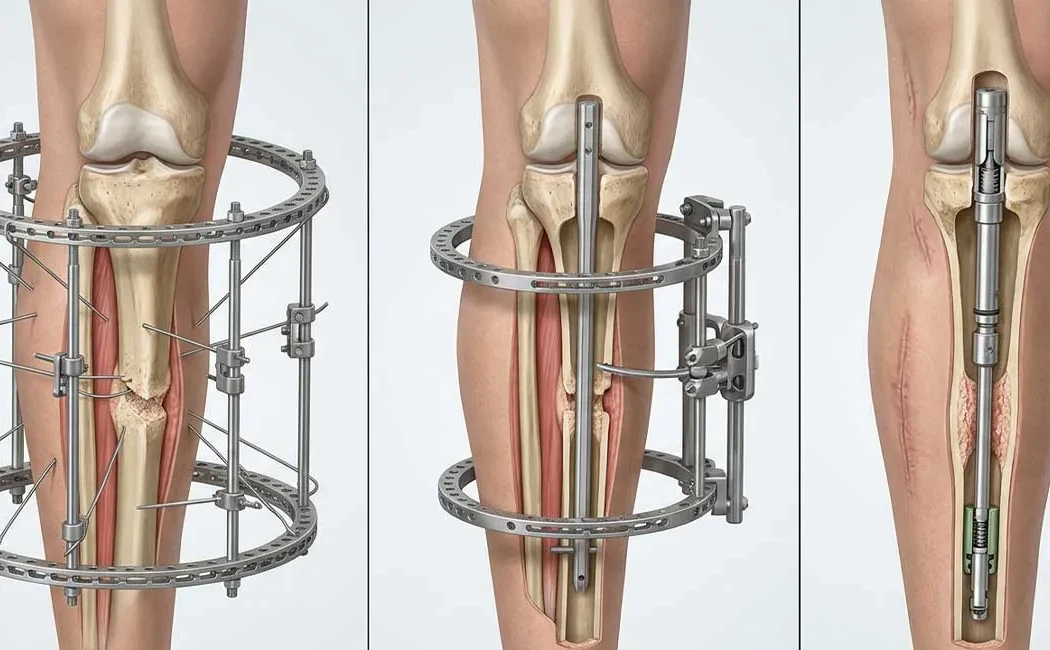
Limb lengthening surgery is an advanced orthopedic procedure performed for congenital short stature, deformities following trauma, or aesthetic concerns. With advances in medical technology, various surgical techniques are now available. When comparing limb lengthening methods, each technique has unique advantages, disadvantages, and risk profiles. Selecting the most appropriate method requires thorough clinical evaluation and radiological examination.
The primary techniques include the classic Ilizarov method, combined approaches, and fully intramedullary systems such as the Precice magnetic nail. Choice depends on the desired lengthening amount, bone quality, and the presence of any associated deformities.
Overview of Limb Lengthening Surgery
Limb lengthening primarily involves controlled bone cutting (osteotomy) followed by gradual mechanical distraction of the bone ends. New bone tissue (callus) forms in the gap during this process, a biological mechanism called “distraction osteogenesis.” For more detailed information, visit our limb lengthening surgery details page.
Surgical planning is not limited to lower limbs; upper limb lengthening can also be performed. Specifically, upper limb lengthening techniques follow similar biological principles but vary anatomically and technically. Patient compliance and rehabilitation are as critical as the surgical method to achieve successful outcomes.
Ilizarov Method
Developed in the 1950s by Gavriil Ilizarov, this method revolutionized orthopedics. It uses an external fixation system composed of rings and wires around the bone. It remains the gold standard for correcting complex deformities and cases with high infection risk.
Procedure
The Ilizarov system attaches a circular metal frame to the bone via thin wires and pins. After a latency period post-surgery, the patient or caregiver gradually adjusts screws on the frame daily to initiate lengthening. This process and its nuances are described in detail on our Ilizarov limb lengthening process page.
Advantages and Disadvantages
The Ilizarov method’s strength lies in its versatility. Besides lengthening, it corrects angular and rotational deformities simultaneously. Early weight-bearing is usually permitted, promoting bone growth.
However, external fixators can reduce patient comfort, complicate dressing changes, and cause sleep disturbances. Pin site infections require regular care, and long fixator duration may lead to joint stiffness.
Risks and Complications
Pin site infections are the most frequent complication and are often manageable with oral antibiotics and local care. Untreated infections can progress to osteomyelitis. Wire tension can limit joint mobility, and although rare, nerve or vascular injuries are serious risks.
Combined Method
The combined (LON - Lengthening Over Nail) technique integrates an intramedullary nail with the Ilizarov external fixator. It aims to reduce external fixation time, improving patient comfort.
Procedure
During surgery, an intramedullary nail is implanted inside the bone, and an external fixator is applied. Lengthening proceeds externally until the desired length is reached, after which the nail is locked, and the external frame is removed. The patient then completes bone healing without external devices.
Advantages and Disadvantages
A major benefit of the combined method is significantly shorter external fixator duration, accelerating return to daily activities. The internal nail provides structural support, reducing fracture risk during recovery.
However, risks from both systems exist: deep infections around the nail and pin site complications from the fixator. The procedure is technically demanding and requires experienced surgical teams.
Risks and Complications
Deep infection is a primary concern, potentially necessitating implant removal if it develops. Technical challenges during nail locking and rare embolic events can also occur.
Precice Magnetic Nail Method
The Precice method involves a fully internal magnetic telescoping nail with no external apparatus. Lengthening is driven by an external remote controller (ERC) that activates the nail’s internal mechanism.
Procedure
A special magnetic telescopic nail is inserted into the medullary canal via surgery. After several days, patients use the external remote controller to non-invasively lengthen the bone at prescribed intervals. The process is painless and can be performed at home.
Advantages and Disadvantages
The greatest advantage is enhanced patient comfort—no external wires, frames, or open wounds reduce infection risks and visible scarring. Joint motion is easier to maintain.
Downsides include higher costs compared to other methods. Patients often have restricted full weight-bearing during lengthening, requiring crutches or wheelchairs.
Risks and Complications
Mechanical failure of the nail, such as incomplete lengthening or device malfunction, may necessitate revision surgery. Implant failure or breakage is possible, especially with premature weight-bearing. Magnetic field interaction restricts MRI scans during treatment.
Comparative Analysis of Techniques
Choosing the appropriate method requires comparing technical features side-by-side. Our Precice vs. Ilizarov limb lengthening comparison explores comfort and cost considerations in detail.
Recovery and Rehabilitation
Postoperative recovery is as important as surgical success. The recovery timeline includes a lengthening phase followed by consolidation (bone hardening). For expected recovery durations, see our limb lengthening postoperative recovery time page.
Physical therapy is essential for adapting muscles and tendons to the lengthened bone. Pain management and joint mobilization exercises, available on our post-lengthening pain control page, play key roles.
Potential Risks and Complications
As with all surgeries, limb lengthening carries risks such as infection, nerve or vascular injury, joint stiffness, and non-union of bone segments. Non-union may require additional corrective surgery following non-union surgery protocols.
Malalignment post-lengthening requires correction using principles of lower limb deformity surgery. Minimizing risks depends on collaboration with an experienced surgeon and strict adherence to postoperative guidelines.
This content is provided for general informational purposes only and does not constitute medical advice. The information presented is not intended to replace professional medical diagnosis, treatment, or guidance. For any health concerns or treatment decisions, please consult a qualified healthcare professional. Since each patient's clinical situation may vary, treatment methods and outcomes should be evaluated on an individual basis.