
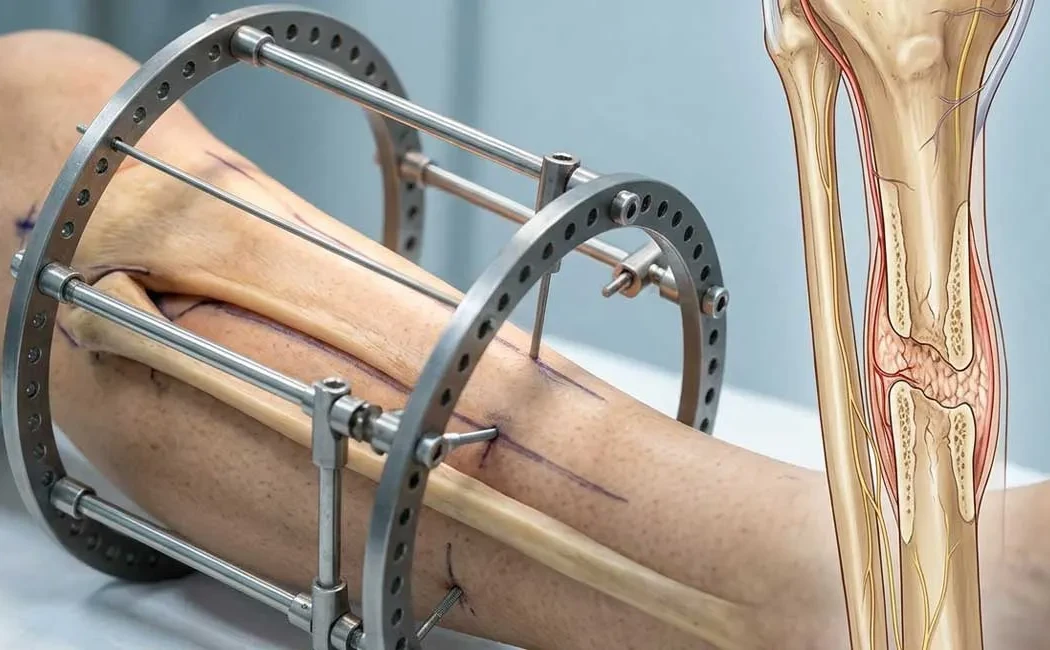
Bone lengthening surgery is a complex orthopedic procedure used to treat congenital anomalies, post-traumatic deformities, bone loss, or short stature. This surgical method relies on the controlled cutting of the bone and gradual separation using specialized devices. New bone tissue forms in the created gap, allowing correction of limb length discrepancies or reconstruction of extremities.
This biological process, known in academic literature as distraction osteogenesis, results from the combination of surgical expertise and the patient's biological healing capacity. The treatment requires long-term planning, disciplined follow-up, and a multidisciplinary approach. This guide covers the biological foundations of the surgery, suitable patient profiles, and treatment stages from a scientific perspective.
Introduction to Bone Lengthening Surgery
Bone lengthening and deformity correction surgery is a specialized branch of orthopedics and traumatology that has significantly advanced in the last century. Its main objectives are to improve functional capacity, correct biomechanical alignment, and enhance the patient's quality of life.
What Is Bone Lengthening?
Bone lengthening is a surgical procedure that harnesses the ability of living bone tissue to produce new bone under mechanical tension. It not only increases the length of the bone but also ensures surrounding muscles, nerves, blood vessels, and skin adapt and lengthen simultaneously. Bone lengthening surgery procedure is generally applied to the leg bones (tibia and femur) and the arm bone (humerus), and can also be used to treat shortening in the fingers and toes.
Mechanism of Distraction Osteogenesis
The biological basis of this technique is the "Tension-Stress Principle" described by Russian orthopedist Gavriil Ilizarov. After a surgically created bone cut (osteotomy), a latency period is observed before gradually lengthening the bone at a rate of about 1 mm per day. This mechanical tension stimulates osteoblasts—bone-forming cells—triggering new bone tissue (regenerate) formation between the two bone ends.
Biological Foundations of Bone Lengthening Surgery
The success of bone lengthening depends on mechanical stability and the preservation of the biological environment. Even with flawless surgical technique, without support for the biological healing process, desired outcomes may be difficult to achieve.
Osteogenesis Process
Bone formation occurs in three phases during the lengthening process:
1. Latency Phase: A waiting period of generally 5–7 days post-surgery during which repair cells migrate to the area.
2. Distraction Phase: The bone is gradually lengthened, and the gap is filled with soft, fibrous tissue.
3. Consolidation Phase: After lengthening is complete, the newly formed tissue calcifies and hardens to become load-bearing bone.
Soft Tissue Adaptation
As the bone lengthens, surrounding soft tissues—muscles, fascia, nerves, blood vessels, and skin—must also adapt. This process, called "histogenesis," involves muscle fibers elongating with new sarcomeres added. Nerve tissue is especially sensitive to tension. Careful monitoring of neural structures is crucial, particularly in upper limb lengthening and deformity correction surgery, to avoid functional loss.
Who Is Suitable? Patient Selection Criteria
Not every patient is a good candidate for bone lengthening surgery. Correct patient selection is as important as the surgical technique for successful treatment.
Medical and Surgical Indications
Bone lengthening surgery is mainly indicated for:
- Congenital Anomalies: Such as fibular hemimelia or proximal femoral focal deficiency. Early intervention may be necessary within the scope of deformity treatment in children.
- Post-Traumatic Conditions: Shortening due to malunion or nonunion of fractures.
- Post-Infection Bone Defects: Resulting from osteomyelitis treatment.
- Cosmetic Short Stature: Requests for height increase in constitutional short stature or achondroplasia.
- Lower Limb Deformities: Combined deformities with limb shortening for which lower limb deformity surgery is applicable.
Evaluation Process for Suitability
Physiological and psychological status must be thoroughly assessed. Bone quality, presence of metabolic diseases, smoking habits, and treatment compliance are critical factors.
Bone Lengthening Surgery Process
The treatment journey extends from preoperative preparation to device removal over a prolonged period.
Surgical Planning and Preparation
Detailed radiological examinations (orthoradiograms, CT, MRI) are performed preoperatively to assess the deformity and calculate the required lengthening. Patients are informed about the difficulties, device care, and importance of rehabilitation.
Techniques and Devices Used
Currently, three main methods are used in bone lengthening surgery:
1. External Fixators (Ilizarov, Holyfix): Circular or monolateral frame systems applied externally.
2. Intramedullary Nails (Motorized Nails): Internal devices inserted into the bone and lengthened remotely via magnetic control without any external hardware. Advances in bone lengthening technologies have improved patient comfort with these systems.
3. Combined Techniques (LON - Lengthening Over Nail): Use of both an external fixator and an internal nail to reduce the external device wear time.
For understanding the pros and cons of these techniques, it is helpful to consult the comparison of Ilizarov and Precice methods.
Lengthening and Consolidation Phases
During the lengthening phase, the patient or caregiver adjusts the device four times a day (totaling 1 mm per day) as instructed. Once the target length is reached, lengthening stops, and the consolidation phase begins. During this period, the new bone hardens. Cosmetic height increase results depend heavily on the success of this consolidation phase.
Risks, Complications, and Recovery
As with any surgery, bone lengthening carries potential risks. However, when performed by experienced surgeons with appropriate follow-up, these risks are manageable.
Surgical Risks and Complications
Common complications include pin site infections, joint stiffness, nerve compression, and premature or delayed bone healing. Smoking significantly increases the risks of infection and nonunion and is therefore strongly discouraged throughout the treatment.
Rehabilitation and Return to Daily Life
Physical therapy is integral to the process, starting as early as the day after surgery to maintain joint range of motion and muscle strength. Awareness of post-lengthening surgery precautions speeds up the return to normal activities. Full weight-bearing and return to sports occur only after radiographic confirmation of complete bone healing and with physician approval.
The information provided here is for general informational purposes only and does not constitute professional medical advice, diagnosis, or treatment. Limb lengthening surgery and other orthopedic treatments should be tailored individually. For any health-related questions and treatment options, please consult a qualified healthcare professional. The content on this site does not establish a doctor-patient relationship and should not be used as a substitute for a medical examination. Do not delay seeking necessary medical care based on this information.