
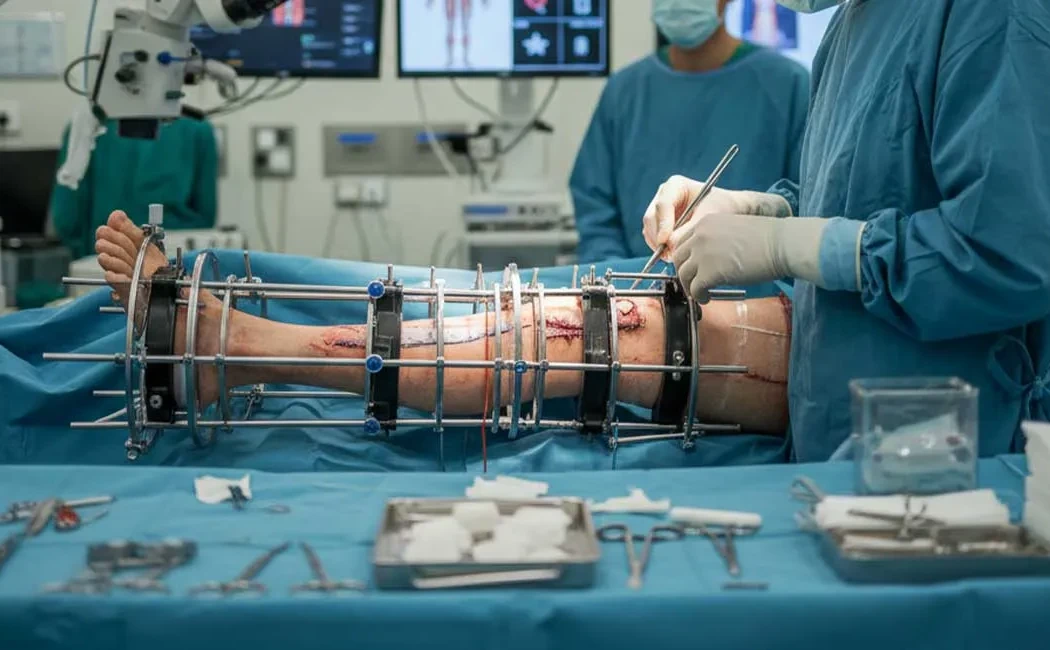
Limb reconstruction is an advanced surgical discipline within orthopedics and traumatology focused on resolving complex issues involving bones, joints, and soft tissues. This field addresses congenital anomalies, post-traumatic deformities, bone infections, and bone loss following tumor surgery. The primary goal is to restore not only the anatomical integrity of the limb but also its functional capacity.
This process encompasses far more than a simple bone correction procedure. It requires coordinated healing of nerves, blood vessels, muscles, and tendons alongside the bone. Experiences gained at international centers such as the Paley Institute have contributed to developing strategic approaches that improve success rates in limb-sparing surgery.
What Is Limb Reconstruction?
Limb reconstruction refers to the full spectrum of surgical procedures aimed at correcting shape deformities, length discrepancies, and biological complications such as nonunion in the arms and legs. These methods aim to improve patients’ quality of life and restore physiological biomechanics. Surgical planning is carefully tailored according to the severity of the deformity, patient age, and bone quality.
When Is It Performed?
This surgical discipline offers solutions for a broad range of orthopedic problems. Patients commonly seek care due to pain, restricted mobility, or cosmetic concerns.
Post-Traumatic Deformities
Severe injuries or improperly healed fractures (malunions) can lead to angulation and shortening of limbs. These post-traumatic deformities disrupt joint mechanics and may lead to early osteoarthritis. In such cases, bone realignment surgery is performed to restore the limb’s axis.
Congenital (Birth) Deformities
Conditions detected in childhood such as fibular hemimelia, tibial hemimelia, or congenital femoral deficiency can cause significant limb shortening and functional impairment. Detailed treatment options are available on our pediatric lower limb deformities page. Less common pediatric deformities require specialized surgical approaches, detailed on our rare childhood deformity surgeries page.
Early diagnosis and appropriate surgical timing are critical in managing congenital anomalies. Families often require comprehensive evaluation regarding congenital deformity surgeries in children.
Post-Tumor Resection
Bone tumor removal (resection) can leave large bone defects. Biological reconstruction methods or specialized tumor prostheses are used to fill these gaps and preserve the limb. The goal is to avoid amputation and maintain functional use of the extremity.
Surgical Techniques Used
Techniques in limb reconstruction have diversified with technological advances. Both classic and modern methods may be combined according to patient needs under the umbrella of lower limb deformity surgery services.
Ilizarov Method
The Ilizarov technique is based on controlled bone cutting (osteotomy) followed by gradual lengthening of about 1 mm per day. This activates a process called "distraction osteogenesis," where new bone forms as the segments are slowly separated.
This method is especially favored for cases with high infection risk or soft tissue complications. It is also considered a gold standard for the biological treatment of nonunion fractures.
Internal Lengthening Systems
Nowadays, bone lengthening can be performed with magnetic nails (motorized intramedullary rods) implanted within the bone, avoiding external devices. This increases patient comfort and reduces infection risks. However, not all patients are suitable candidates for these systems.
Bone Grafting and Segmental Reconstruction
In cases of major bone losses or when malunion surgery is required, reconstruction uses bone grafts from the patient (autograft) or bone banks (allograft). Recent advances in robotic-assisted deformity surgery have enhanced the precision of these reconstructions.
Limb Lengthening and Leg Length Inequality Treatment
Leg length discrepancy is a mechanical problem that may cause gait abnormalities and spinal issues. Treatment depends on the extent of the difference. Differences under 2 cm are often manageable with insoles, while larger discrepancies may require surgical correction.
Surgical options include lengthening the shorter limb or shortening the longer limb through techniques such as epiphysiodesis or osteotomy. Further information is available on the bone lengthening surgery page.
Postoperative Process and Physical Therapy
Surgical success is complemented by a rigorous postoperative rehabilitation program. Muscles and tendons must adapt to the new limb length or alignment, making intensive physical therapy vital to prevent joint stiffness.
Patient adherence to post-limb lengthening care guidelines significantly reduces complication risks. Infection control, pin site care, and adherence to weight-bearing restrictions directly affect recovery speed.
Paley Institute Approach and Areas of Expertise
Prof. Dr. Halil İbrahim Balcı integrates experiences from the Paley Institute in the United States into his clinical practice. This approach is grounded in a "biological and limb-sparing" surgical philosophy. The focus is on salvaging limbs whenever possible rather than amputation, even in challenging cases.
Transparency regarding potential risks and their management throughout treatment is essential. Challenges encountered in limb reconstruction surgery and corresponding solutions are thoroughly discussed with patients. A multidisciplinary perspective is adopted to formulate the most appropriate and sustainable treatment plan for each individual.
In summary, limb reconstruction is a specialized, long-term treatment process. With careful planning and an experienced team, patients can regain functional capacity and return to active lifestyles.
All information provided is for general informational purposes and does not constitute medical advice. This content does not replace individual diagnosis, treatment, or consultation by a healthcare professional. Diagnosis and treatment plans should be developed following in-person clinical evaluation. Each patient’s clinical condition is unique, and surgical or nonsurgical treatments may vary accordingly. The information presented is based on current scientific literature and up-to-date medical practices.