
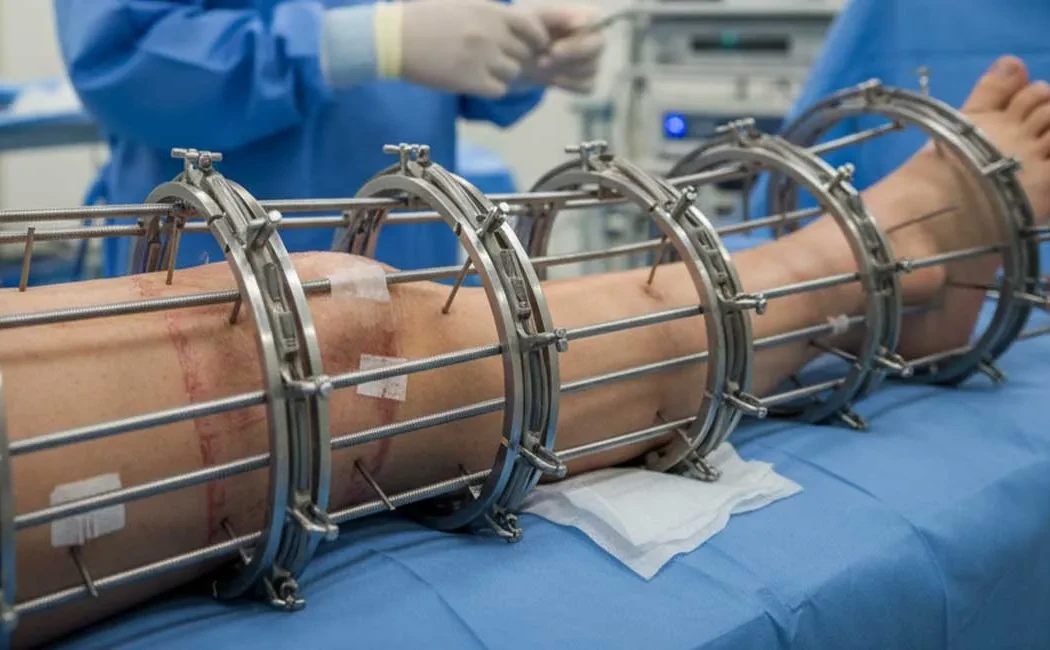
The question "What is Ilizarov surgery?" often arises among patients with complex orthopedic issues and individuals exploring options for limb lengthening. The Ilizarov method involves controlled cutting of the bone and gradually pulling the bone segments apart by about 1 mm per day using an external fixator. This process activates the body's natural healing mechanisms, encouraging new bone tissue to form in the gap.
Developed by Gavriil Ilizarov, this revolutionary technique is widely used today to treat deformities, limb length discrepancies, bone infections, and complications resulting from trauma. Because it relies on biological principles, it maximizes the body’s natural healing potential.
Core Principles of the Ilizarov Technique
The Ilizarov method is based on a biological principle called "distraction osteogenesis." This principle describes how living bone tissue, when gradually stretched, generates new bone and associated soft tissues (muscle, nerve, blood vessels, skin) along the tension line. During surgery, the bone’s periosteum (outer membrane) is preserved, and a surgical cut is made. An external apparatus composed of rings and wires, known as a fixator, is mounted.
This system allows the bone ends to be separated gradually and precisely. In the resulting gap, the body produces new bone tissue—known as the "regenerate." This process not only lengthens the bone but also stretches surrounding soft tissue, aiming for functional recovery. The following diagram outlines how the fixator facilitates bone lengthening and correction.
Applications of Ilizarov Surgery
Ilizarov surgery is a versatile method applicable in a broad range of orthopedic conditions—from congenital anomalies to acquired traumatic injuries. It is well-documented in literature for its high success rates in deformity correction using the Ilizarov technique. Procedures combining lower limb deformity correction with Ilizarov are commonly employed to straighten bowed legs. Similarly, upper limb lengthening and deformity correction using Ilizarov are options for arm length discrepancies.
Treatment of Malunion (Improper Bone Healing) with Ilizarov
Malunion refers to bones healing in improper alignment following a fracture, causing limb shortening, deformity, and loss of function. Using Ilizarov surgery, the bone is re-cut and properly realigned with the fixator to allow for correct healing. This process is managed step-by-step through Malunion treatment with the Ilizarov method.
The technique is also effective in nonunion cases, where the bone fails to heal completely. Ilizarov treatment promotes healing by improving blood circulation around the site and stabilizing bone ends. In challenging cases, especially where infection is involved, it allows resections and bone transport procedures.
Ilizarov Method in Limb Lengthening Surgery
The Ilizarov method is considered a classical and reliable technique for limb lengthening, whether for medical or cosmetic reasons. It allows gradual, controlled lengthening of bones. The lengthening phase, starting after surgery, is called the distraction phase, during which the patient turns screws on the device as instructed by the surgeon to elongate the bone.
Use of the Fixator and Treatment Process
Success depends not only on surgical skill but also on proper use of the fixator and patient compliance. The Ilizarov fixator consists of rings attached to the bone via fine wires (K-wires) and thicker pins (Schanz screws). These rings connect with telescopic rods. Postoperatively, patients or caregivers turn nuts on these rods at regular intervals (typically 4 times a day to total about 1 mm) to achieve gradual lengthening.
The treatment process consists of three main phases:
1. Latency Period: A 5–7 day wait after surgery to allow initial callus formation.
2. Distraction Phase: Active period of bone lengthening or deformity correction.
3. Consolidation Phase: Time during which the newly formed bone hardens and becomes strong enough to bear weight.
Recovery Process and Important Considerations
The recovery period requires time and patience. Meticulous care of wire entry points is essential to minimize infection risk. Intensive physiotherapy maintains joint mobility and prevents muscle shortening. Specialist recommendations for post-limb lengthening care must be strictly followed.
Potential Risks and Complications
Like all surgeries, Ilizarov surgery carries possible risks. The most common complication involves superficial infections at wire entry sites, generally treatable with oral antibiotics and dressing changes. Other less frequent complications include joint stiffness, nerve or vessel injury, and delayed bone formation. Studies show that complication rates can be reduced significantly under experienced surgical teams with close follow-up. Expert orthopedic care is essential for patient safety.
Frequently Asked Questions About Ilizarov Technique
Patients often ask about the treatment process, pain management, and return to daily life. Because the device is external, concerns about appearance and comfort are common. Preoperative consultations address bathing, clothing, and social adaptation in detail. Despite temporary difficulties, the technique is preferred due to its biological healing potential and ability to correct complex deformities. Below are answers to key patient questions.
Conclusion and Disclaimer
When applied with proper indications by an expert team, Ilizarov surgery is a powerful treatment that can prevent limb loss and improve quality of life. Whether for limb lengthening or deformity correction, successful outcomes require close cooperation between patient and physician.
All content is provided for general informational purposes and does not constitute medical advice. Diagnosis and treatment decisions require individual clinical evaluation by a physician. Treatments vary depending on the specific case. Content is based on current scientific knowledge and medical standards. (Updated January 2026)
The information provided is for general informational purposes only and does not constitute medical advice. It is not intended to replace professional diagnosis, treatment, or guidance. Diagnosis and treatment should be planned only after an in-person consultation with a qualified healthcare provider. Since each patient’s clinical condition is unique, surgical or non-surgical approaches may vary accordingly. The content is based on current scientific knowledge and up-to-date medical practices.