
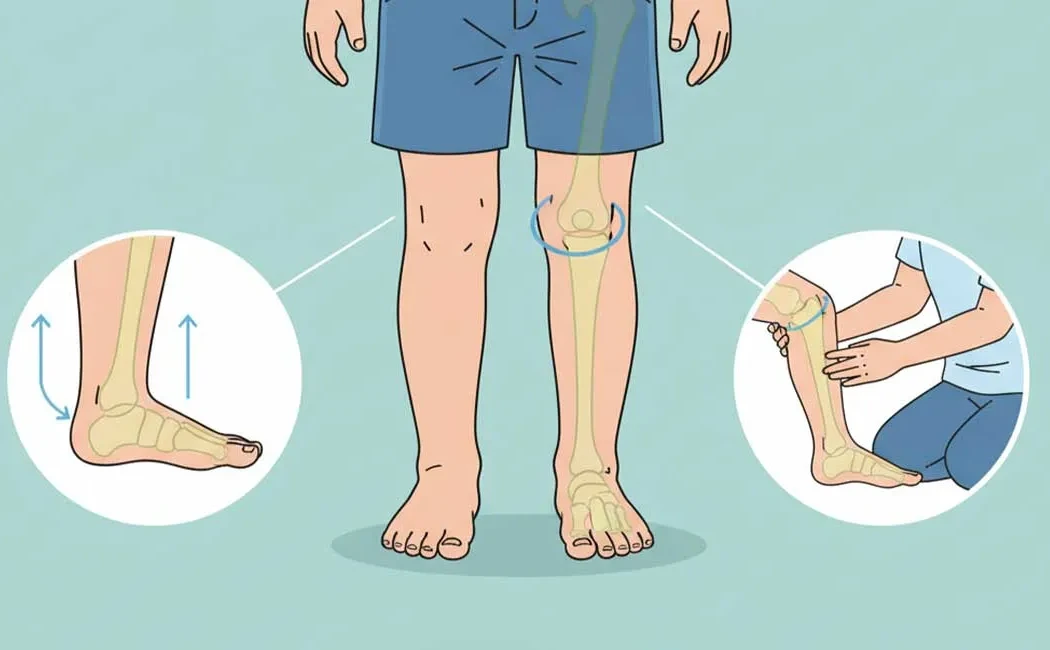
Among the most common orthopedic concerns parents face during childhood are unusual walking patterns in their children. Complaints such as in-toeing or rotated legs often stem from tibial torsion, which refers to twisting of the shinbone. This condition may be a physiological process that corrects itself as the child grows, or it may represent a pathological issue requiring specialist evaluation and treatment.
For parents, managing the process correctly means understanding which cases are normal and when medical intervention is needed. This article will explore the symptoms, diagnostic methods, and current treatment strategies for tibial torsion in children, based on the latest scientific research.
What Is Tibial Torsion?
Tibial torsion is the rotation of the tibia (shinbone) along its longitudinal axis. This twist can be inward (internal) or outward (external). Common in childhood, it usually develops due to the baby's position in the womb and becomes noticeable in the early years after birth. Although it is not classified as a rare pediatric deformity, clinical monitoring is important depending on its severity.
It is physiologically normal for infants to have some degree of inward tibial rotation. However, this typically corrects itself as the child grows. If the rotation persists or becomes severe enough to impair walking function, it should be evaluated as a deformity by an orthopedic specialist.
Symptoms: How to Recognize Tibial Torsion?
The most noticeable sign is the child’s feet turning inward or outward while walking. Parents often observe frequent tripping or the child’s legs hitting each other while running. These signs can resemble other lower limb deformities in children, making accurate differential diagnosis essential.
Common symptoms include:
- Feet turning clearly inward (pigeon toe) or outward while walking.
- Kneecaps facing forward while the feet point in a different direction.
- Frequent falls and balance issues during walking.
- Complaints of leg fatigue or pain, especially in older children.
Sometimes this condition is confused with foot deformities in children, but the issue lies in the rotation of the leg bone rather than the foot.
Diagnostic Process: Physical Examination and Imaging
Diagnosis begins with a thorough medical history and physical examination. The physician observes the child's gait and performs specific measurements, such as the thigh-foot angle, to determine whether rotation originates from the hip, tibia, or foot.
In most cases, physical examination is sufficient for diagnosis. However, for surgical planning or suspected complex deformities, imaging methods such as CT (Computed Tomography) or MRI (Magnetic Resonance Imaging) may be used. These provide precise measurements of the bone’s torsion angle.
Follow-Up: When Is Intervention Not Necessary?
Not every child diagnosed with tibial torsion requires surgery. Especially in children up to 8 years old, growth-related remodeling usually leads to natural correction of most rotations. A "wait and see" approach is generally adopted during this time.
Parents should mainly monitor whether the deformity worsens. Regular doctor evaluations, typically every six months, are adequate to track progress. Scientific evidence is limited regarding the effectiveness of special shoes, braces, or splints in altering the natural course of tibial torsion; thus, these are generally not recommended in modern orthopedics.
When Is Surgery Needed? Understanding Tibial Derotation Osteotomy
Surgical treatment is considered mainly for children over 8-10 years old with no potential for spontaneous correction, and who have serious functional or cosmetic issues. Surgery is typically recommended if the tibial torsion angle exceeds normal limits significantly (usually more than 15-20 degrees of inward rotation or 30-40 degrees of outward rotation) and interferes with walking or running.
In addition, children with neuromuscular conditions (such as Cerebral Palsy) may require earlier surgical correction as part of deformity management protocols. Surgery is tailored based on the location and severity of the deformity. Rarely, complications such as delayed bone healing may occur; in these cases, advanced biological treatments for non-union fractures might be necessary.
What Is Tibial Derotation Osteotomy?
Tibial derotation osteotomy involves surgically cutting the shinbone and rotating it to the correct alignment, then fixing it in place. This procedure permanently corrects bone rotation. Fixation devices such as plate-and-screw systems, intramedullary nails, or external fixators (e.g., Ilizarov) may be used.
Pre- and Postoperative Care
When surgery is decided, orthopedic preoperative preparations begin for the family and child, including anesthesia assessment and detailed information about postoperative rehabilitation.
After surgery, the leg may be immobilized in a cast or supported by special devices until bone healing occurs (usually 6-8 weeks). Weight-bearing might be limited during this phase. Once healing is complete, physical therapy is started to strengthen muscles and retrain walking. With successful surgery and rehabilitation, the child can achieve physical activity levels comparable to peers.
Recommendations and Supportive Approaches for Parents
For parents of children with tibial torsion, patience and maintaining regular follow-ups are crucial. Avoiding certain postures such as the "W-sitting" position (knees bent with feet turned outward) is encouraged, although constant correction should not cause psychological stress.
Supporting overall muscle development, promoting participation in sports or physical activities, and nurturing the child’s confidence form an important part of care.
The content on this website is intended for informational purposes only and does not constitute medical advice, diagnosis, or treatment. Always consult a qualified healthcare professional for any decisions or treatment plans related to your health concerns. While the information provided is based on current scientific sources, medical knowledge and practices may evolve over time. Surgical procedures and treatment methods may vary depending on individual circumstances. Do not delay seeking professional medical care based on the information provided here.