
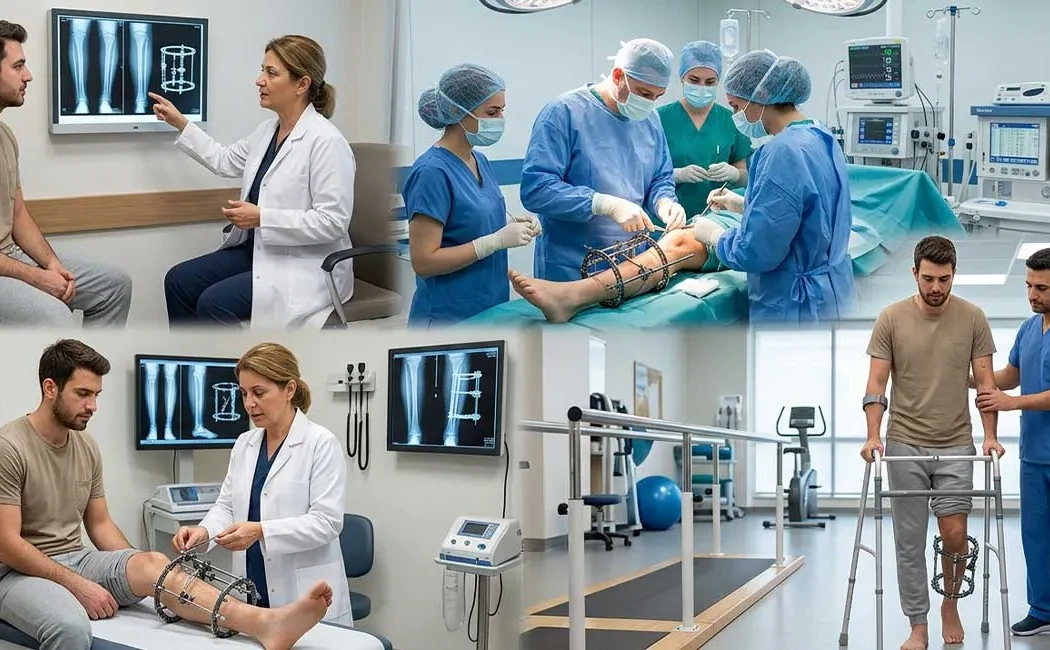
Limb lengthening surgery is a complex orthopedic operation performed both to correct congenital limb length discrepancies and to address concerns related to short stature for aesthetic reasons. Based on the principle of distraction osteogenesis, this method involves surgically cutting the bone and gradually separating the bone segments, prompting new bone tissue to form. This is a complex biological process that not only lengthens the bone but also the surrounding soft tissues, muscles, and nerves.
The decision to proceed with surgery is made after evaluating the patient's bone structure, overall health status, and psychological readiness. Today’s advanced technologies allow for various methods to be applied, all requiring patience and discipline throughout a lengthy recovery. This guide, prepared with reference to scientific data and expert opinions, examines each stage of the limb lengthening process in detail.
Overview of Limb Lengthening Surgery
Limb lengthening surgery fundamentally leverages the body’s self-healing mechanisms to increase bone length. During the procedure, the bone is surgically cut (osteotomy) and gradually separated by approximately 1 millimeter per day using specialized devices. In this spacing, the body generates new bone tissue. Once this process completes and the new bone solidifies (consolidation), the desired length increase is achieved.
This procedure may be performed for aesthetic reasons or medically necessary conditions such as leg length inequality, dwarfism (achondroplasia), or deformities following trauma. Proper management of patient expectations before and after surgery is critical.
The treatment involves more than surgery alone; it comprises preoperative planning, hospital stay, lengthening phase, and bone healing (consolidation) stages consecutively. Success depends as much on the surgeon’s expertise as on the patient’s adherence throughout the process.
Who Is Suitable for Limb Lengthening Surgery?
Limb lengthening surgery is not suitable for every individual experiencing short stature. Eligibility depends on factors including age, bone maturity, and overall health. Candidates are generally those whose growth plates (epiphyseal plates) have closed, indicating skeletal maturity—typically between ages 18-21 for males and 17-20 for females.
For medical indications such as leg length discrepancy, poliomyelitis sequelae, or congenital deformities, age limits and criteria may vary. In elective cases for cosmetic limb lengthening, patients must have realistic expectations and be psychologically prepared for the challenges surgery entails.
Physical suitability is as important as mental preparedness. For detailed insights, refer to our psychological preparation guide before limb lengthening surgery. Individuals with chronic bone disease, active infections, or habits impairing bone healing such as smoking may not be appropriate candidates.
Techniques and Technologies Used
Techniques for limb lengthening continue to evolve alongside medical technology advancements. The choice of method depends on the patient’s anatomy, budget, and lifestyle preferences. Our bone lengthening surgery services offer options ranging from traditional external fixators to fully internal devices.
Sometimes limb lengthening is combined with upper extremity lengthening and deformity correction or lower extremity deformity surgery to address both length and alignment simultaneously.
Advancements in bone lengthening technologies improve patient comfort and reduce complication rates.
Ilizarov Method
The Ilizarov method is one of the oldest and foundational techniques in limb lengthening surgery. It uses circular (ring) external fixators—metal rings fitted around the limb connected to the bone by thin wires. This method is especially effective for correcting complex deformities and cases challenging for infection control. It is relatively cost-effective, though the external device can reduce patient comfort and requires careful wound care.
LON (Lengthening Over Nail) Method
The LON method combines an external fixator with an internal intramedullary nail. Lengthening is performed externally, while the internal rod supports the newly forming bone. After the lengthening phase ends, the external device is removed, and healing continues with the internal nail only. This technique significantly shortens the duration of external fixation and improves patient comfort.
Precice and New Generation Lengthening Systems
Precice and similar motorized nail systems are the most advanced methods, consisting entirely of internal devices not visible externally. The lengthening is controlled externally via a magnetic remote controller activating the internal mechanism. Benefits include lower infection risk, minimal scarring, and earlier mobility, though these systems generally involve higher costs.
Surgical Process and Preparation
The surgical process begins with comprehensive clinical and radiological evaluation. Long-leg X-rays (orthoroentgenograms) are taken to plan the amount of lengthening and osteotomy site. Blood tests, anesthesia clearance, and necessary consultations are completed before surgery preparation.
Surgery is performed under general or epidural anesthesia and typically lasts between 2 and 4 hours, depending on the method used. The average hospital stay postoperatively is 3 to 5 days. Pain management is provided, and early mobilization is initiated under physiotherapist supervision.
The distraction phase usually starts 5 to 7 days after surgery (latency period). Patients or caregivers receive detailed training on device operation. Adjustments are made four times daily at 0.25 mm per session, targeting a total of 1 mm per day. This gradual pace enables tissue adaptation and reduces complications.
Recovery and Rehabilitation
The success of limb lengthening surgery is highly dependent on the postoperative phase. Lengthening places stress on muscles and tendons, necessitating an intensive physical therapy program. Neglecting exercises can lead to joint stiffness (contractures) and limited range of motion.
During recovery, proper nutrition, avoiding smoking, and adhering to scheduled doctor visits are critical. Being informed about post-limb lengthening care helps ensure the process progresses smoothly. Complete bone formation allowing full weight-bearing and walking can take between 6 months to a year, depending on the length achieved.
Patients may use assistive devices such as wheelchairs, crutches, or walkers during the process. Psychological support and patience remain vital throughout this long journey.
Potential Risks and Complications
As with any surgery, limb lengthening carries certain risks. Awareness and early intervention can prevent permanent damage. Common complications include pin-site infections (with external fixators), joint stiffness, and transient pain.
More severe issues involve insufficient or absent bone formation (non-union), sometimes requiring non-union surgery. Malunion, where the bone heals at an incorrect angle, may also necessitate corrective operations (post-malunion recovery process).
Rare but serious risks include nerve damage, deep vein thrombosis (blood clots), and compartment syndrome. Surgeon experience and facility equipment are crucial in managing these risks effectively.
Medical Disclaimer and Information
Limb lengthening surgery is a significant surgical intervention and should not be regarded as a mere cosmetic procedure. Before making a decision, patients must thoroughly consider all risks, costs, and the lengthy recovery involved. The information provided here is for educational purposes and does not replace professional medical advice. Definitive diagnosis and treatment planning require consultation with an experienced orthopedic surgeon.
This content is provided for general informational purposes only and does not constitute medical advice. It is not a substitute for individual diagnosis, treatment, or consultation. Diagnosis and treatment should be determined only after a face-to-face examination by a qualified healthcare professional. Since each patient's clinical condition is unique, surgical and non-surgical treatments may vary accordingly.