
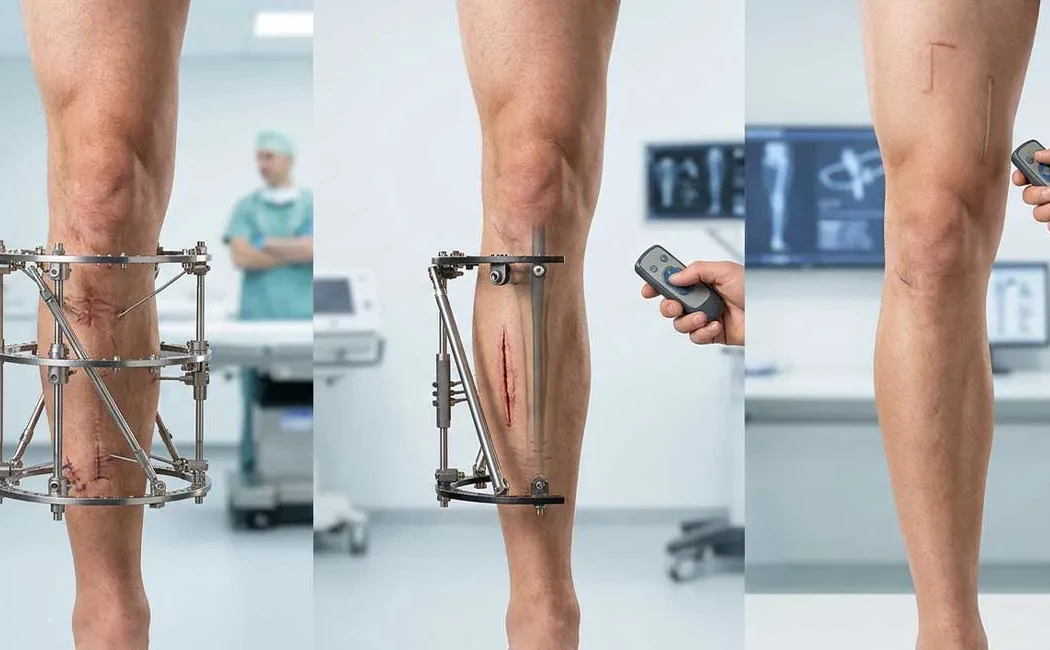
Advancements in limb reconstruction and deformity correction have enabled various limb lengthening methods to offer patients multiple treatment options. Whether addressing short stature or cosmetic concerns, the choice of surgical technique directly impacts the patient’s quality of life and recovery process. The most commonly used techniques include Ilizarov, Precice 2 (magnetic nail), and combined methods, each differing in biomechanical principles, patient comfort, and costs.
Successful treatment depends on selecting the appropriate method for the individual patient and meticulous management of the process. Patients should thoroughly evaluate all available options before deciding on surgery. The diagram below illustrates the fundamental steps in the surgical lengthening process.
Overview of Limb Lengthening Methods
Limb lengthening surgery is fundamentally based on controlled bone cutting (osteotomy) and gradual mechanical distraction that encourages new bone formation in the gap (distraction osteogenesis). The fixation system used defines the technique’s classification. Currently, techniques include external devices (external fixators), internal devices (intramedullary nails), or a combination of both.
Method selection depends on factors like the desired length increase, bone quality, presence of deformities, and financial considerations. For detailed information, see our bone lengthening surgery service page. Similar principles apply to upper limb lengthening such as arm shortening correction; refer to upper extremity lengthening and deformity correction for further information.
Ilizarov Method
The Ilizarov method is a classical, biologically based limb lengthening and deformity correction technique developed by Russian orthopedist Gavriil Ilizarov. It relies on securing the bone externally with rings and wires and is frequently used for complex deformities or cases at risk of bone infection. Further detail is available in The Ilizarov Technique for Limb Lengthening.
Principle of the Ilizarov Technique
In this method, the bone segment to be lengthened is stabilized externally by thin wires and circular metal rings (fixator). After surgery, following a latency period, daily incremental adjustments are made by turning nuts on the device, gradually separating the bone ends millimeter by millimeter. This tension stimulates the body to produce new bone and soft tissue. The following image illustrates internal and external fixation device placement on the body.
Advantages and Disadvantages
The Ilizarov method is notably cost-effective compared to other techniques and can concurrently treat bone infections. It also allows correction of angular deformities during lengthening. However, the external frame can reduce patient comfort, requires regular wound care, and may cause infections at wire entry points. The device must remain attached until the bone fully consolidates.
Precice 2 (Magnetic Nail) Method
Precice 2 is a modern lengthening method involving a fully implanted magnetic telescopic nail with no external hardware visible. This technique prioritizes patient comfort and is preferred by those concerned about aesthetics and quicker social reintegration.
How Does the Precice 2 System Work?
A telescopic, magnetically extendable nail is implanted inside the bone. Postoperatively, an external magnetic controller (ERC) placed over the skin activates a gear mechanism inside the nail, slowly lengthening the bone daily. As there are no external pins or wires, the infection risk is lower.
Advantages and Disadvantages
The major advantage of Precice 2 is enhanced patient comfort—no external device, minimal scarring, and better preservation of joint mobility. However, its high cost and technical demands limit its availability. Weight-bearing during lengthening is often restricted. Implant costs and procedural complexity are key limiting factors.
Combined Method
The combined method, also known as Lengthening Over Nail (LON), aims to integrate the cost benefits of the Ilizarov technique with the early rehabilitation advantages of intramedullary nailing. This approach places an intramedullary nail inside the bone while a temporary external fixator performs the lengthening. Once lengthening completes, the external fixator is removed, and the internal nail supports bone healing.
This method significantly reduces the duration the external fixator remains in place, improving patient comfort while offering a more economical alternative to fully internal systems. It is effective for deformity correction and lengthening, especially in lower extremity deformity surgery.
Comparison of Methods: Benefits, Risks, and Costs
Choosing the optimal method involves assessing technical, financial, and lifestyle factors. When comparing Precice and Ilizarov methods, considerations include infection risk, weight-bearing ability, and return to daily activities. Likewise, limb lengthening surgery costs vary based on the technology and hospital service levels.
Rehabilitation After Limb Lengthening Surgery
Rehabilitation is as important as the surgery itself. Muscles, nerves, and blood vessels surrounding the bone must adapt to the new length. Intensive physical therapy is essential to prevent joint stiffness and maintain muscle strength. The limb lengthening aftercare process (postoperative care details) strongly influences surgical success.
Risks and Complications
Like any surgery, limb lengthening carries risks including infection, nerve injury, joint stiffness, and delayed bone healing (nonunion). Understanding common complications is important for early detection and management. Avoiding risk factors such as smoking and reviewing success factors in nonunion surgery contribute to better outcomes.
Preoperative Preparation and Psychological Considerations
Limb lengthening is a prolonged process requiring patience. Physical and psychological readiness is crucial, with realistic expectations and awareness of potential challenges throughout treatment. Seeking professional guidance on psychological preparation before limb lengthening can improve adherence and recovery.
This content is provided for informational purposes only and does not constitute medical advice. It is not intended to replace professional diagnosis, treatment, or guidance. Diagnosis and treatment should always be determined through an in-person consultation with a qualified healthcare provider. Individual clinical conditions vary, and surgical or non-surgical treatment options may differ accordingly. The information presented is based on current scientific knowledge and medical practices.